A Complete Guide to Soviet Army, VDV, Spetsnaz, DRA Army, and Mujahideen Uniforms in Afghanistan
Soviet Afghan War uniforms are among the most recognizable military uniforms of the Cold War. During the conflict in Afghanistan (1979–1989), Soviet soldiers, VDV paratroopers, Spetsnaz units, Border Guards, tank crews, engineers, and the Democratic Republic of Afghanistan (DRA) Army all wore distinctive uniforms and equipment designed for mountain warfare and harsh weather.
This guide explores the uniforms, insignia, weapons, boots, camouflage, and field gear used by both Soviet and Afghan forces. Each section includes historical illustrations and easy-to-understand explanations for collectors, reenactors, historians, and military enthusiasts.
More interesting articles:
How the Soviet Army Uniform Changed from 1955 to 1991
Soviet Spetsnaz Uniform in Afghanistan (1979–1989)
What Soviet Soldiers Really Ate in the Afghan War
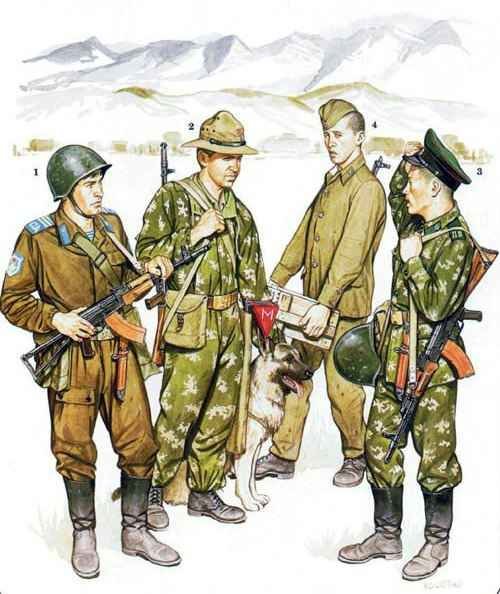
Airborne Troops (VDV)
VDV Paratrooper – 1979
Soviet paratroopers were among the first troops sent to Afghanistan in 1979. Airborne divisions, together with Soviet special forces, took part in the operation to capture Kabul. Later, they led many of the biggest attacks against the Mujahideen.
The Soviet Airborne Forces (VDV) were never officially called special forces, but in reality they worked like them. They were trained for night operations, mountain warfare, and fighting guerrilla forces.
The soldier in this illustration is wearing the famous blue-and-white telnyashka under his uniform. This striped shirt was worn not only by sailors, but also by Marines, paratroopers, and Soviet special forces.
Most VDV soldiers wore the standard Soviet field uniform, but this paratrooper is wearing an insulated jump suit. Under his helmet he wears a padded helmet liner. The warm suit was very useful in the cold mountains of Afghanistan.
On his left side is a holster, probably carrying a 9 mm Stechkin APS automatic pistol. On his right side is a field bag.
The first Soviet airborne units sent to Afghanistan included the 103rd, 104th, and 105th Guards Airborne Divisions, together with KGB Alpha special forces.
VDV Sergeant – 1983
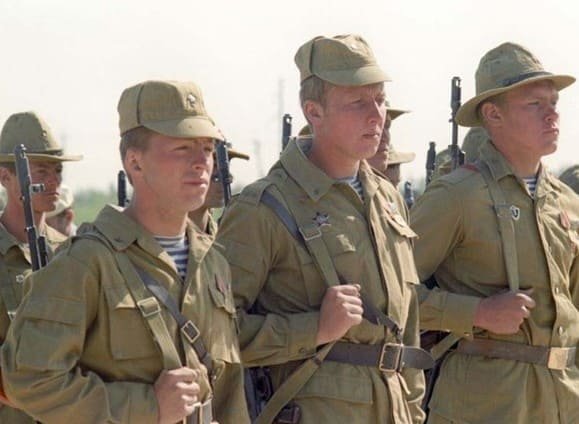
This VDV sergeant is wearing the standard khaki field uniform. His jacket is open at the collar, showing the blue-and-white telnyashka underneath.
His shoulder boards and collar tabs are light blue, the traditional color of the Airborne Forces. Three yellow rank stripes and the letters “CA” (Soviet Army) can be seen on his shoulder board. Airborne patches are worn on both sleeves.
He carries a 5.45 mm AKS-74 assault rifle with a folding metal stock, the standard weapon of Soviet paratroopers.
His belt holds a bayonet and magazine pouch. A gas mask bag hangs over his shoulder. He wears a steel helmet.
Like soldiers in most other Soviet Army units, the VDV sergeant wears tall kirza boots.
VDV Private – 1988
This soldier is wearing an insulated khaki field uniform and a standard Soviet ushanka fur hat.
Body armor became common in Soviet Airborne units after 1984 and was usually worn during combat missions.
The Soviet Airborne Forces and Motor Rifle units also formed special anti-sniper teams. These teams used SVD Dragunov sniper rifles and also carried RPG-7 and RPG-18 rocket launchers, which were effective against enemy sniper positions.
Soviet Special Forces (Spetsnaz)
Spetsnaz Sergeant – 1986
Soviet Spetsnaz units were widely used during the war in Afghanistan. Their main missions included patrols, ambushes, and special operations.
This soldier is shown in combat gear. Like many elite units around the world, Soviet special forces often received better equipment.
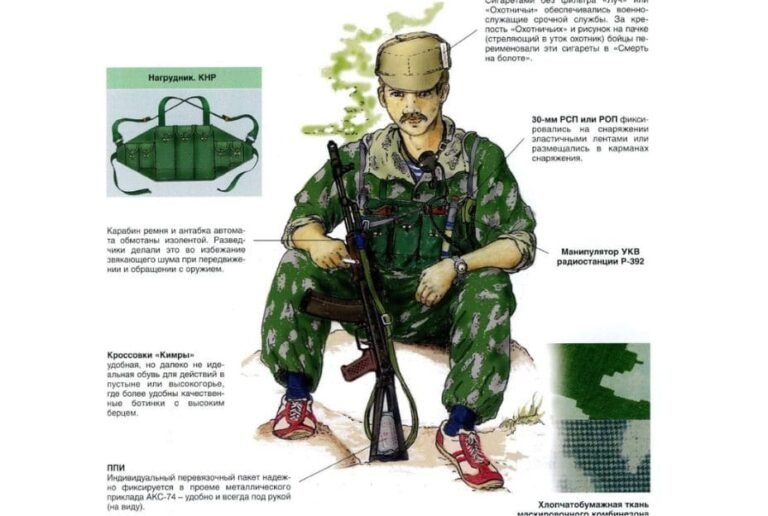
He is wearing the famous Soviet leaf camouflage uniform. Spetsnaz soldiers were trained to travel light and survive with very little support, using captured equipment and local resources when needed.
On his back is a small field pack with only essential personal gear. His belt carries an AK bayonet with a wire-cutting scabbard and a magazine pouch. At the front is a holster with a 9 mm Makarov pistol (PM) and a spare magazine pocket.
His main weapon is an AKS-74 assault rifle with a folding stock.
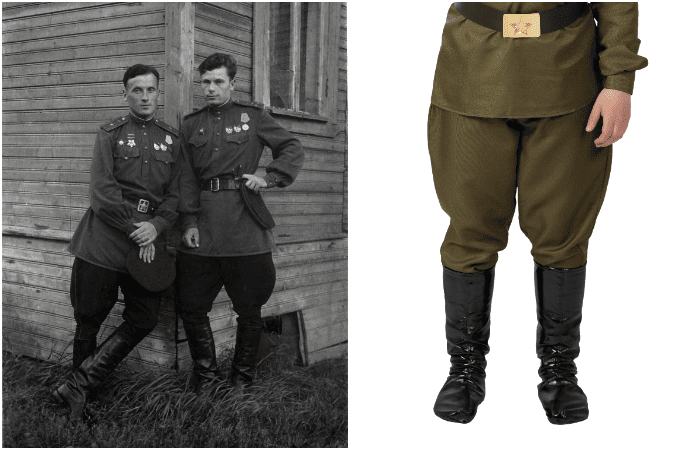
He wears tall Soviet military boots, usually made from kirza or, in better cases, genuine leather. These boots had been used by Russian soldiers since the time of the Tsar and remained standard because they were simple, durable, and reliable.
Spetsnaz Sergeant – 1989
The Soviet Special Forces were better known as Spetsnaz. Their soldiers and officers received some of the best military training in the Soviet Union. They were trained for many missions, including secret infiltration, reconnaissance, airborne operations, and direct combat.
For security reasons, Spetsnaz had no unique uniform. Their clothing depended on the mission.
The soldier in this illustration has no rank insignia. His belt is simply part of his equipment, but this simple appearance was common among Spetsnaz troops.
When serving outside the Soviet Union, Spetsnaz soldiers often wore the same uniforms as the local Soviet units. However, they usually wore the standard VDV blue beret. Unlike airborne troops, they did not wear the Guards badge on the front of the beret, which could help tell them apart.
This soldier is shown during hand-to-hand combat training. On his back is a 5.45 mm AKS-74 assault rifle, fitted with a muzzle brake to reduce muzzle climb during automatic fire. In his right hand he carries the standard AK bayonet.
The simple uniform and equipment shown here were typical of many Soviet special forces units. Their confidence came not from special clothing, but from their high level of training and combat experience.
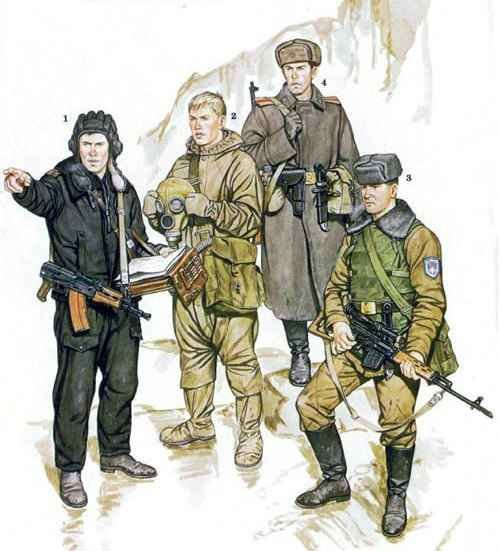
Motor Rifle Troops
Senior Sergeant, Motor Rifle Company – 1980
The Soviet winter uniform was designed for Russia’s harsh climate and gave soldiers excellent protection from the cold.
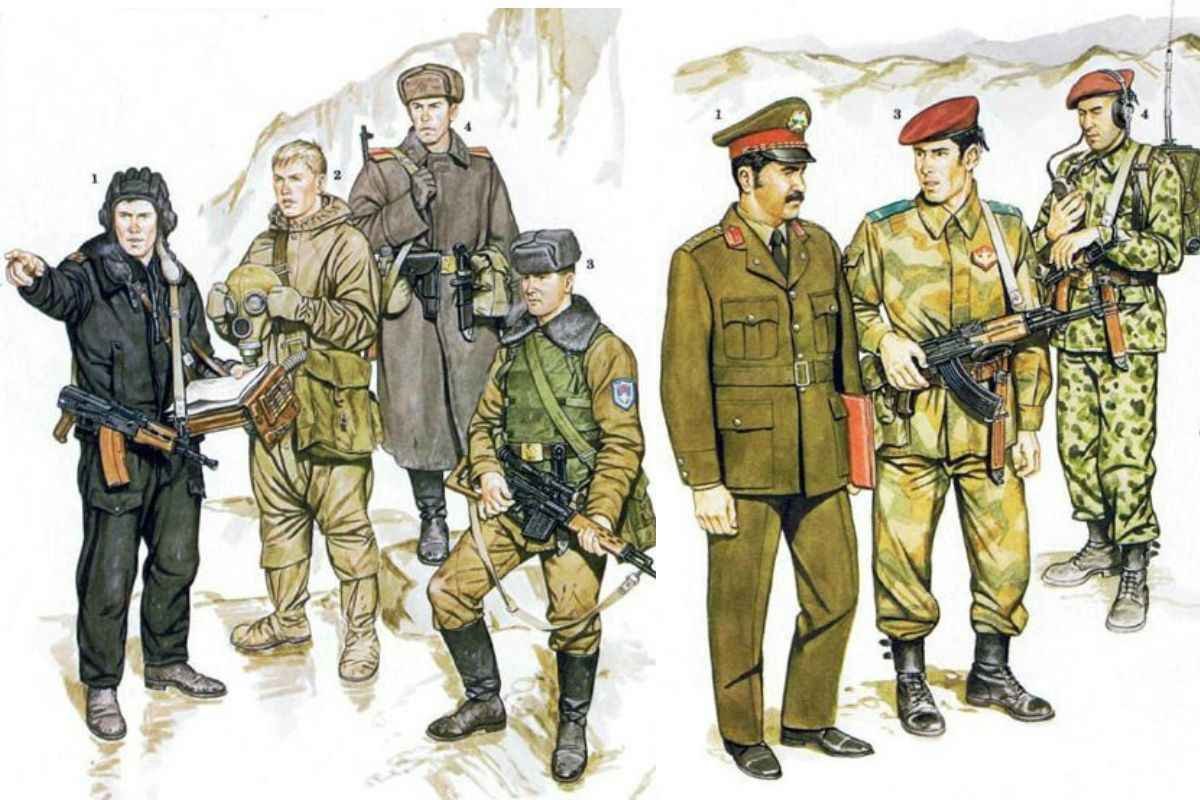
This senior sergeant is wearing the traditional brown-gray greatcoat with a hidden front closure and a fur ushanka hat. His rank is shown on the shoulder boards, while the branch of service is identified by the collar tabs.
He carries a 7.62 mm AKM assault rifle, which replaced the AK-47. The AKM became one of the most reliable and widely used rifles of the 20th century because of its durability and firepower. It can be recognized by the smooth receiver above the magazine, without the large cut found on the AK-47.
On his belt he carries a Makarov PM pistol, magazine pouch, AKM bayonet, and a gas mask bag. Soviet soldiers in Afghanistan were also often seen carrying backpacks.
Tank Troops
Tank Captain – 1984
Junior officers often led operations in the mountains of Afghanistan.
This captain is wearing a black winter jacket over the standard black Soviet tank crew uniform and tanker helmet. Although some Soviet tank crews painted vehicle numbers on their helmets, this was uncommon in Afghanistan.
He carries a compact AKS-74U assault rifle for personal protection after leaving the vehicle. Unlike many officers, he does not carry a Makarov pistol because a holster could catch on equipment and slow him down during an emergency escape from the tank.
He is holding a Soviet officer’s field map case.
The same uniform was also worn by the crews of BMD airborne fighting vehicles and self-propelled artillery.
Engineer Troops
Combat Engineer – 1981
As Afghan resistance forces used more landmines, Soviet engineer units became increasingly important.
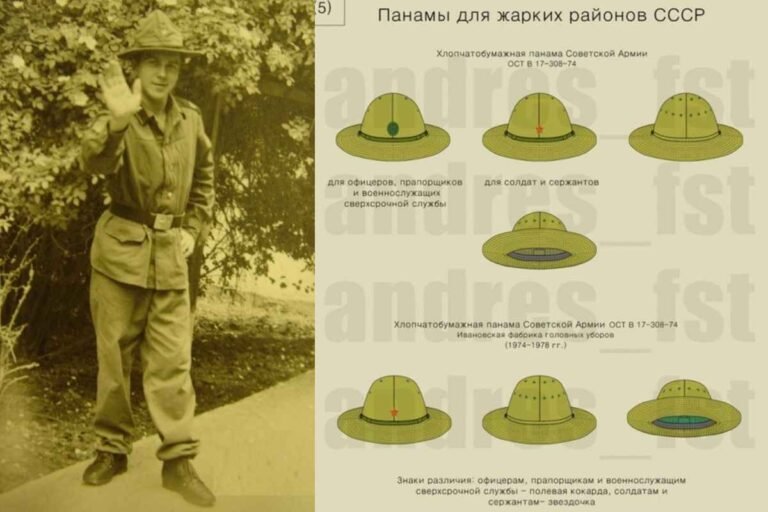
This soldier wears the standard Soviet summer panama hat, a design that had changed very little since the 1930s.
He is dressed in a camouflage coverall with the hood folded down so he could better hear the click of a mine trigger or the bolt of a Lee-Enfield rifle.
Across his shoulder is a long bag carrying marker flags and tools for finding non-metallic mines.
His German Shepherd is trained to detect landmines.
He is armed with an AK-74 rifle with a wooden stock.
Motor Transport Troops
Driver – 1981
Soldiers in the Soviet motor transport units drove and maintained military vehicles. Their job was dangerous because supply convoys were often attacked by ambushes on Afghan roads.
This soldier is wearing the standard khaki summer uniform of the Soviet Army.
He wears the traditional side cap with a red star on the front. The only branch insignia is the small metal badge on the collar tabs.
His weapon is a 7.62 mm AKM assault rifle, which was common in many support units.
Notice the white collar liner sewn inside the tunic, a standard feature of Soviet military uniforms.
Border Troops
Border Guard – 1982
Mobile Soviet Border Guard units protected the Soviet border from attacks by armed groups operating from Afghanistan.
Their most recognizable features were green service caps, green shoulder boards with the letters “PV” (Border Troops), and green collar tabs.
This soldier is wearing the camouflage uniform introduced in the early 1980s.
He is armed with an AK-74 assault rifle. On his belt he carries an AK bayonet and magazine pouch, while his steel helmet is attached beside the pouch.
DRA Army
Approximate comparison between officer ranks in the Democratic Republic of Afghanistan Army
and military ranks in the Soviet Army.
| Officer Rank in the DRA Army | Equivalent Rank in the Soviet Army |
|---|---|
| Dreyom Bridman | Warrant Officer |
| Dwakhom Bridman | Junior Lieutenant |
| Lomri Bridman | Lieutenant |
| Torin | Senior Lieutenant |
| Jag Turan | Captain |
| Jagran | Major |
| Dagarman | Lieutenant Colonel |
| Dagarwal | Colonel |
| Brid General | Brigadier General |
| Dagar General | Major General |
| Sitar General | Lieutenant General |
| Marshal | Army General |
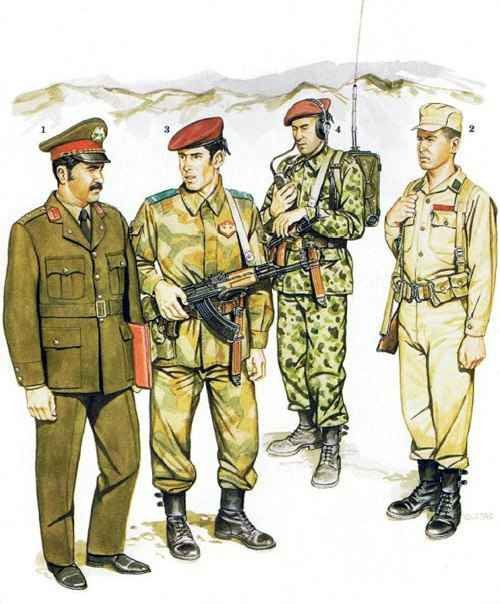
Infantry
Major in Service Uniform
An officer with the rank of Jagran, equal to a major, can be identified by one star and crossed swords on his shoulder board. The insignia is gold-colored.
The major wears the standard khaki service uniform with a stone-colored shirt and a khaki tie.
The color of the cap band changed according to the officer’s rank. Before the revolution, generals wore caps with red bands, senior officers wore red-brown bands, and company-grade officers wore green bands. After the revolution, senior officers also began to wear caps with red bands.
All officers’ caps had a large colored badge showing the national emblem of the Democratic Republic of Afghanistan. The badge was fixed to a high crown, similar in shape to German officer caps from the Second World War.
The piping on the caps of company-grade officers was gold. Senior officers could have gold or red piping.
The collar tabs usually matched the color of the cap band. They carried a simple corn-shaped symbol, gold for senior officers and green for company-grade officers.
Branch badges were not strictly controlled and were usually not worn. Before the revolution, branch patches introduced in 1965 were worn on the right sleeve.
Afghan Army Private – 1980
During most of its history, the Afghan Army suffered from poor organization and weak military planning. This was caused by internal political groups and long-standing ethnic conflict.
From 1979 to 1988, the Afghan government army fought beside the Soviet Army against the Mujahideen and suffered very heavy losses. Many soldiers, and later even senior officers, changed sides and joined the Islamic resistance.
The Afghan Army always had a shortage of standard uniforms and equipment. Soldiers often fought in worn brown-gray trousers and shirts. The same clothing was also used as their everyday uniform. In winter, they wore long greatcoats when these were available.
This soldier wears the standard Afghan Army uniform. On his head is a soft field cap with a flap at the back to protect his neck from the sun and rain.
Under his equipment belt, he wears a black leather dress belt with a large gold buckle. Wearing two different belts at the same time was common in the Afghan Army.
Much of the field equipment was very old. Locally made leather belts and pouches were also widely used, although they worked badly in wet and cold weather and were not suitable for mountain service.
The soldier wears leather boots with canvas gaiters reinforced by black leather pieces.
The Afghan Army also lacked modern weapons. This soldier carries a Soviet 7.62 mm M1944 Mosin carbine with a folding bayonet. This weapon had already gone out of production in 1950.
Infantryman in Summer Uniform
The same basic summer field uniform was used by soldiers of all ranks. It included a field cap, khaki tunic, and khaki trousers.
The main differences were the number and shape of the pockets.
Enlisted soldiers had two chest pockets with straight flaps. Officers had an extra sleeve pocket and shaped pocket flaps. Enlisted uniforms normally had no shoulder boards.
This illustration was based on a photograph taken during a military inspection.
Colored collar tabs were added to field uniforms only for special events. During normal service, they were usually the same color as the uniform.
Notice the unusual mix of ammunition pouches. The soldier has pouches for an SKS carbine on his belt, but he carries a Kalashnikov rifle over his shoulder. Such combinations were not rare in the Afghan Army.
The color of field uniforms varied greatly, from golden khaki to light gray and brown. Green uniforms were also common in mechanized and armored units.
Infantryman in Winter Field Uniform
Only the modern RPD light machine gun makes this soldier look different from an infantryman of the early 20th century.
The poor quality of Afghan Army uniforms can be seen in many photographs. This soldier’s clothing is badly worn.
Notice the simple belt with a round buckle and the heavy, square-shaped boots with gaiters.
During winter, Afghan Army units often had a serious shortage of warm Soviet-style clothing. Soldiers sometimes used traditional Afghan blankets to protect themselves from the cold.
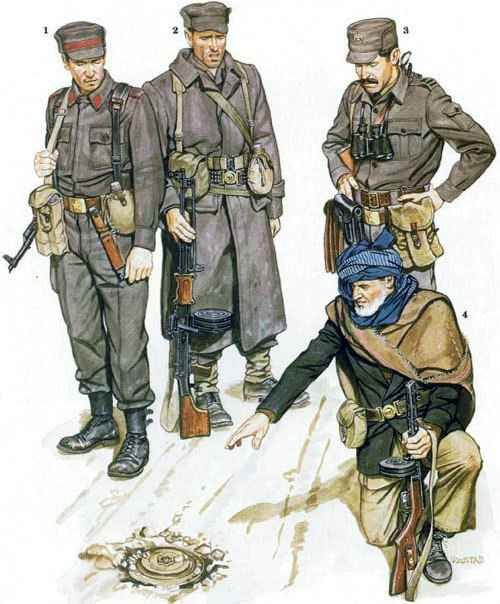
Special Forces
Private, Special Forces Unit
The details of this uniform suggest that this soldier belongs to the Tsarandoy, the Afghan internal security force under the Ministry of Interior, rather than the regular Army Special Forces. The red band on the field cap, red collar tabs, and red piping on the shoulder boards all point to this.
The gray cap, tunic, and trousers are made from low-quality wool fabric used for the Afghan Army’s winter uniform. Soldiers wore this uniform both in combat and during everyday service.
His equipment follows Soviet standards and includes a Kalashnikov rifle, magazine pouch, canteen, and bayonet. The belt is Soviet in style but has an Afghan Army buckle with the DRA national emblem inside a five-pointed star.
The shoulder straps are an older design that had already been used by the Royal Afghan Army before the revolution.
He wears tall leather boots with double buckle straps.
No badges or insignia can be seen in the original photograph. Before the revolution, Afghan Army sergeants wore one to five red sleeve chevrons. The top chevron had a loop, similar to naval rank insignia used in many countries.
Soviet-style steel helmets were uncommon in the Afghan Army. Even during military parades, soldiers were often seen wearing older Austro-Hungarian M1918 helmets or Czechoslovak Model 1930 helmets.
Commandos
Commando Lieutenant and Radio Operator
It is impossible to identify this unit with complete certainty, but it was most likely the 26th Airborne Brigade, one of the best-trained and most reliable formations in the Afghan Army.
Photographs show Afghan commandos wearing several camouflage patterns. Two of these camouflage uniforms are shown here.
Both soldiers wear dark red berets.
The officer has the Afghan Airborne Forces badge on his chest. This badge was normally worn only with the everyday service uniform, which had the same cut and colors as the standard Afghan Army uniform.
During combat operations, Afghan commandos often wore Soviet camouflage uniforms.
The officer wears standard colored shoulder boards, while the radio operator has camouflage shoulder boards made from the same fabric as his uniform.
His shoulder board has one yellow stripe, showing the rank of Dreyom Bridman, a junior officer rank between warrant officer and junior lieutenant.
The standard weapon of Afghan commandos and airborne troops was the AKMS assault rifle with a folding metal stock.
Militia
Village Militiaman
Afghanistan had many local militia groups. Some had simple uniforms, while others looked no different from Mujahideen fighters. In many areas, the same man could serve as a government militiaman during the day and fight with the Mujahideen at night.
This illustration shows a village militiaman. The only thing that clearly separates him from local civilians is his old ammunition pouch for the PPSh-41 drum magazine and the PPSh-41 submachine gun itself.
Many Afghan militia units continued to use PPSh-41 submachine guns.
His clothing is a typical mix of Afghan and Western styles. He wears a traditional Afghan turban, a Western-style jacket, and a local sand-colored shirt.
He is pointing at a TM-46 anti-tank mine. These mines had been used by the Afghan Army before the arrival of Soviet troops, and many later fell into the hands of the Mujahideen.
Jag Turan Infantry Officer in Winter Field Uniform
The officer’s uniform was almost the same as that of senior NCOs, but it was made from better-quality materials.
His field cap has a smaller metal enamel badge than the one used on service caps.
A stone-colored shirt and khaki tie can be seen under the tunic.
Pocket designs were not standardized and changed between different uniform versions. The example shown here has the most common layout with two chest pockets and one smaller pocket on the left sleeve.
His shoulder boards display the rank of Jag Turan, shown by two stripes and one star. On field uniforms, the rank insignia was less brightly colored than on service uniforms.
The officer wears two belts. One supports his trousers, while the second carries a Makarov pistol holster and magazine pouch for his Kalashnikov rifle.
He also carries Soviet binoculars and a Soviet map case used for military maps.
More interesting articles:
How the Soviet Army Uniform Changed from 1955 to 1991
Soviet Spetsnaz Uniform in Afghanistan (1979–1989)
What Soviet Soldiers Really Ate in the Afghan War
Looking original Soviet boots and accessories? Please visit here: Soviet Boots Store