|

How the Soviet Army Uniform Changed: From M69 to Afghanka & M88

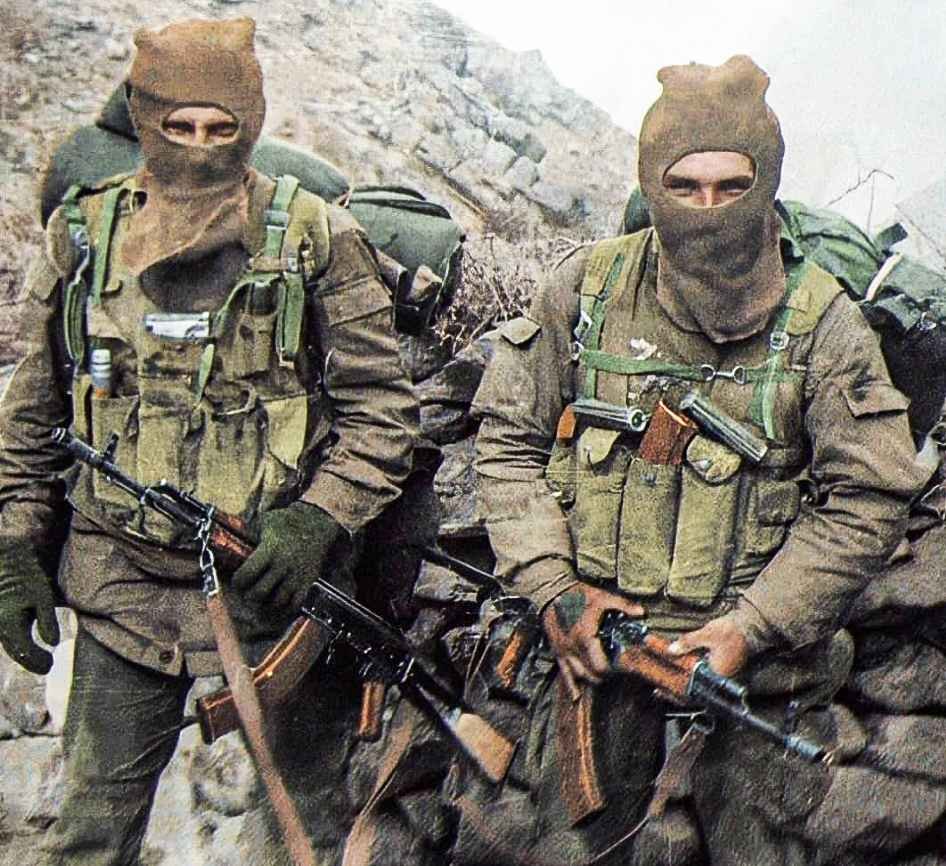
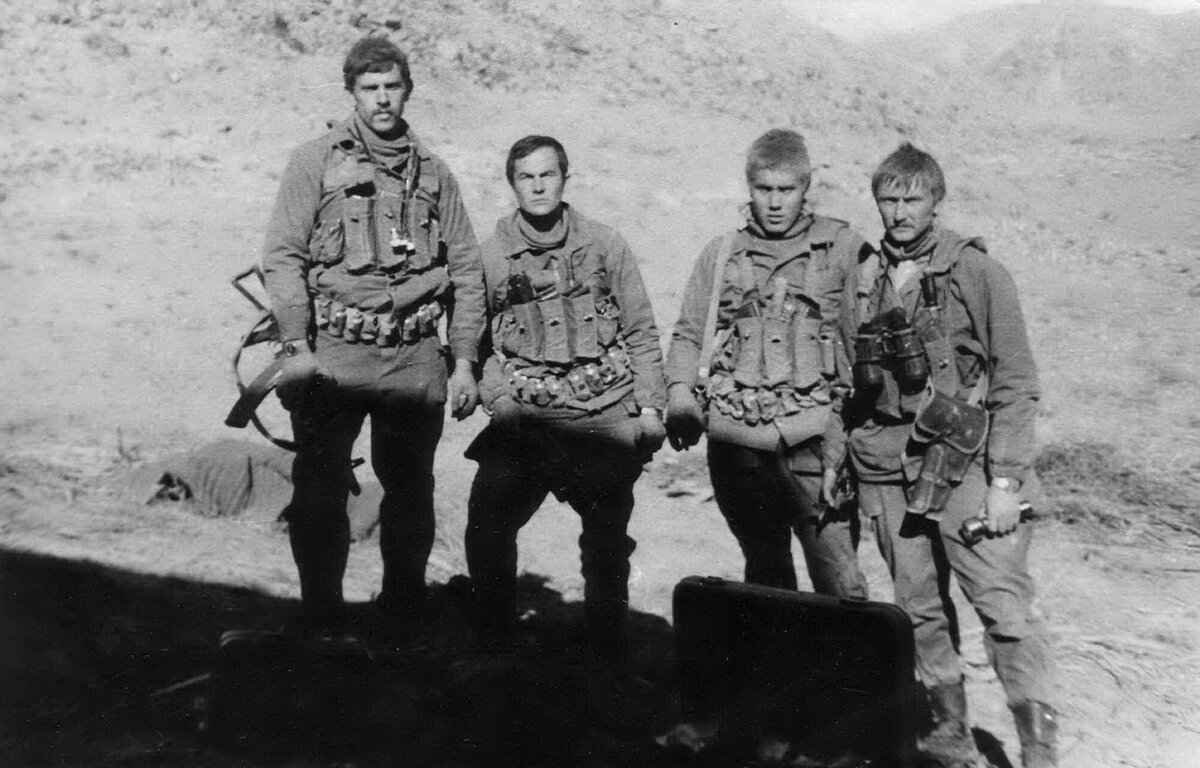
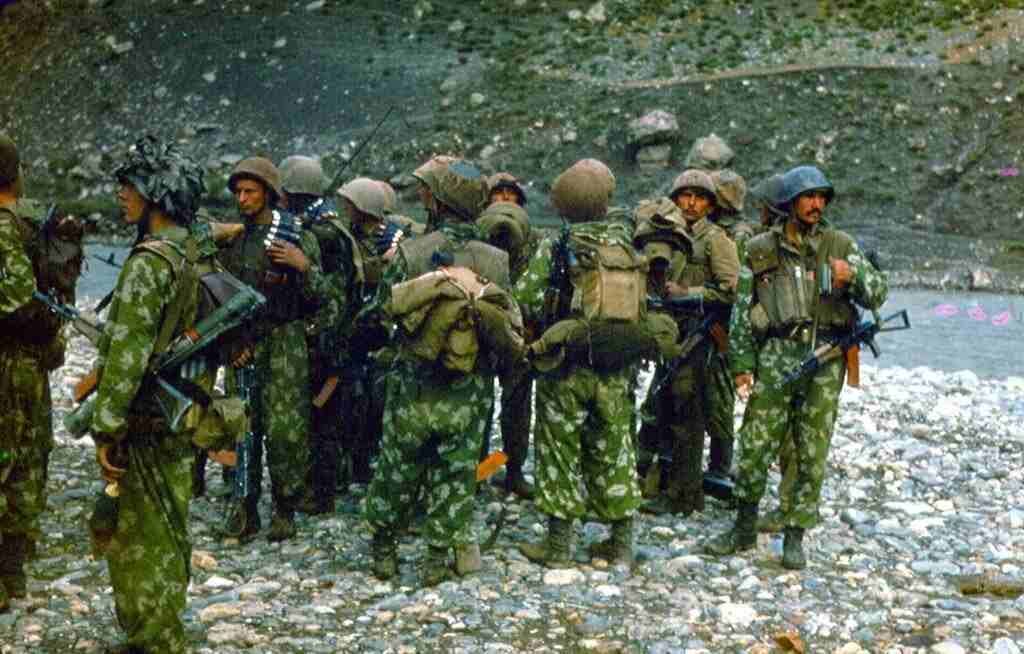
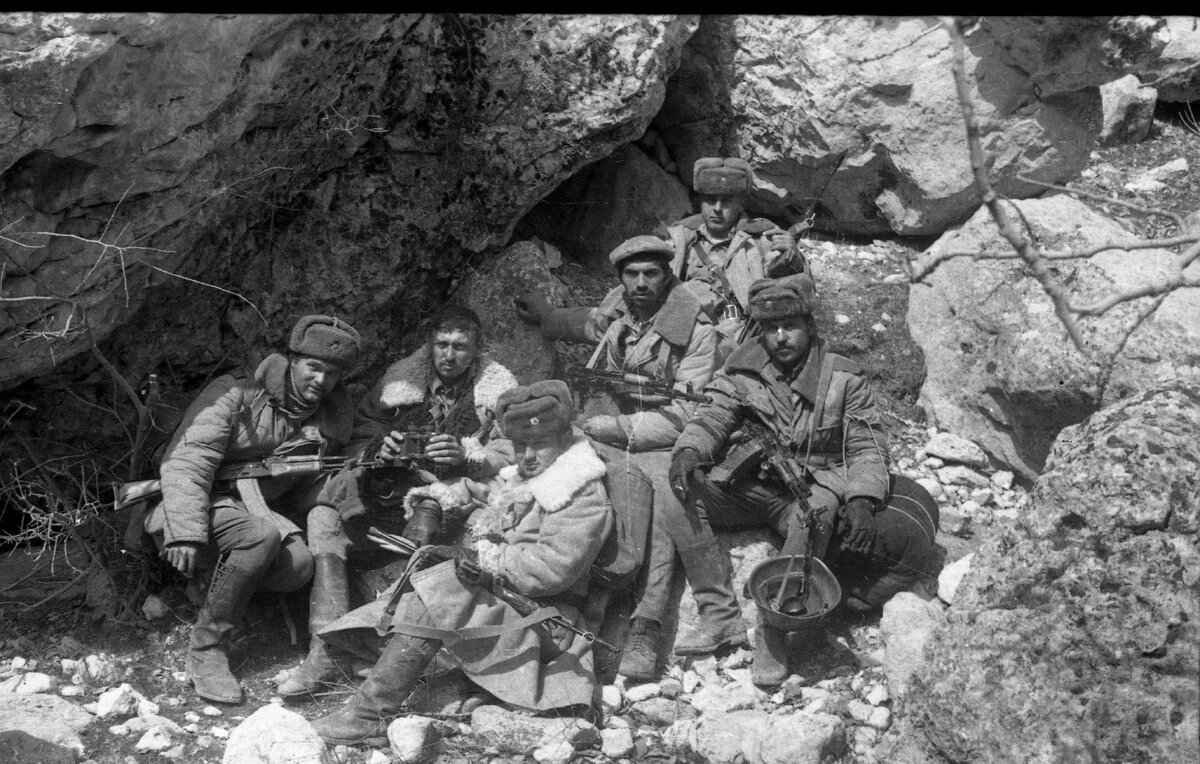
Soviet Spetsnaz soldiers wearing Gorka mountain suits during the Soviet-Afghan War.

ON THE SCORCHED LAND OF AFGHANISTAN

Soviet Field Uniforms During the Soviet-Afghan War (1979–1989)

A Different War

At the end of 1979, the Soviet Union sent the Limited Contingent of Soviet Forces in Afghanistan (40th Army) into Afghanistan at the request of the Afghan government. At first, the mission was not to fight the enemies of the Afghan government. Soviet soldiers were expected only to support the Afghan Army and police forces. But very soon, they became involved in combat across the whole country. The war lasted for nine long years, until February 1989.

More interesting articles:

How the Soviet Army Uniform Changed from 1955 to 1991

Soviet Spetsnaz Uniform in Afghanistan (1979–1989)

What Soviet Soldiers Really Ate in the Afghan War

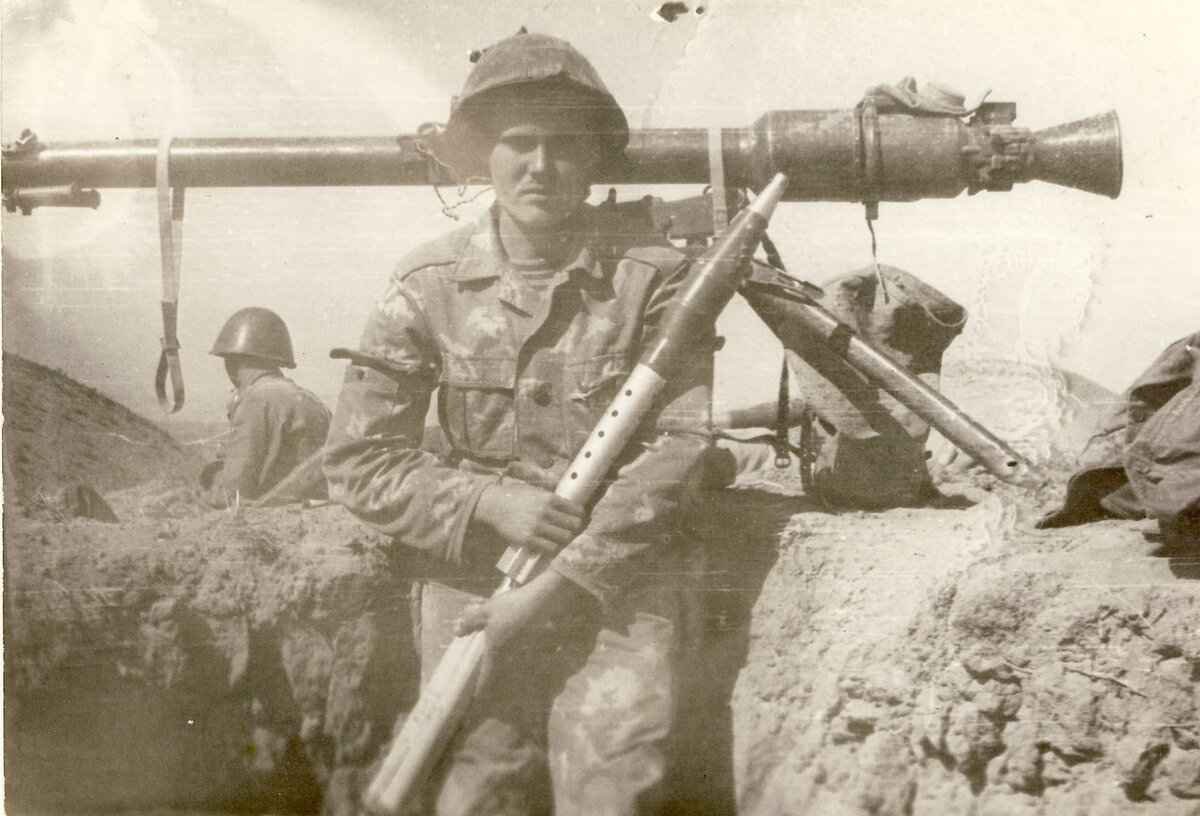
During the first months in Afghanistan, it became clear that this war would be very different from the battles of World War II, where battalions and regiments were the main fighting units. There was no front line in Afghanistan. Soviet soldiers and their Afghan allies controlled many strongpoints across the country. The enemy tried to capture these positions or cut supply routes by attacking transport convoys and placing mines on the roads.

In response, Soviet forces and Afghan government troops regularly attacked Mujahideen base areas. They also tried to break enemy supply lines by using ambushes and raid operations.

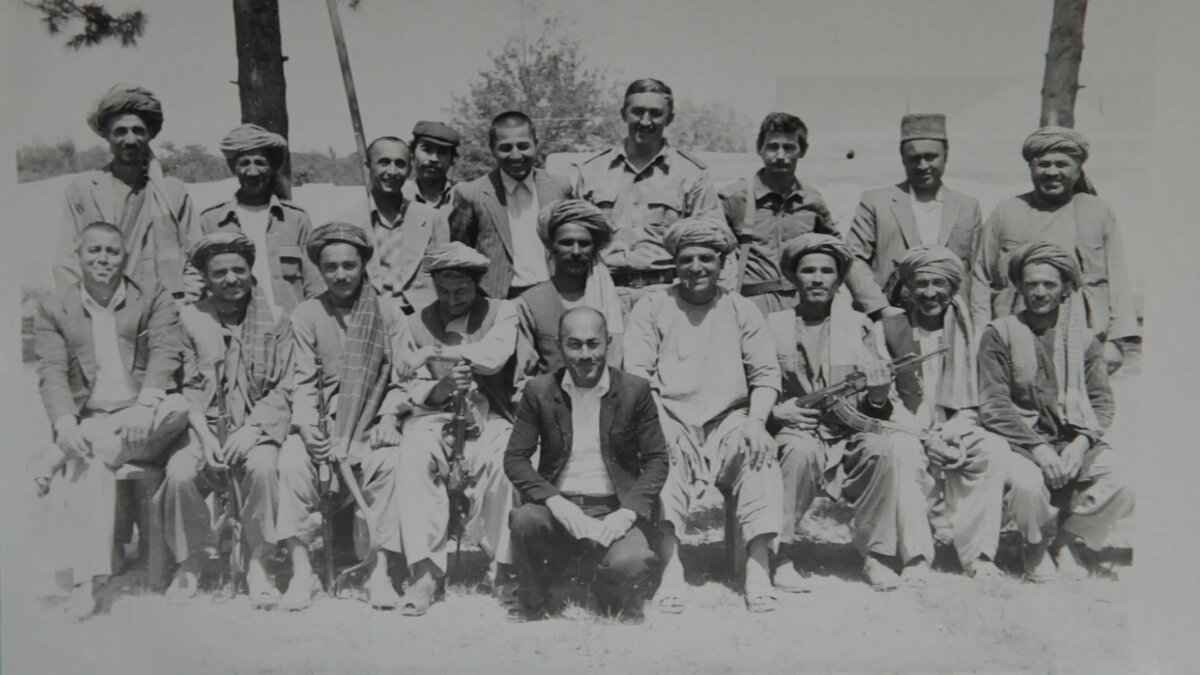
Group of Afghan local men posing together during the Soviet-Afghan War, Afghanistan, 1979–1989.
Afghanistan’s unique climate required special clothing. People needed to protect their bodies, especially their heads, from the strong sun. Light shoes, loose trousers, and lightweight, breathable fabric were the best choice. This could be clearly seen in the way the local people dressed.

Because of the way the war was fought, combat was usually carried out by small units-companies, platoons, or sometimes even small groups of only three to five soldiers. This made every single soldier much more important. As a result, much higher demands were placed on individual training, weapons, and personal equipment.

The deployment of Soviet troops to the Democratic Republic of Afghanistan became a real challenge for the Soviet military supply system. For almost ten years, the Soviet Armed Forces had lived in peacetime. From the end of the Soviet-Chinese border conflict in 1969 until December 1979, they had taken part in almost no real combat. The Cold War kept the military on alert, large military exercises were held, and huge amounts of uniforms and equipment were stored in case World War III began.

In many ways, the Soviet Army was still a peacetime army. Great attention was given to smart appearance, military parades, clean barracks, and the quality of painted vehicles and buildings. When Soviet troops arrived in Afghanistan, they quickly discovered that these ideas did not work in a real war. This affected everything-from tactics, military vehicles, and weapons to field uniforms, equipment, and protective gear.

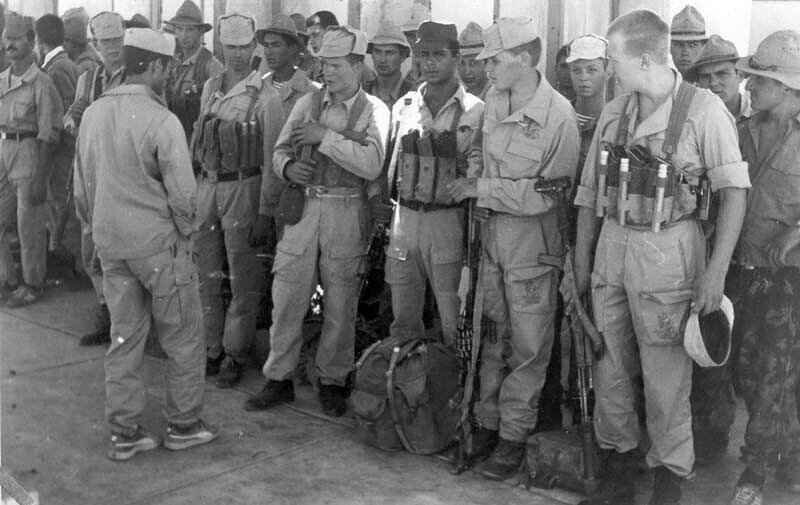
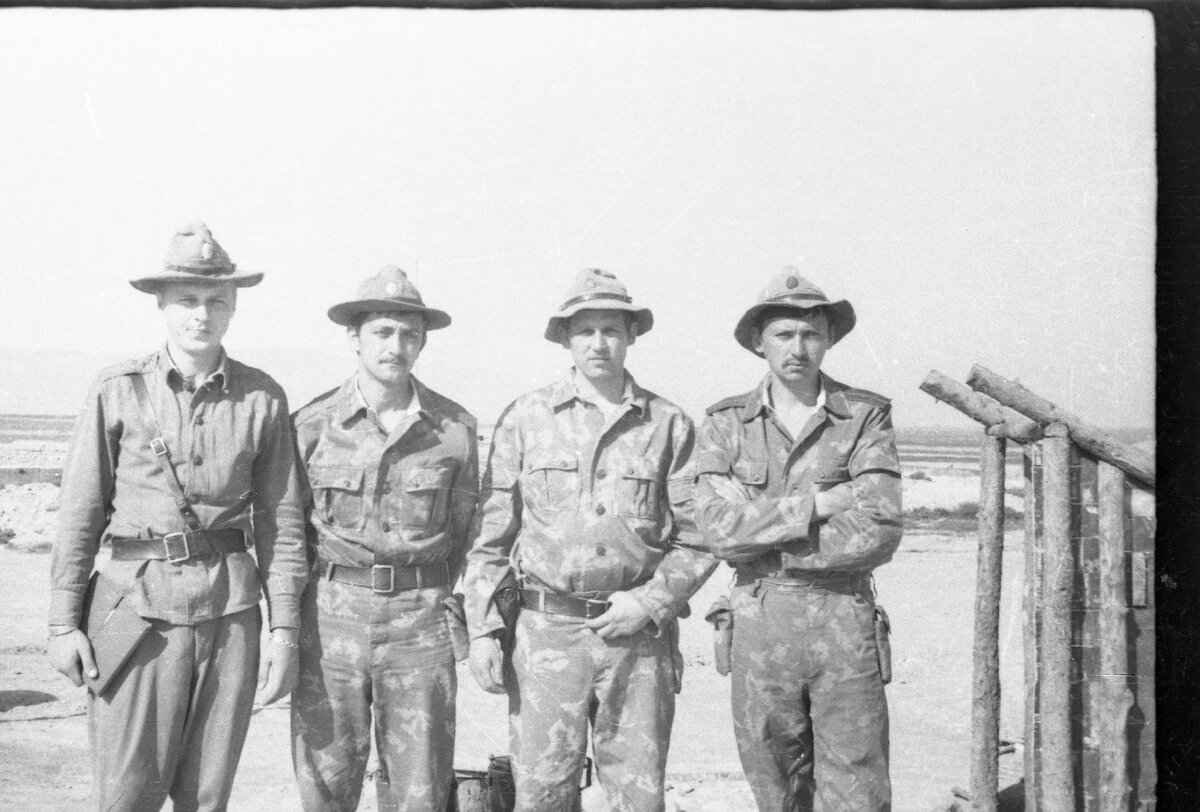
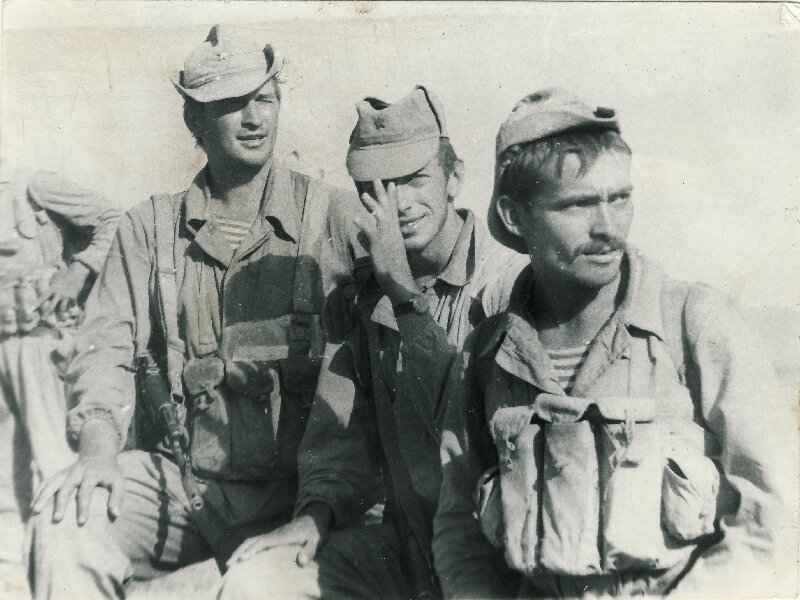
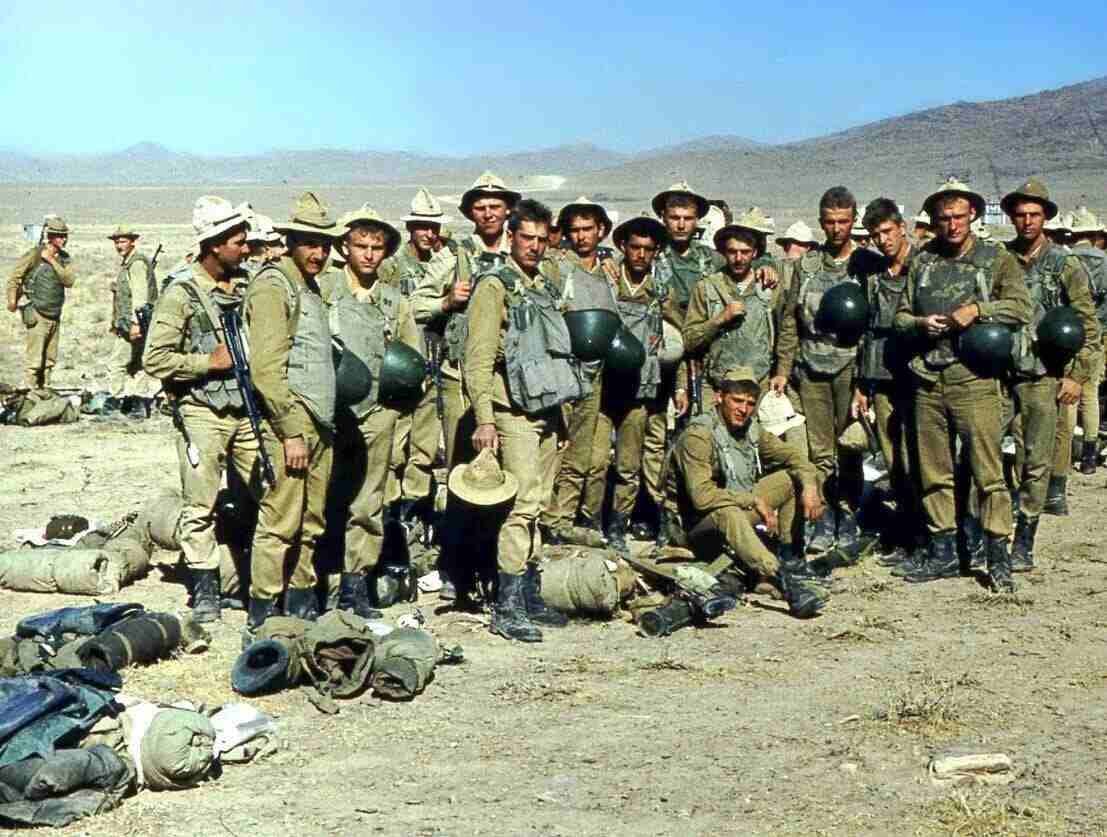
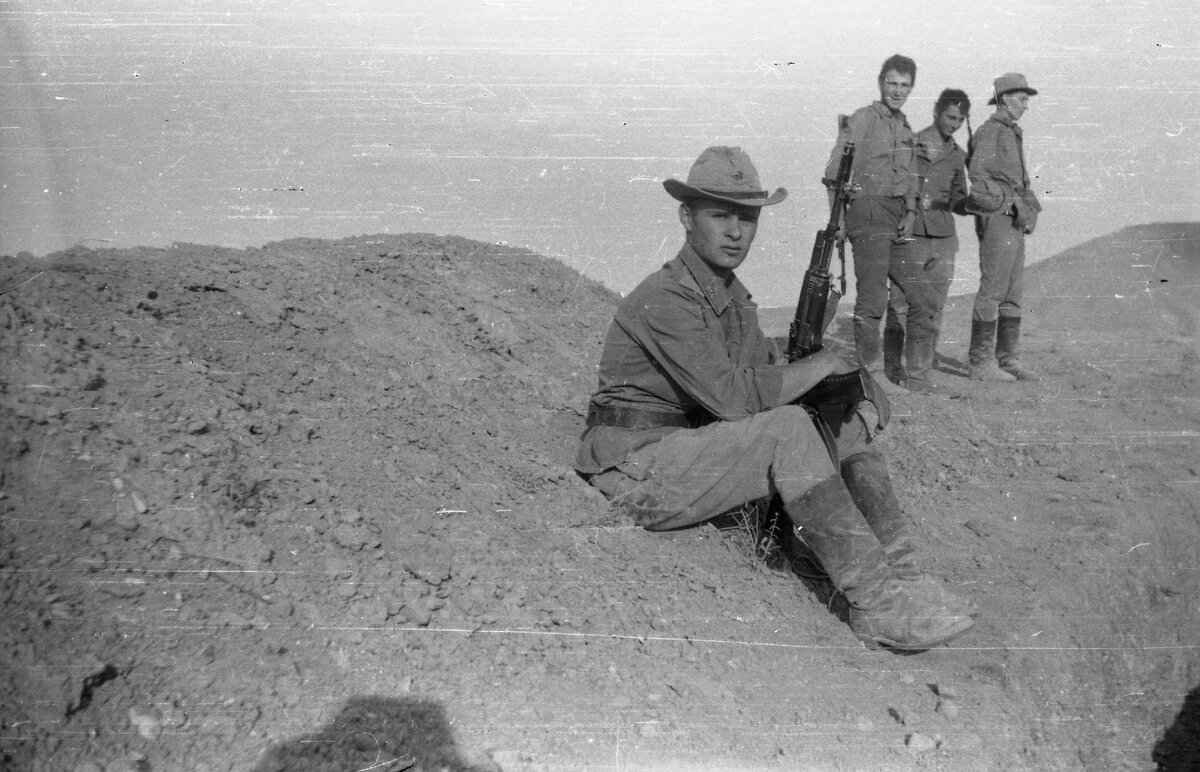
Soviet soldiers wearing early field uniforms and panama hats during the Soviet-Afghan War, 1979–1989.
Soviet soldiers in standard field uniforms during the early years of the Soviet-Afghan War. The harsh Afghan climate quickly showed the need for more practical combat clothing.

The 1969 field uniform looked good in official photos, but in real combat, it proved to be far from the best choice.

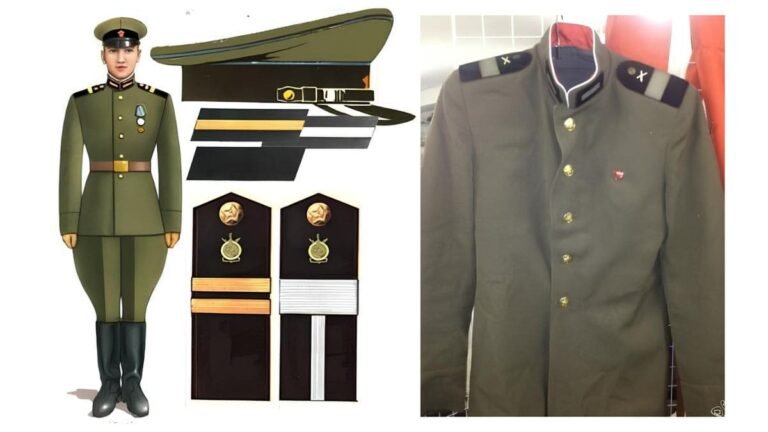
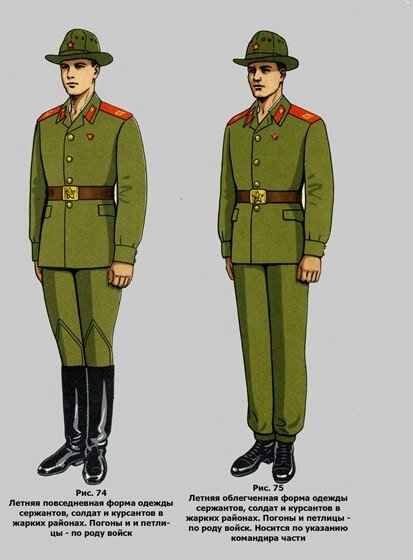
Illustration of the 1969 Soviet Army field uniform for soldiers and sergeants in hot climate regions.
Official illustration showing the 1969 Soviet Army summer field uniforms designed for soldiers, sergeants, and cadets serving in hot climate regions.

Figure 74

Summer everyday uniform for sergeants, soldiers, and cadets in hot climate regions. Shoulder boards and collar tabs depend on the branch of service.

Figure 75

Summer lightweight uniform for sergeants, soldiers, and cadets in hot climate regions. Shoulder boards and collar tabs depend on the branch of service. Worn only by order of the unit commander.

The problems with the uniform also became clear because of Afghanistan’s extreme mountain climate. In summer, temperatures in most parts of the country reached 45°C (113°F) in the shade. In winter, they could drop to –30°C (–22°F), with strong winds and heavy snow. Most of Afghanistan is covered by mountain ranges reaching 3,000 meters (9,800 feet), while the south is home to the hot Registan Desert. In these conditions, the standard Soviet field uniform did not provide the comfort or practicality needed for combat.

The summer uniform for soldiers and sergeants included a tight-fitting tunic and riding breeches. It was hot, tight, and uncomfortable. It was especially difficult to wear while riding in armored personnel carriers (APCs) and infantry fighting vehicles (BMPs). When climbing onto the armor, the tunic would ride up, and the tight trousers often tore at the knees if a soldier lifted his leg too high.

The tunic also had no large patch pockets. It had only two inside pockets and two small side pockets. There was very little space to carry useful items, and even a few things made the tunic bulge awkwardly. The open collar did not provide enough ventilation in the heat. The large metal buttons were also a problem. When wearing body armor, they pressed painfully into the body, and they often caught on equipment and were easily torn off.

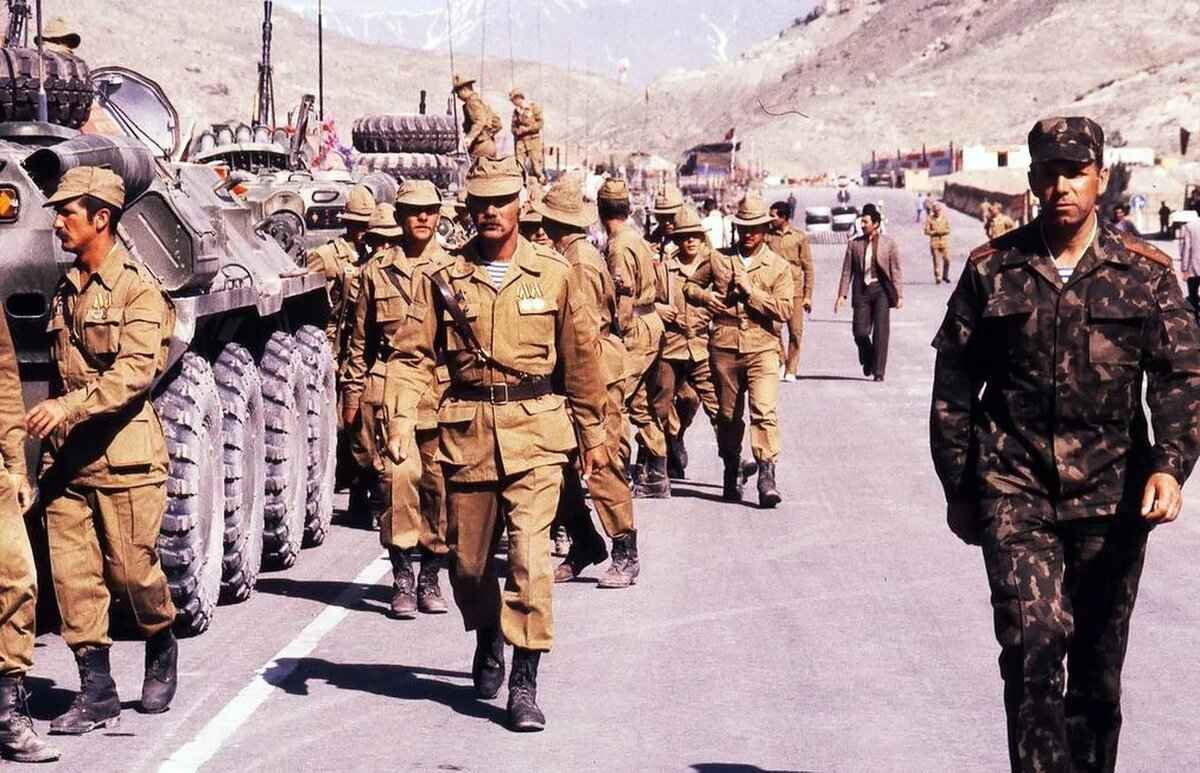
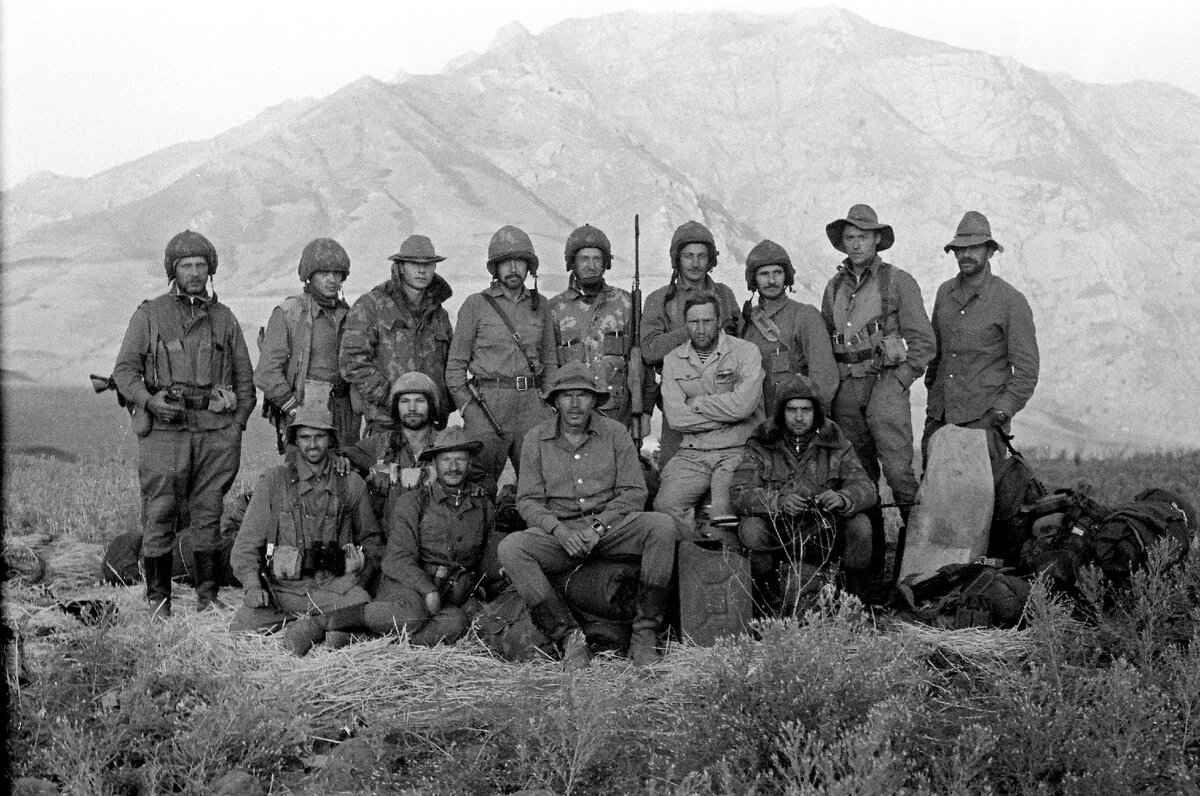
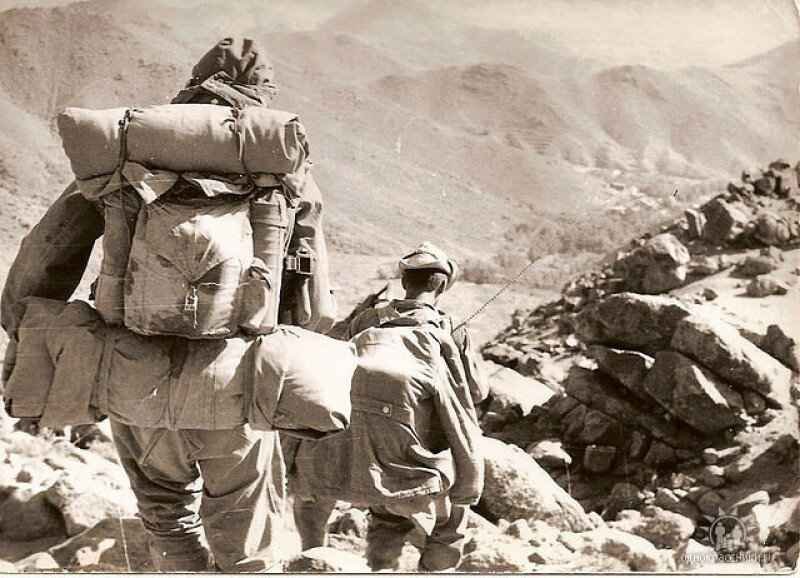
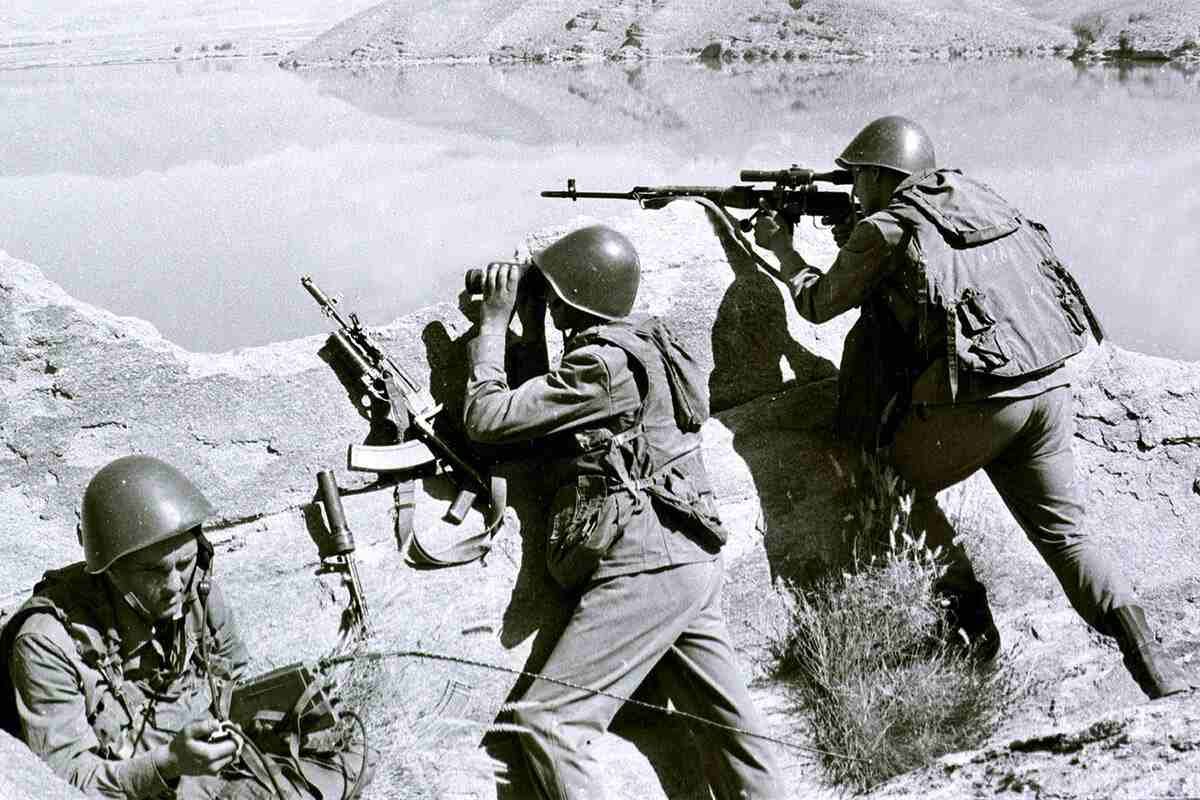
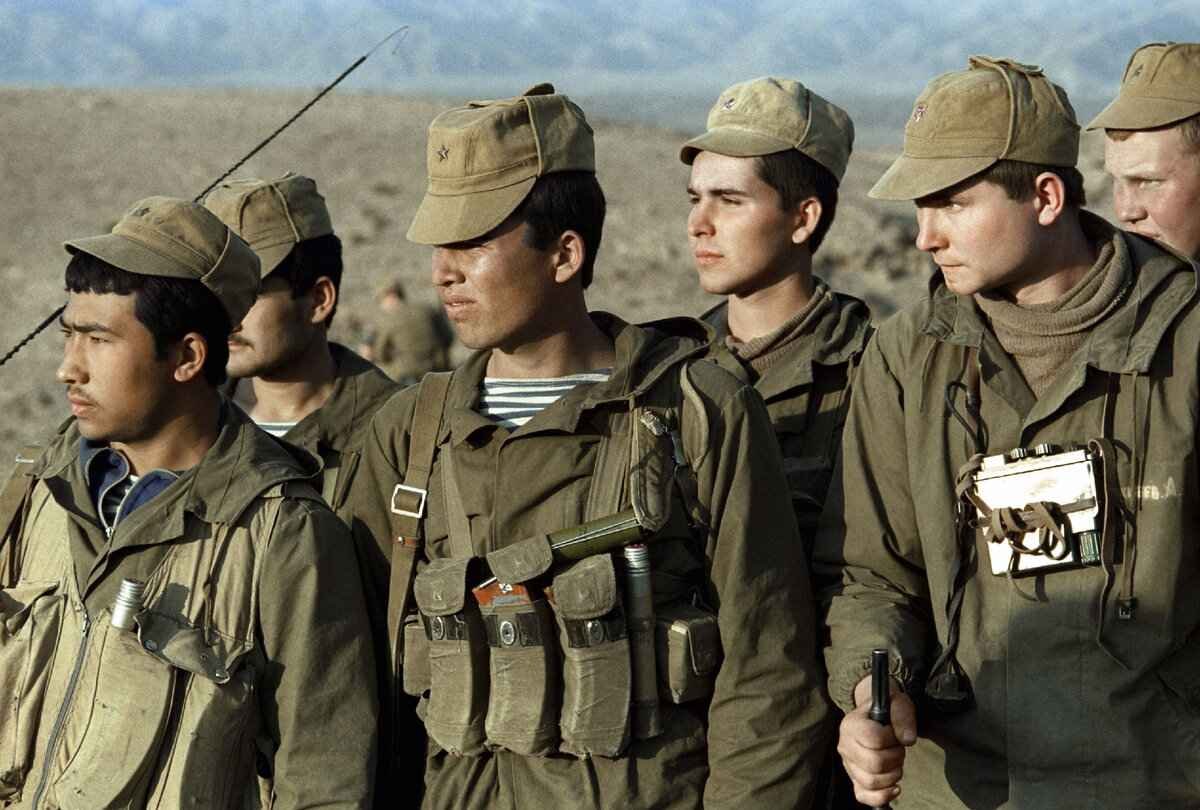
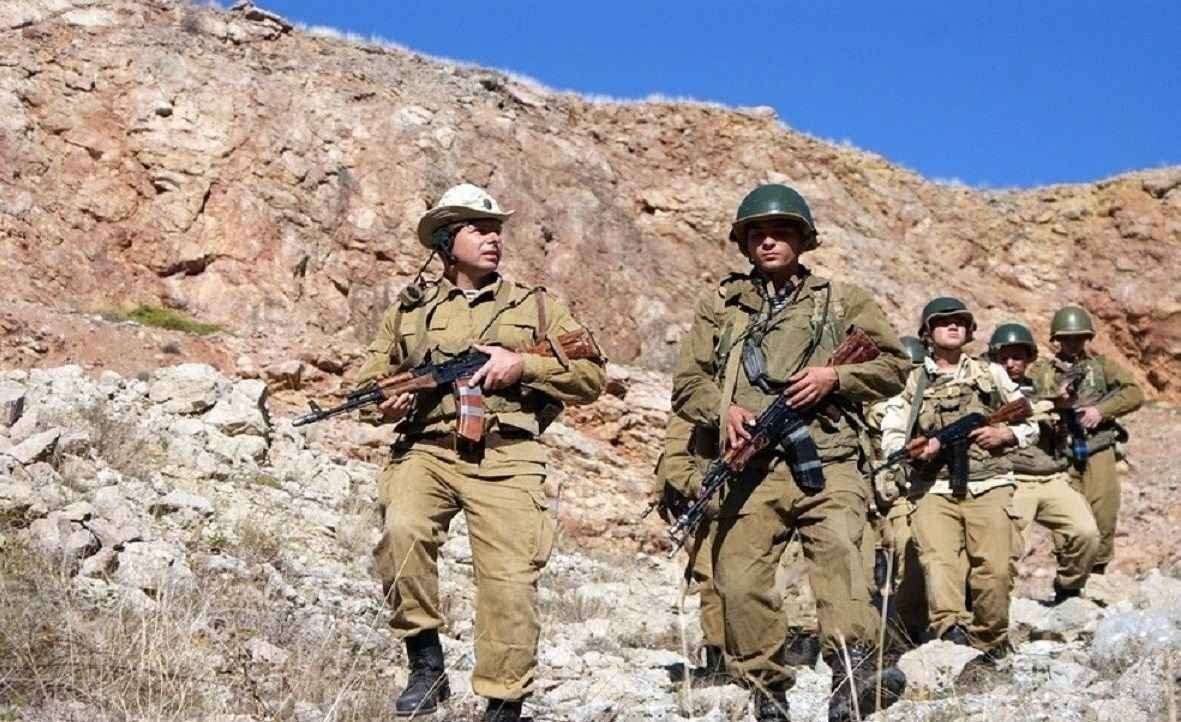
Soviet soldiers on patrol in the mountains of Afghanistan during the Soviet-Afghan War, wearing practical field uniforms and combat gear.
Soviet soldiers patrol through Afghanistan’s rocky mountain terrain. The harsh landscape and extreme climate quickly showed the need for more practical field uniforms and equipment.

Pilotka cap gave almost no protection to the eyes or face from the burning Afghan sun. Panama hat, which was designed for hot climates, protected soldiers much better. However, it had one major problem-it was not suitable for wearing under a combat helmet.

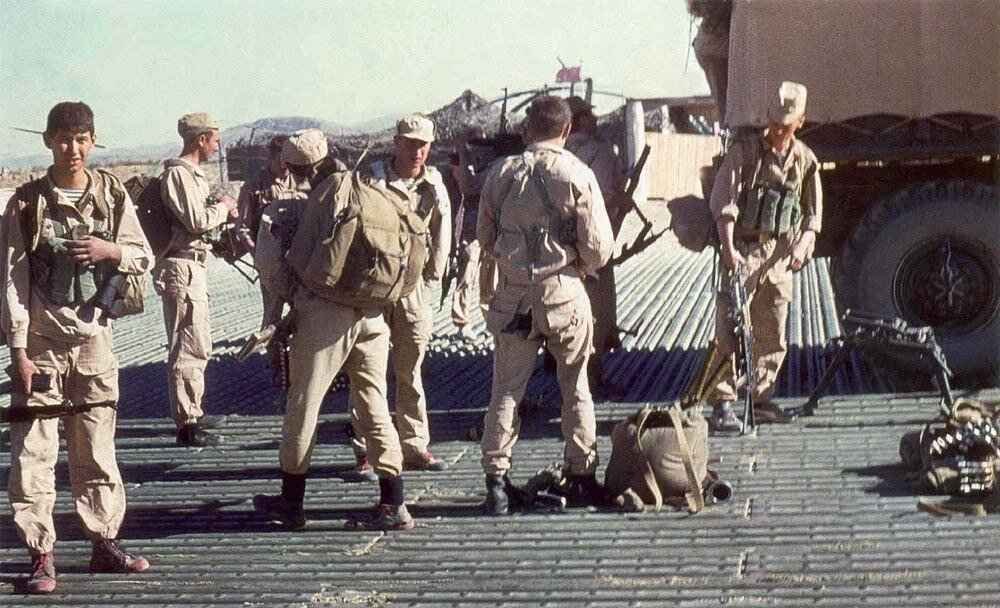
Soviet soldiers wearing panama hats during the Soviet-Afghan War, showing the practical hot-weather field uniform used in Afghanistan.
Kirza boots in Afghanistan

Soldiers wore simple kirza boots like these
Soviet Kirza Boots
Classic Soviet military kirza boots inspired by the simple footwear worn by Red Army soldiers.


View Soviet Kirza Boots


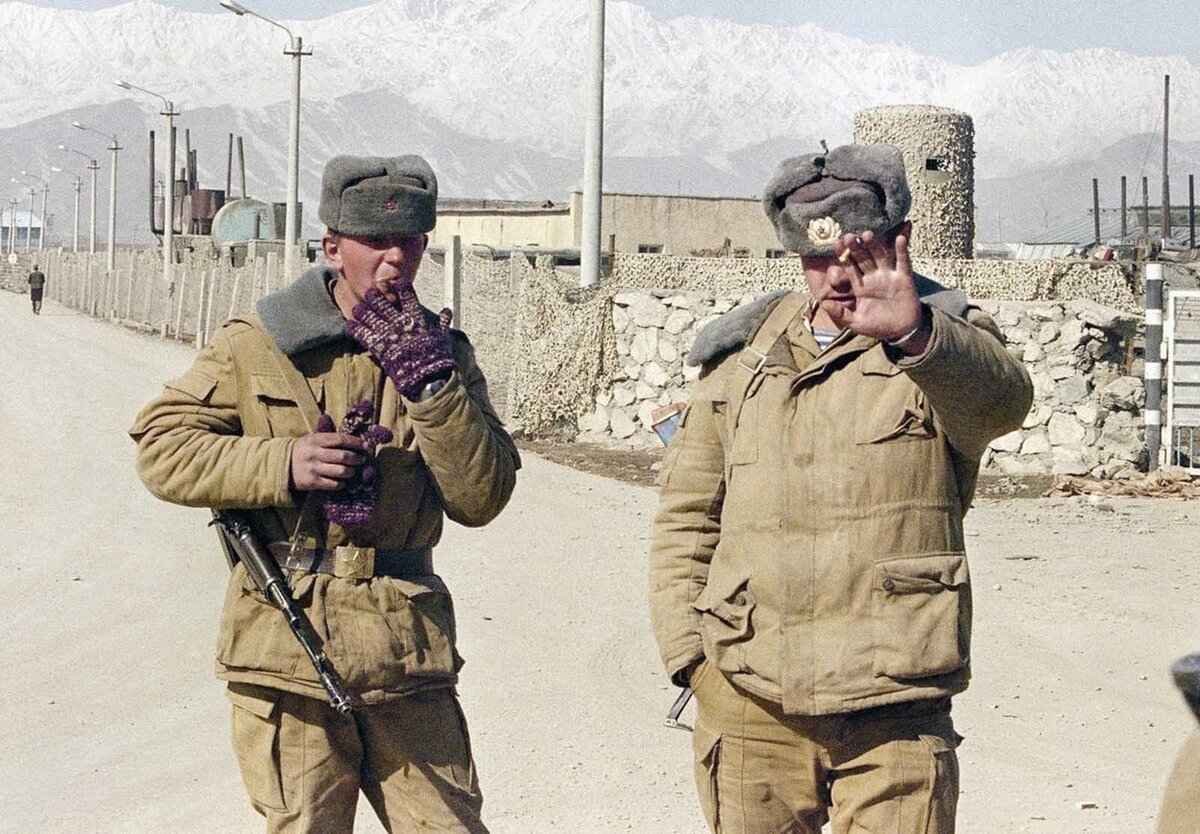
The winter uniform was not very practical either. In Afghanistan, the standard greatcoat turned out to be almost useless because it gave very little protection from the cold mountain wind. For this reason, soldiers almost always wore insulated jackets, commonly called bushlat jackets. Even these jackets were not well suited for the Afghan winter. They had no windproof flap and no large patch pockets-only two side pockets. Their fitted shape also made movement more difficult. A decorative back strap was fastened with two buttons, and the sleeve cuffs were also closed with buttons. In real combat, these details served no useful purpose.

The cotton fabric of the uniform allowed air to pass through quite well. However, in the field it quickly became dirty with dust, oil, grease, and other stains. As a result, dark shiny patches appeared on the fabric. The collar, sleeve cuffs, knees, and elbows wore out the fastest. Another problem was that the protective green color faded very quickly in the strong Afghan sun, sometimes becoming almost white.

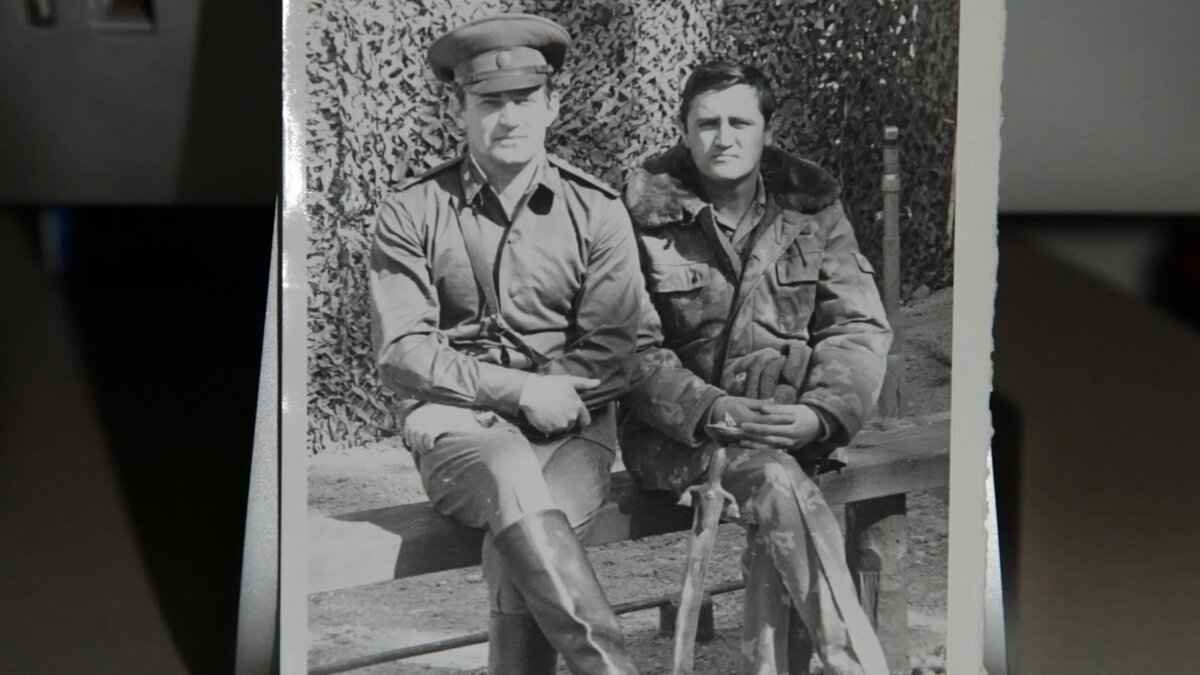
The officers’ field uniform was made from better-quality fabric and looked very different from the soldiers’ version. It was worn with a green service cap and a leather belt with a pistol holster. All of this made officers easy targets for enemy snipers. Because of this, the officer’s field uniform disappeared from combat units during the very first year of the Afghan War and remained in use only by staff officers.

Soviet Army officer in the early field uniform during the Soviet-Afghan War, wearing a service cap and leather pistol belt.
During the first years of the Soviet-Afghan War, an officer wearing the standard field uniform was usually someone from headquarters. Combat officers quickly stopped wearing this easily recognizable uniform because it made them an obvious target for enemy snipers.

The standard footwear of the Soviet Army was boots. Soldiers and sergeants usually wore kirza boots, while officers in the field wore yuft leather boots. Both types were worn with portyanki (foot wraps), and wrapping them correctly was considered a real skill. In the Afghan heat, wearing boots with foot wraps often felt like having two hot stoves on your feet.

Kirza boots were lighter than yuft boots, so they stayed a little cooler. Because of this, many officers preferred kirza boots during combat missions. One downside was that new boots had to be broken in. If the boots were not worn in properly, or the foot wraps were wrapped the wrong way, painful blisters could appear very quickly.

Some units, especially Airborne (VDV) and Spetsnaz, wore Afghan M88 combat boots. Soldiers simply called them bertsy. These boots were originally designed for parachute jumps and gave much better ankle support than standard boots. Their stiff soles made them less comfortable at first, but they provided better grip on rocky ground, were lighter, and allowed soldiers to move faster during long patrols and mountain operations.

Because of these advantages, M88 boots became one of the most respected pieces of Soviet military footwear from the Afghan War. Today they remain a favorite among collectors, reenactors, and anyone looking for authentic Soviet combat boots that combine historical accuracy with real field performance.

Afghan soldiers used combat boots like these
Soviet M88 Combat Boots (Afghanka)
Soviet military combat boots introduced later, designed with nailed soles and field conditions.


View Soviet M88 Combat Boots

Soviet soldiers wearing winter field uniforms and sheepskin coats in the mountains of Afghanistan during the Soviet-Afghan War.
Afghan winters could be freezing, with strong winds and snow in the mountains. Sheepskin coats kept Soviet soldiers warm but were heavy and impractical during long patrols and combat operations.

During the winter, Soviet soldiers received extra cold-weather gear in addition to their standard uniform. This included sheepskin coats, shorter sheepskin jackets, and felt boots (valenki). None of these items were very practical, especially when riding in armored vehicles, but they helped protect soldiers from frostbite.

The ushanka fur hat was also very uncomfortable to wear under a combat helmet. Some units, especially Spetsnaz, used brown wool balaclavas or helmet liners, but they were very rare. Even harder to find were the famous mountain sweaters, also made from brown wool. Most soldiers stayed warm by wearing the standard white cotton underwear with an extra layer of insulated light-blue thermal underwear.

In cold weather, soldiers, sergeants, and senior sergeants wore three-finger mittens, which allowed them to fire their rifles while keeping their hands warm. Officers and warrant officers were issued brown knitted wool gloves instead.

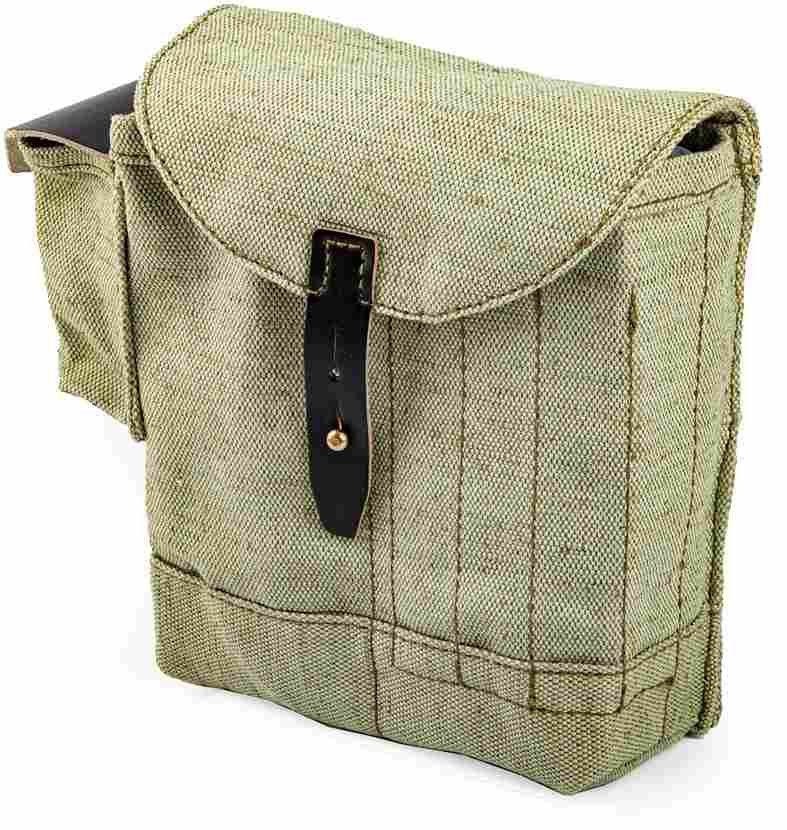
Original Soviet AK-74 magazine pouch designed to carry four magazines during the Soviet-Afghan War.
The standard AK-74 magazine pouch was officially designed to hold four magazines, but soldiers often managed to fit even more ammunition inside when preparing for combat missions.

Although the Soviet Army entered the fighting gradually, it quickly became clear that many parts of the 1969 field uniform were not suitable for the conditions in Afghanistan. The uniform had been designed with one goal-to equip a large army in case of a world war. Because of this, it was made as simple as possible, with few extra features and easy mass production. But in a long local war, simplicity alone was not enough.

The soldiers of the 40th Army were not satisfied with this situation, especially as the war continued year after year. They needed a new field uniform, better equipment, and improved protective gear designed for a fast-moving and highly mobile war.

The “Afghanka”

In fact, the need to replace the 1969 field uniform became clear even before the Soviet-Afghan War began. As early as 1975, the Central Clothing Directorate of the Soviet Armed Forces started developing a completely new field uniform. In 1976, different prototypes were tested by Soviet Army units. They used different fabrics and varied in the number, size, and placement of pockets.

The final design was completed by 1978. However, the new uniform did not enter mass production until 1984, following Order No. 0145 of the Soviet Minister of Defense. At first, soldiers simply called it the “experimental uniform,” but before long it became known by the name that is still famous today-the “Afghanka.”
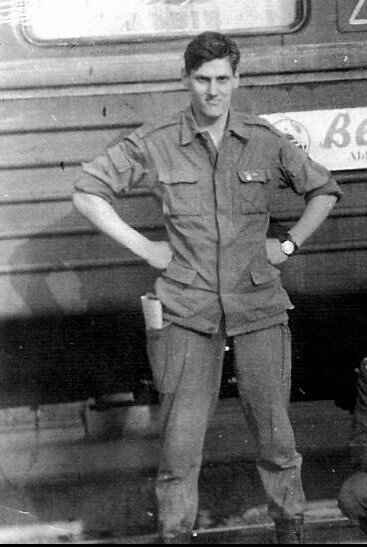
Author wearing the Soviet Afghanka field uniform in 1992.
The author wearing an original Soviet Afghanka field uniform. Photo taken in 1992.

The Afghanka uniform was made according to Soviet military standard TU-17-08-194-84 using two types of cotton fabric that differed in both color and texture. The yellow-brown version was made from fabric No. 3303. Soldiers called it “khabe” or “pesochka” (“sand color”). The dark green version was made from fabric No. 3155. This version became known as the “steklyashka.”
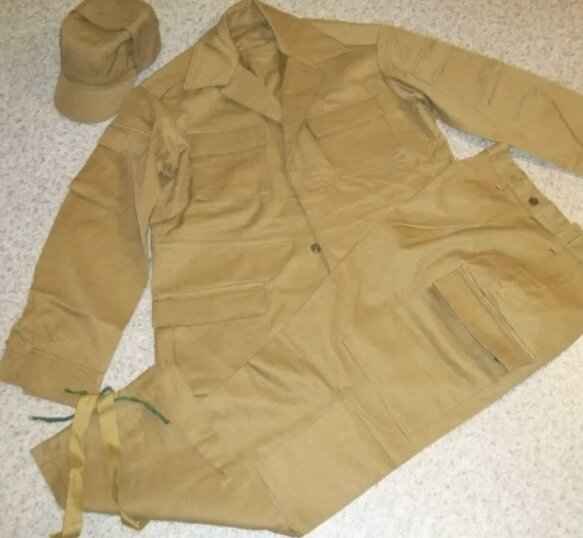
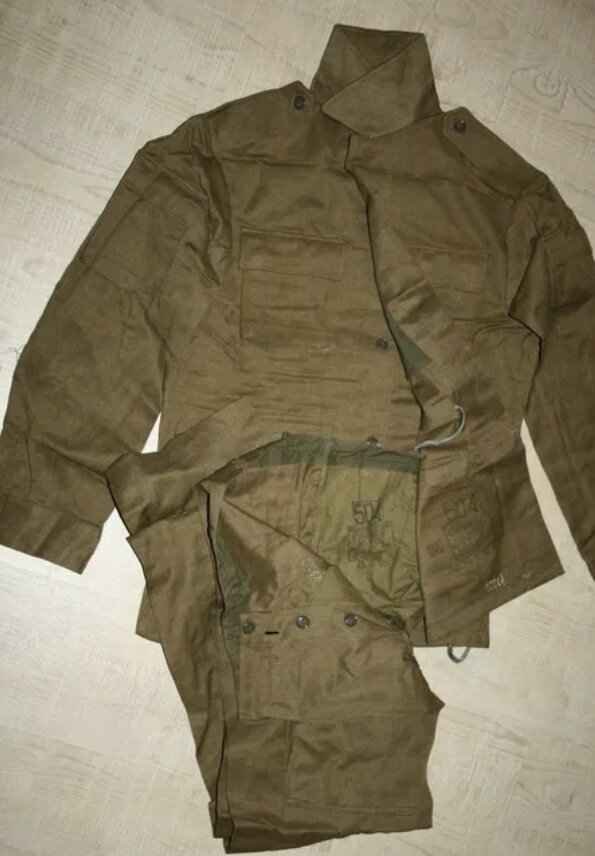
Soviet Afghanka field uniform in the "Pesochka" sand-colored fabric used during the Soviet-Afghan War.
Two versions of the Soviet Afghanka uniform. The yellow-brown version at the top was called “Pesochka” (“sand color”), while the dark green version at the bottom was known as “Steklyashka.”
Soviet Afghanka field uniform in the dark green "Steklyashka" fabric used during the Soviet-Afghan War.
The “Steklyashka” was the dark green version of the Soviet Afghanka uniform. It resisted fading and washing better than the “Pesochka,” but soldiers often considered it hotter because of its higher synthetic fiber content.

At first, there were two versions of the Afghanka uniform-a soldier’s version and an officer’s version. The officer’s jacket had only two waist pockets with flaps, while the trousers had no cargo pockets. After field testing with the Soviet forces in Afghanistan, the uniform was made the same for everyone because officers were too easy for enemy snipers to identify.

The only difference that remained was the collar of the winter jacket. Soldiers and sergeants received jackets with an artificial fur collar, while officers and warrant officers were issued jackets with a natural fur collar. Later, a special version with an astrakhan fur collar was introduced for generals.
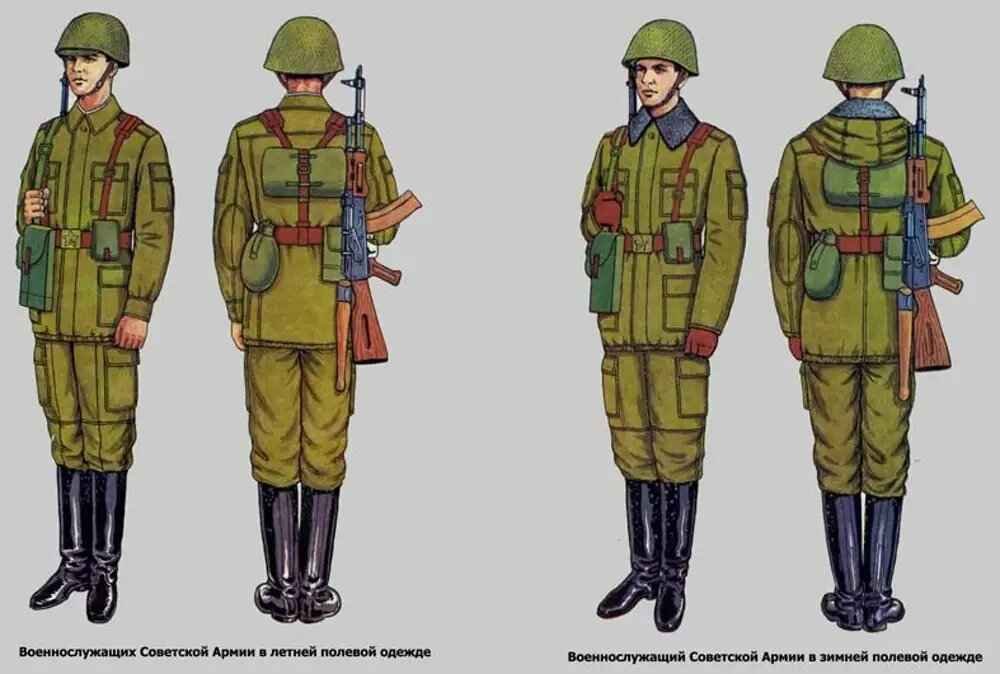
Official illustration of the Soviet Afghanka summer and winter field uniforms worn by Soviet Army soldiers.
Official illustration showing the Soviet Afghanka field uniform in both summer and winter versions. The Afghanka became the standard Soviet combat uniform during the later years of the Soviet-Afghan War. Soviet Army soldier in the summer field uniform and
Soviet Army soldier in the winter field uniform
The Afghanka was produced in both summer and winter versions. The summer set included a jacket, straight-cut trousers, and a field cap with fold-down ear flaps. The jacket had an open collar with olive-green metal branch insignia, two chest pockets, two lower patch pockets, two sleeve pockets, and two inside pockets. All outer pockets had flaps fastened with flat plastic buttons.

The front of the jacket had a windproof flap closed with large plastic buttons. Two vertical pleats ran down the back to give more freedom of movement. The waist and bottom of the jacket could be tightened with built-in nylon drawstrings. Shoulder straps held the rank insignia. Officers and warrant officers wore olive-green metal stars, while soldiers, sergeants, and senior sergeants wore cloth rank stripes in either red or olive green. At their home garrisons, these stripes were usually yellow or gold.

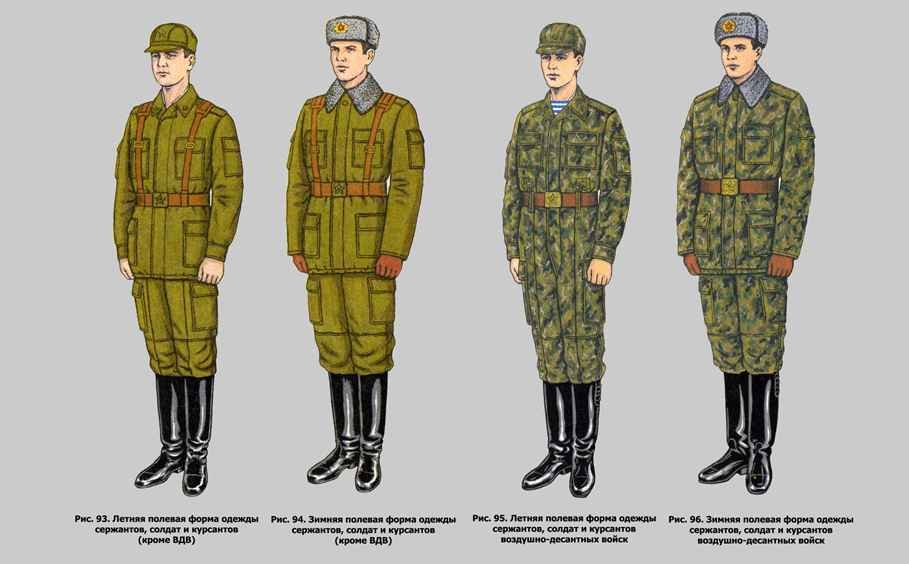
Official illustration of Soviet Afghanka field uniforms for the Soviet Army and Airborne Forces (VDV), showing both summer and winter versions.
Official illustration comparing the standard Soviet Army Afghanka uniform with the VDV (Airborne Forces) version in both summer and winter configurations.

Fig. 93
Summer field uniform for sergeants, soldiers, and cadets (except Airborne Forces).

Fig. 94
Winter field uniform for sergeants, soldiers, and cadets (except Airborne Forces).

Fig. 95
Summer field uniform for sergeants, soldiers, and cadets of the Airborne Forces (VDV).

Fig. 96
Winter field uniform for sergeants, soldiers, and cadets of the Airborne Forces (VDV).
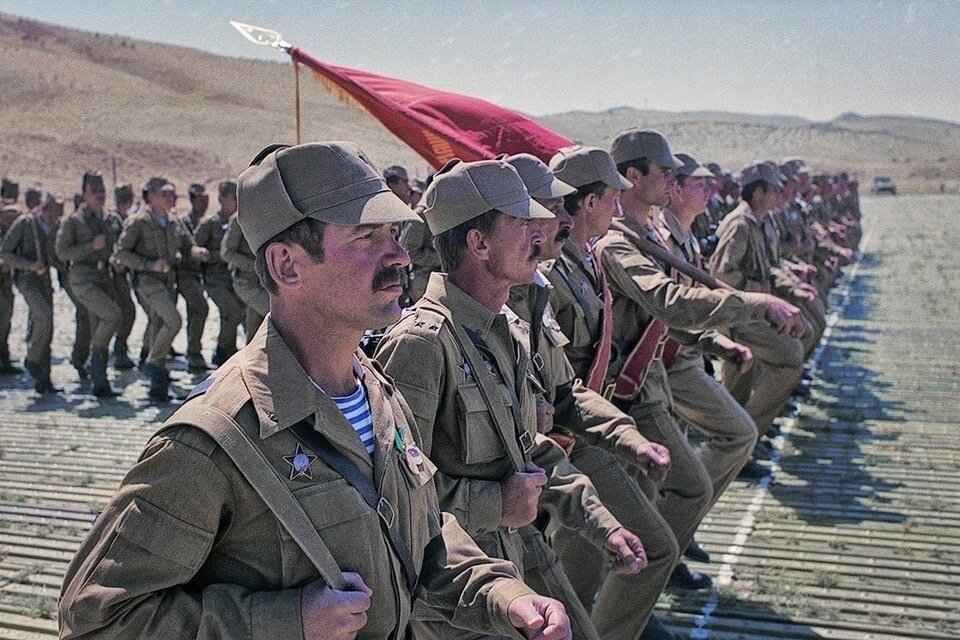
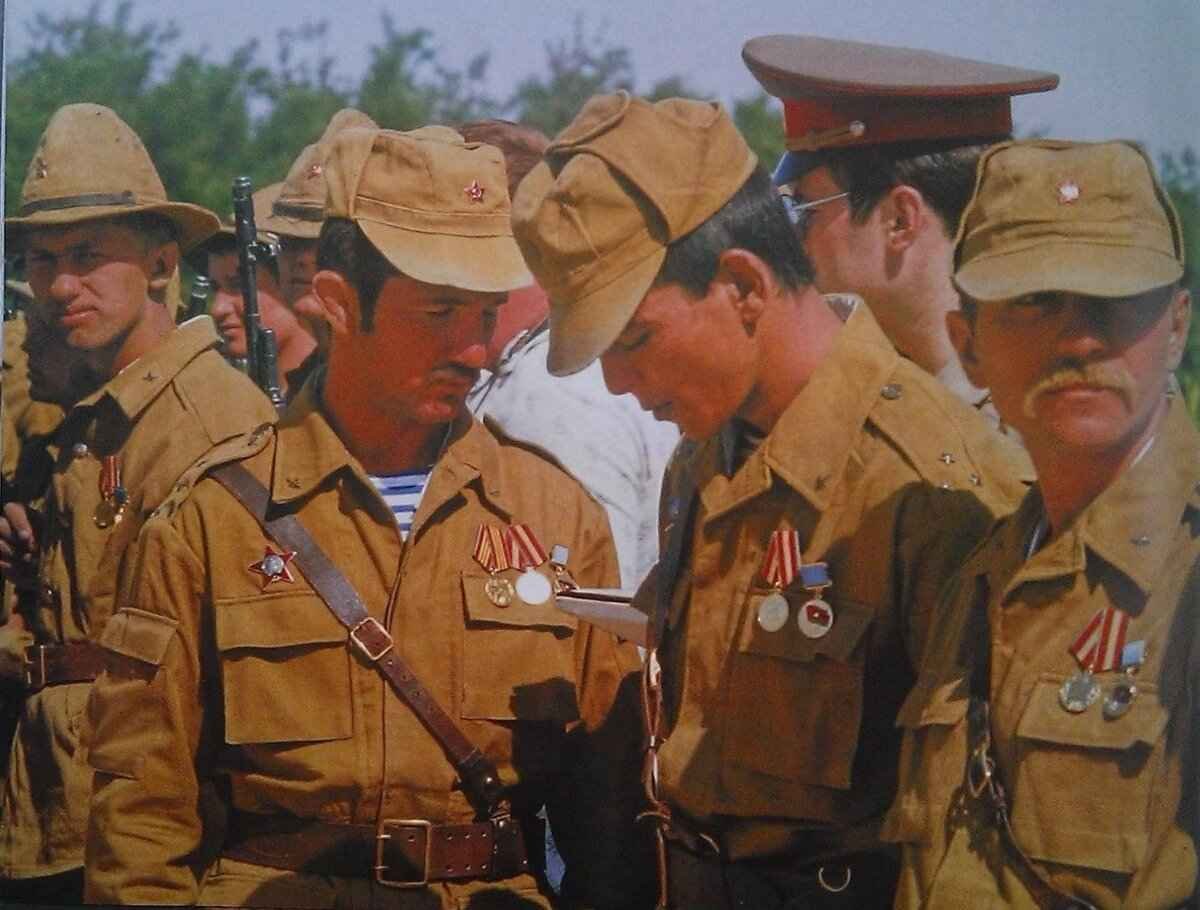
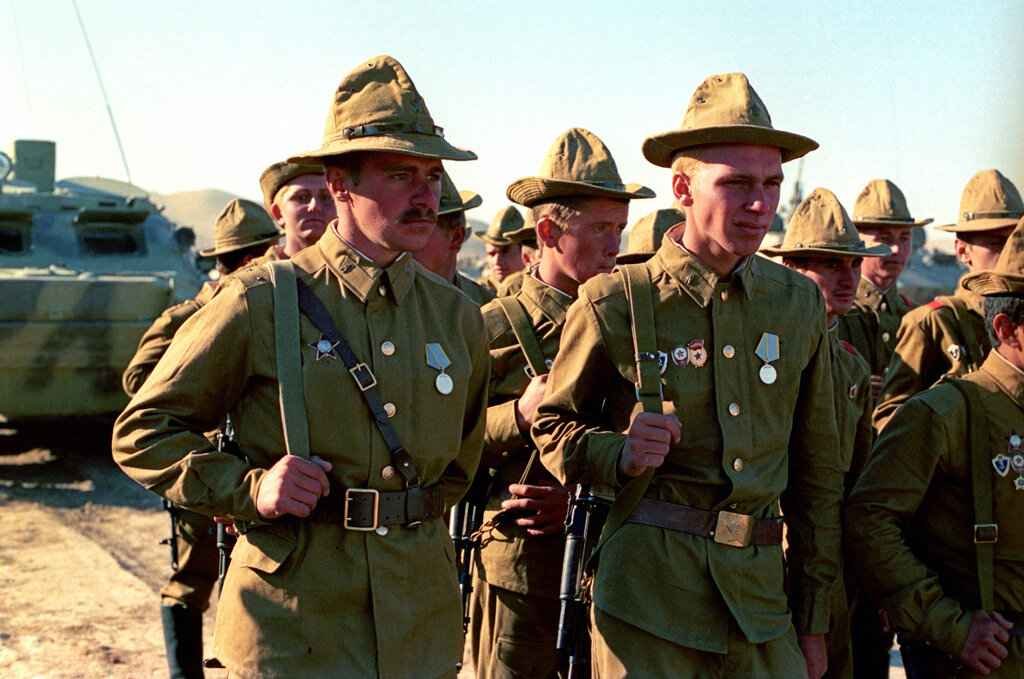
To help with camouflage, soldiers were officially not allowed to wear medals, badges, or other decorations on their field uniforms. In reality, during the Soviet-Afghan War, this rule was often ignored.

The jacket collar could be buttoned all the way up or worn folded down, depending on the season, the region, or the unit commander’s orders. In Afghanistan, soldiers usually wore the collar folded down. In both cases, the inside of the collar had to be lined with a removable strip of white cloth called a collar liner, which was changed regularly to keep the uniform clean.

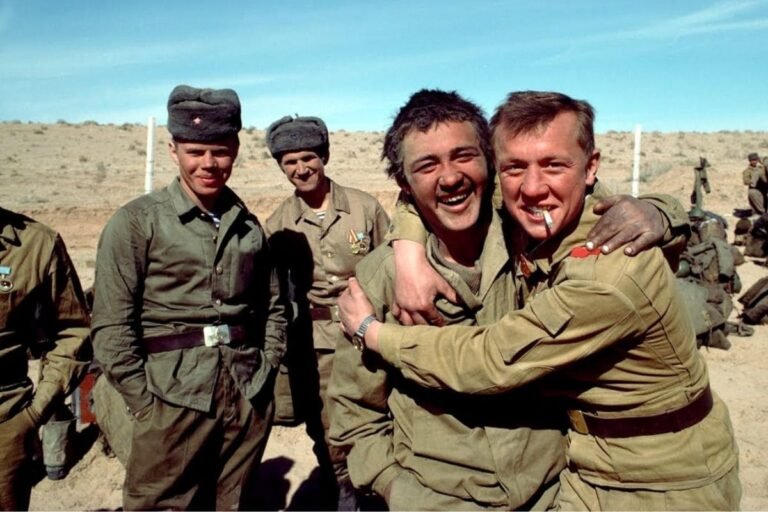
Soviet soldiers wearing Afghanka field uniforms during a military formation in Afghanistan.
Soviet soldiers wearing the Afghanka field uniform during a military formation in Afghanistan. Although medals and badges were officially forbidden on field uniforms for camouflage, many soldiers continued to wear them during the Afghan War.

The summer jacket was usually worn untucked and secured with a belt. Airborne (VDV) soldiers were the main exception. Following their tradition, they often tucked the jacket into their trousers. They were also issued the famous blue-striped telnyashka, while the rest of the Soviet Army received a plain light-blue undershirt.

Soviet soldiers wore Telnyashkas like these
Original Soviet & Russian Telnyashka Shirts
Authentic 100% cotton Telnyashkas inspired by the legendary striped shirts worn by Soviet Navy, VDV, Border Guards, and Spetsnaz troops. Available in summer and winter versions with multiple colors and styles.


Shop Original Telnyashkas

In Afghanistan, however, many soldiers preferred to buy their own black-striped telnyashkas. They wore them with the jacket collar folded down so the stripes could be seen at the neck. From a camouflage point of view, this was not a good idea, since the black and white stripes were easy to spot from a distance. Even so, wearing a telnyashka became a matter of pride among Soviet soldiers. Those who did not have one often wore black or olive-green T-shirts instead.

The trousers were fastened with plastic buttons. They had two upper side pockets, one small pocket for the soldier’s identification tag, and two large cargo pockets on the legs. The front of each leg had a reinforced vertical seam and extra fabric over the knees. At the bottom were stirrups designed for wearing the trousers with boots. When worn with lace-up boots, the stirrups could be buttoned inside the trouser legs.

The field cap had an olive-green metal cockade above the visor. It was much more practical than the old side cap because it protected the eyes from the sun. It was also more comfortable than the panama hat because it could be worn under a combat helmet. The only feature that confused many soldiers was the fold-down ear flaps, called “ears,” which were held up by two buttons. The designers probably expected soldiers to lower them in cold weather, similar to the old Budyonovka hat, but in reality this feature was almost never used.

Soviet soldiers wearing the winter Afghanka uniform and ushanka hats during the Soviet-Afghan War.
Soviet soldiers in the winter version of the Afghanka uniform during the Afghan War. The insulated jacket and ushanka hat provided warmth in the cold mountain climate, although the fur hat was uncomfortable to wear under a combat helmet.

The winter set included an insulated jacket with a removable liner, a fur collar, and a hood, insulated trousers with suspenders, and an ushanka fur hat. Like the summer jacket, the winter jacket had two chest pockets, two lower pockets, and two sleeve pockets. All outer pockets had flaps fastened with flat plastic buttons. Inside the jacket was a standard pocket on the right side. The officer’s version also had a special pistol pocket on the left side. It was reinforced with artificial leather and included a nylon cord with a metal clip to secure the pistol.

Soviet soldiers wore ushankas like this
Original Soviet Ushanka Hat
Authentic Soviet Army winter fur hat with fold-down ear flaps, designed to keep soldiers warm in harsh winter conditions.


View Original Soviet Ushanka Hat

Behind the collar was another pocket that held a hood made from waterproof synthetic fabric. The jacket also had built-in nylon drawstrings at the waist and bottom, allowing the fit to be tightened in cold weather.

The jacket had a fold-down collar that closed with a hook. The removable liner had its own fur collar, which attached to the jacket collar. In strong winds, the collar could be raised and secured with an extra fabric strap sewn inside the jacket.

The sleeves of the liner had knitted wool-blend cuffs that fit tightly around the wrists to keep warm air inside. Early versions of the liner were attached with snap buttons, but these were later replaced with regular buttons. The liner could also be worn on its own as a separate jacket.

The winter trousers had a high waist, two upper inside pockets, two cargo pockets on the thighs, and wide fabric suspenders. The lower legs were wide enough to fit over the tops of kirza boots or lace-up combat boots. A removable insulated liner was buttoned inside the trousers.

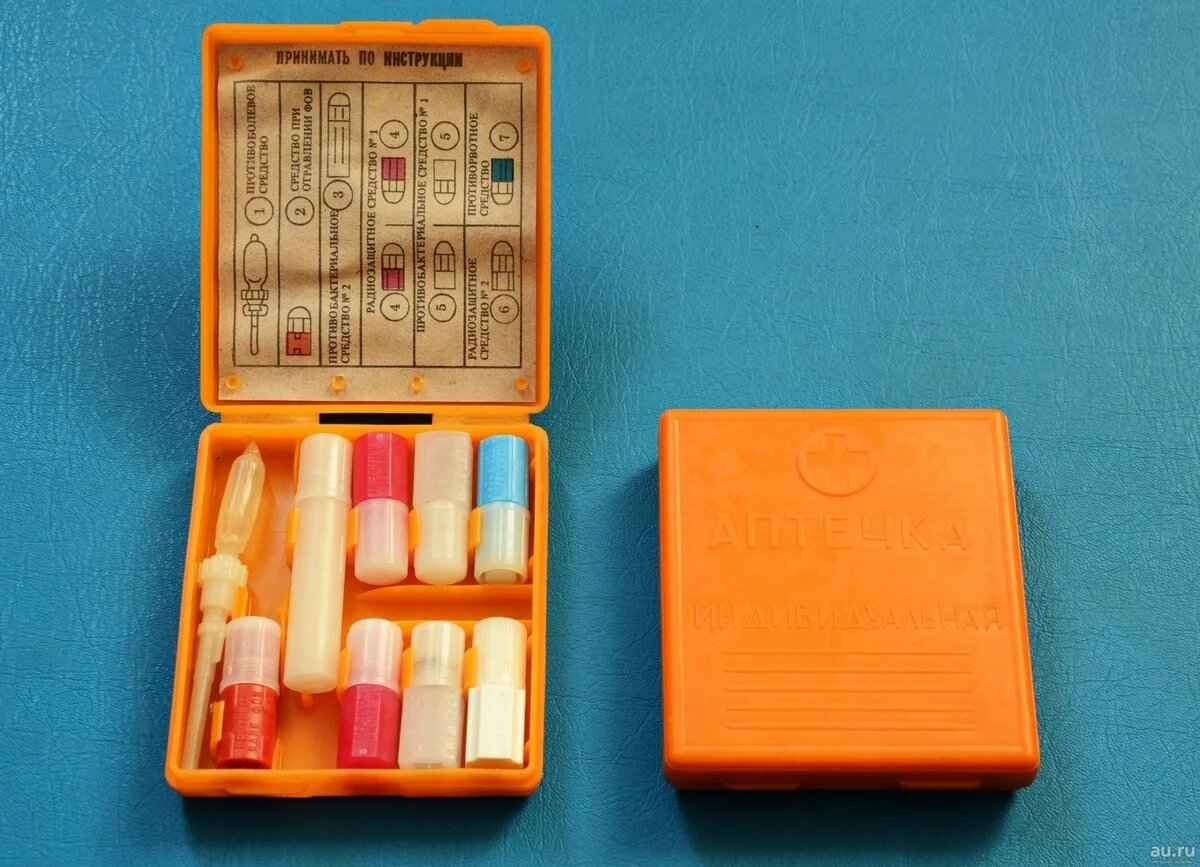
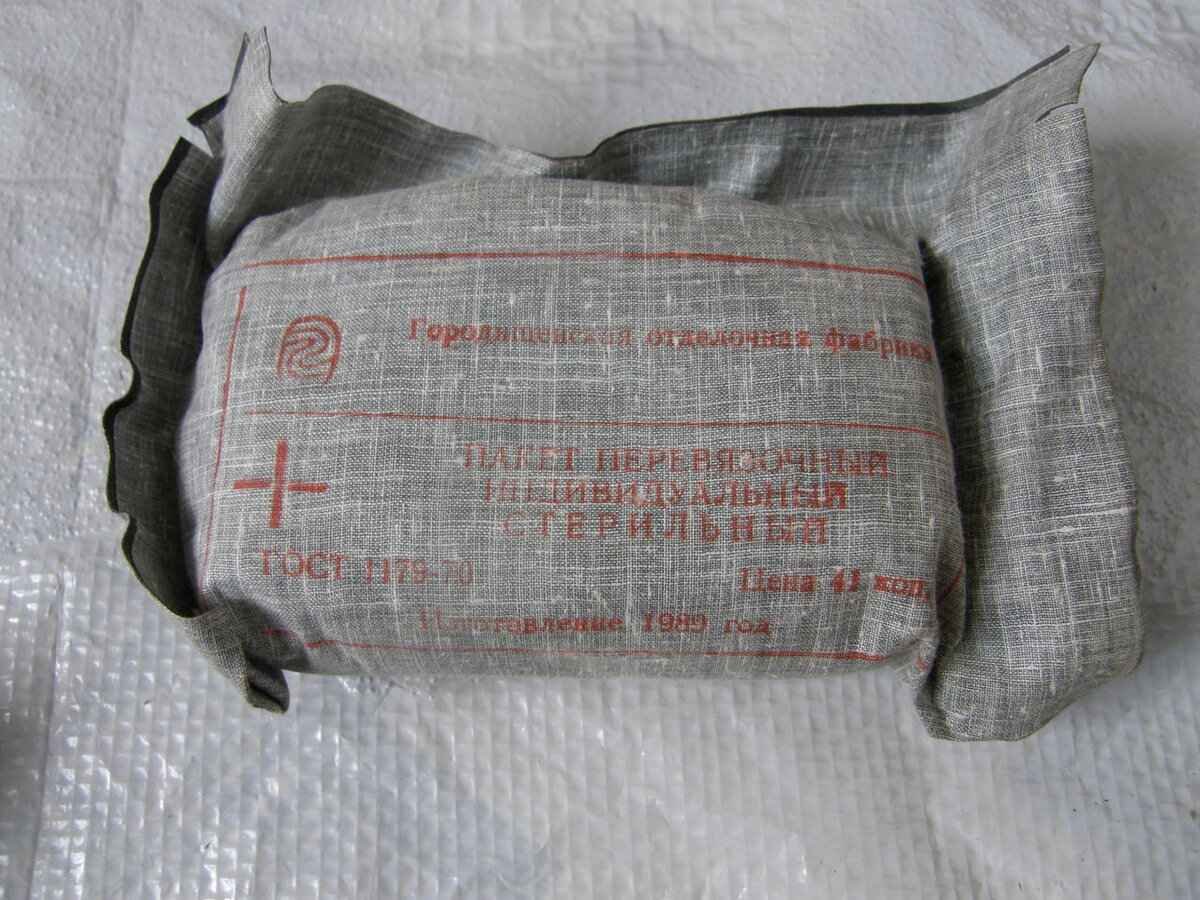
Soldiers quickly appreciated the Afghanka because it was much more practical than the older field uniform. Its many large cargo pockets allowed them to carry everything they needed during combat missions. For example, the lower side pocket of the jacket usually held a tourniquet. Some soldiers preferred to wrap it around the rifle stock, although this reduced its ability to stretch properly. The same pocket often carried hard biscuits from field rations, cigarettes, lighters, and other small items that needed to be close at hand.
Leave a Reply

Your email address will not be published. Required fields are marked *

Similar Posts