Main Elements of Red Army Uniforms Before WWII
Red Army uniforms before WWII changed a lot between 1935 and 1941 as the army prepared for war. This guide shows the main parts of Red Army uniforms before WWII, including clothing, hats, and equipment used by soldiers and officers.
More interesting articles:
Equipment Set of a Red Army Soldier in 1941 and 1945
How to Put Together a WWII Soviet Soldier and Officer Uniform for Reenactment
What Soviet Soldiers Really Ate During WW2
How Soviet Soldiers Slept During WW2 (Rare Archival Photos)
The main elements of Red Army uniforms were introduced by Order No. 176 of the People’s Commissar of Defense on December 3, 1935:
- a wool service cap with a colored band showing the branch of service, used by all troops;
- a wool side cap (pilotka) with colored piping for officers, designed to be worn with a steel helmet and for field work (enlisted soldiers had no piping);
- a dark blue side cap with light blue piping for Air Force personnel, worn instead of the service cap;
- a winter wool helmet (kept in use since 1927);
- an open-front tunic and breeches for Air Force and armored troops;
- a closed tunic and straight trousers for officers serving in staff and rear units;
- a gymnasterka (field shirt), trousers, and standard footwear for everyday service, used by all branches (introduced in 1929 and kept in use);
- a double-breasted greatcoat for all troops (except cavalry and horse artillery, which kept the older style coat).
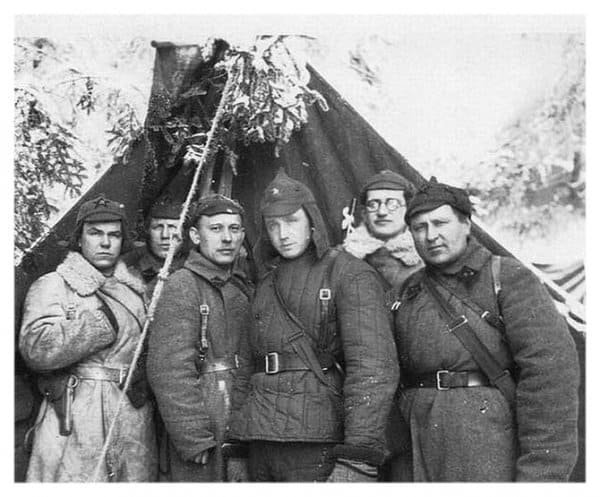
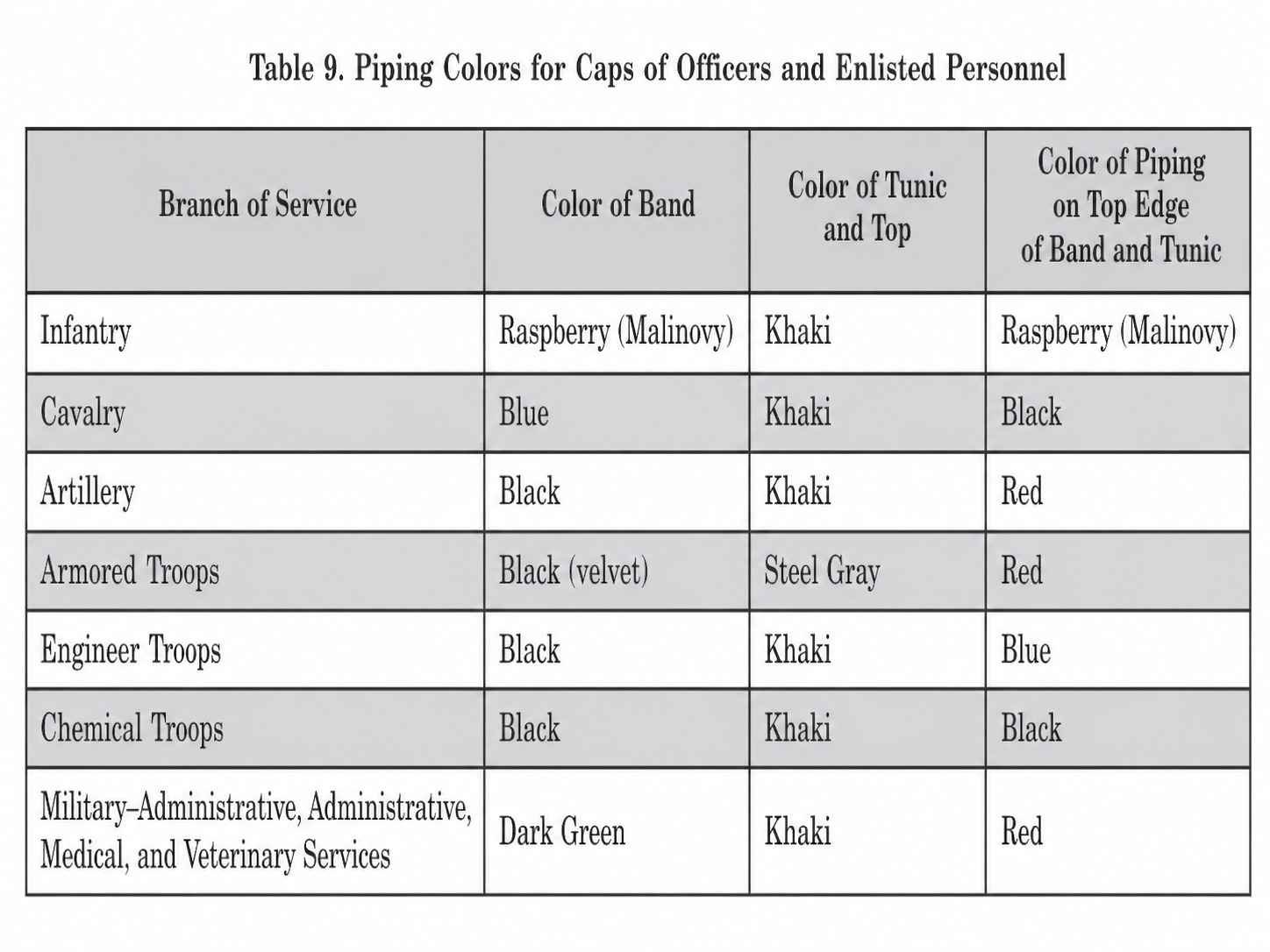
The service cap for officers was made from wool or finer fabric. For enlisted soldiers, cotton fabric was often used for the top.
The front of the cap was straight and slightly raised, with a stiff band inside supported by a spring steel frame. The black lacquered visor was long and made from fiber material. Above the visor, a black chin strap was attached to yellow brass buttons.
The top of the cap was usually a protective (khaki) color, while the band was colored depending on the branch of service. Piping along the edge of the top and the band also matched the branch color.
The pilotka cap was not a new item in the Red Army uniform system. As early as 1919, military cadets used a dark green side cap with red piping as a summer hat.
The pilotka introduced in 1935 for officers was made from wool fabric, the same as the tunic (gymnasterka). For Air Force officers, dark blue fabric was used. For armored troops, the color was steel gray. For all other branches, it was khaki.
The design of the pilotka was quite simple. It consisted of a crown and two side flaps. The crown had a cotton lining, while the flaps were made from two layers of the main fabric. Piping ran along the top edges and seams. At the front, a cloth star was sewn on, with a small red metal star attached to it.
The color of the cloth star and piping depended on the branch of service. Enlisted soldiers and junior commanders did not have piping on their caps.
The winter wool helmet was also an older item in the Red Army uniform. The first version appeared in 1918, was improved in 1922, and reached its final form in 1927.
It was made from coarse dark gray wool and consisted of a lined crown, a visor, and a fold-down neck flap that fastened with two small metal buttons. The crown was made from six triangular panels sewn together, meeting at the top and secured with a fabric-covered button.
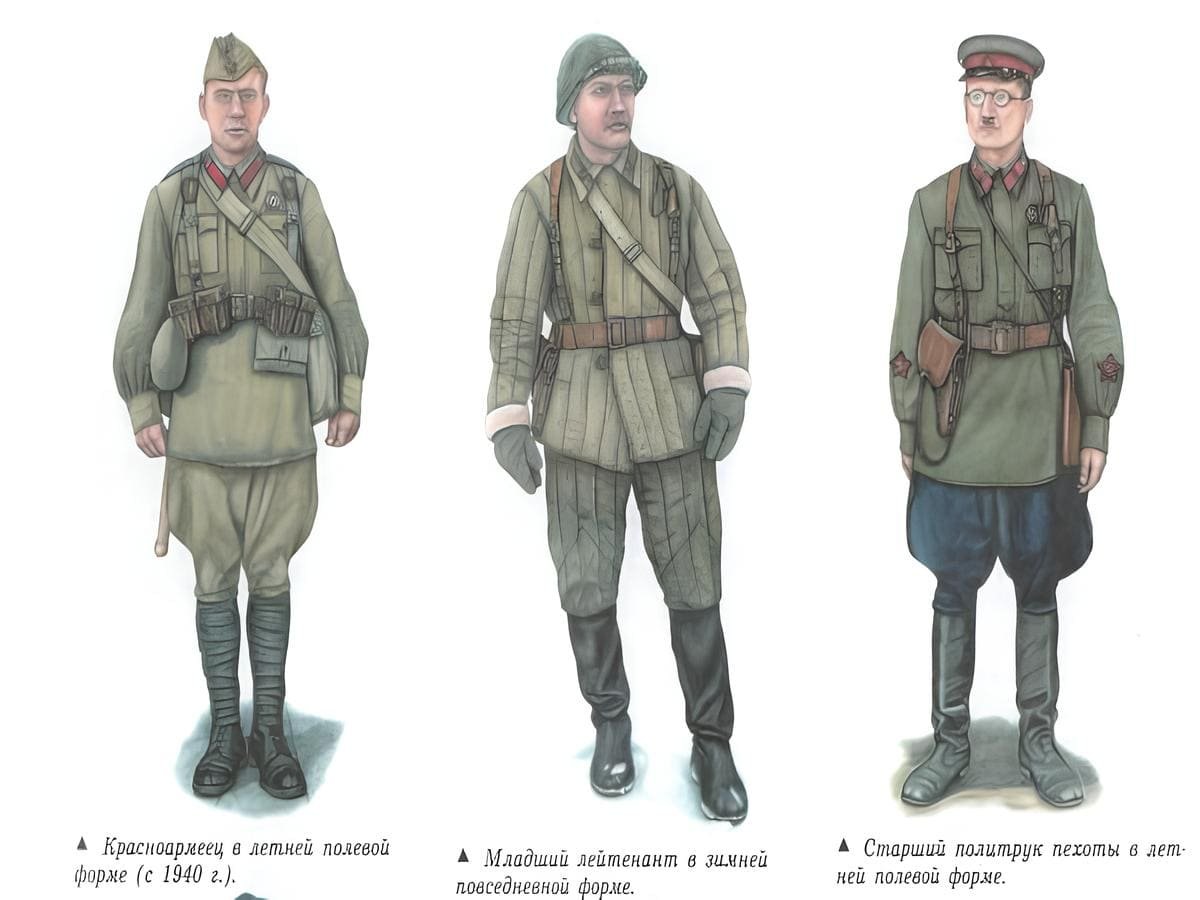
- Red Army soldier in summer field uniform with combat low boots (1940)
- Junior lieutenant in winter everyday uniform with kirza jackboots
- Senior political officer (infantry) in summer field uniform with chrome officer boots
Looking for original Soviet boots for reenacting? You can find it here:
Soviet WW2 Early RKKA Combat Low Boots
Soviet Army Classic Kirza Boots Sapogi
Chrome Soviet Officer Riding Boots
In normal use, the neck flap was folded in half across its width. The narrow ends were tucked inside and fastened to the sides of the helmet with small metal buttons.
At the front of the helmet, a regular five-pointed star made of cloth was sewn on. The color of the star depended on the branch of service, and a small red metal star was attached on top of it.
During the Winter War against Finland in 1940, it became clear that the wool helmet did not protect well against extreme cold. It was also difficult to wear together with a steel helmet.
Because of this, in July 1940, the ushanka hat was introduced to replace it.
For senior officers, the ushanka was made from wool fabric and natural gray fur. For enlisted soldiers and junior commanders, it was made from cotton fabric and artificial gray fur.
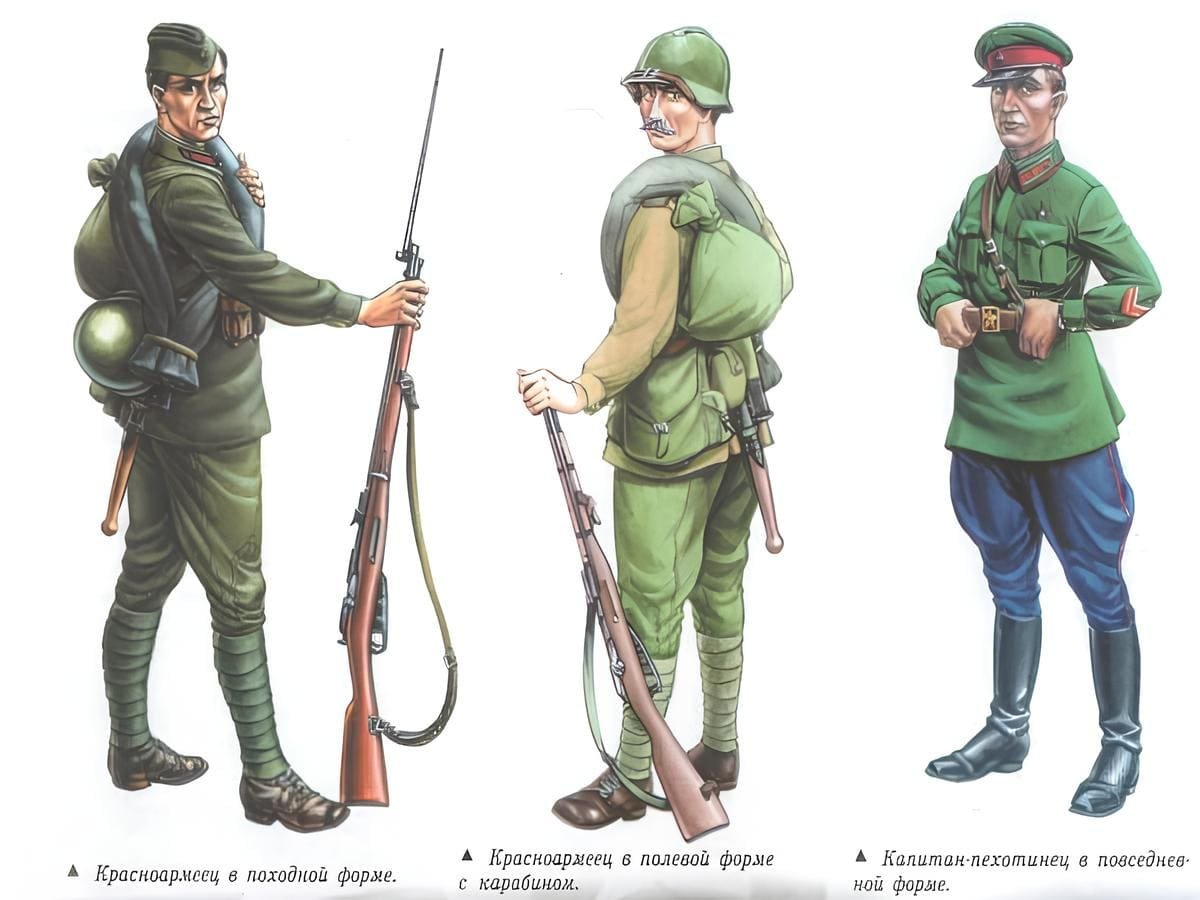
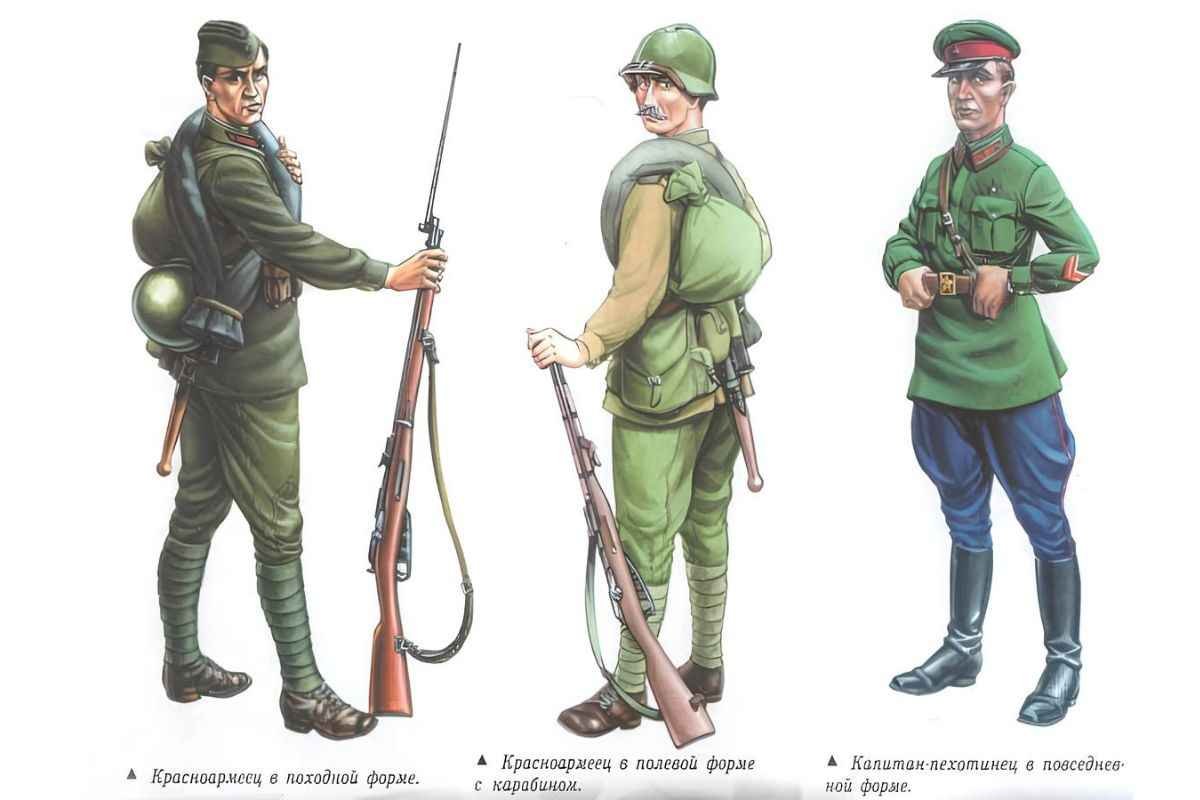
- Red Army soldier in marching uniform
- Red Army soldier in field uniform with rifle
- Infantry captain in everyday uniform
By official order, senior officers were allowed to have their ushankas made at their own expense from natural sheepskin or gray karakul fur.
Although by the winter of 1941–1942 the Red Army supply system had built up large stocks of ushanka hats, the 1927 pattern winter helmet was still widely used during the early period of the Great Patriotic War.
The introduction of a special uniform – an open tunic and breeches – for Air Force and armored troops officers showed how important tanks and aviation were considered in the coming war.
These tunics were made from wool or finer fabric. For the Air Force, dark blue fabric was used, while armored troops used gray (steel-colored) fabric.
The design of the tunics was the same. They were open-front, single-breasted, without a back strap, and fastened with four large buttons. The collar was fold-down, and the sleeves were made from two pieces.
For armored troops, the cuffs were straight. For the Air Force, the cuffs had a pointed shape. The chest pockets were patch pockets with pleats and pointed flaps, closed with one button. The side pockets were slit pockets with flaps of the same shape as the chest pockets.
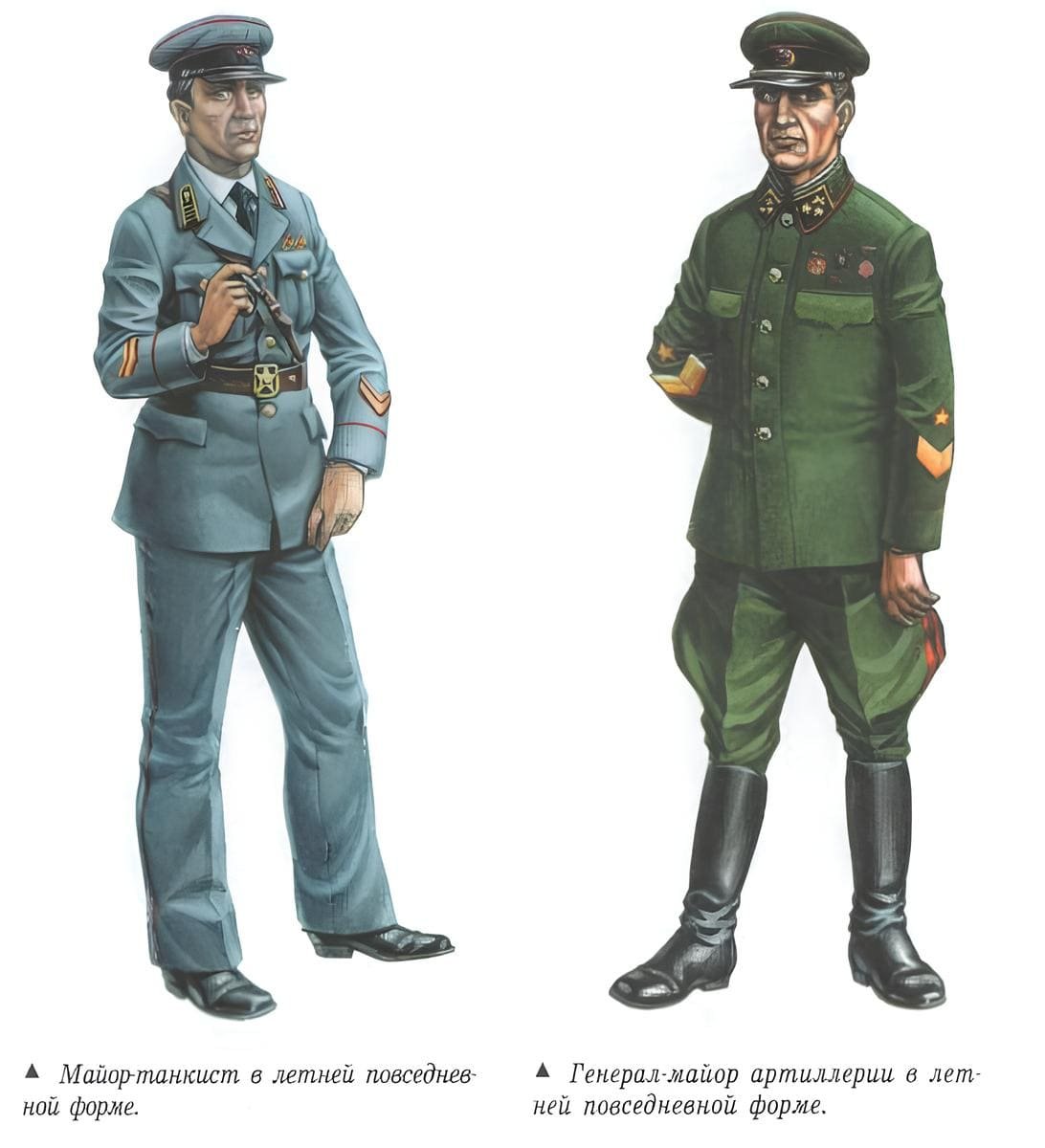
- Major of armored troops in summer everyday uniform
- Major General of artillery in summer everyday uniform
Collar tabs were sewn onto the ends of the collar. The tunic had piping on the collar and cuffs: red for armored troops and light blue for the Air Force.
The tunic was worn with a white shirt and a dark tie.
A closed tunic for officers who were not part of the Air Force or armored troops was also made from wool or similar fabric, but in a protective khaki color. It was single-breasted, without a back strap, and fastened with six large buttons. The collar was fold-down and closed with one hook. The sleeves were made from two pieces with straight cuffs.
The chest pockets were patch pockets with pleats and pointed flaps, closed with one button. The side pockets were straight slit pockets with flaps of the same shape. On the sides of the waist, two large brass hooks were sewn in for attaching a belt.
Gymnasterka-style collar tabs were also sewn onto the collar. The tunic had piping along the collar and cuffs, with the color depending on the branch of service.
At first, the rules required trousers worn with the tunic to match its color and piping. However, in early 1938, officers were allowed to wear a khaki tunic with dark blue trousers or breeches.
The gymnasterka was the most common uniform item in the Red Army.
For officers, the gymnasterka had a stand-and-fold collar, closed with two hooks. Collar tabs were attached based on the branch of service.
The front opening was covered by a placket with a hidden closure using three buttons. The lower end of the placket had a pointed shape and was reinforced with stitching.
There were two chest patch pockets with pointed flaps, each closed with one button. These pockets were usually loose and slightly puffed, often with a central pleat, and sometimes with narrow edging.
Unlike officer gymnasterkas, the pockets on enlisted versions were sewn flat along the edges.
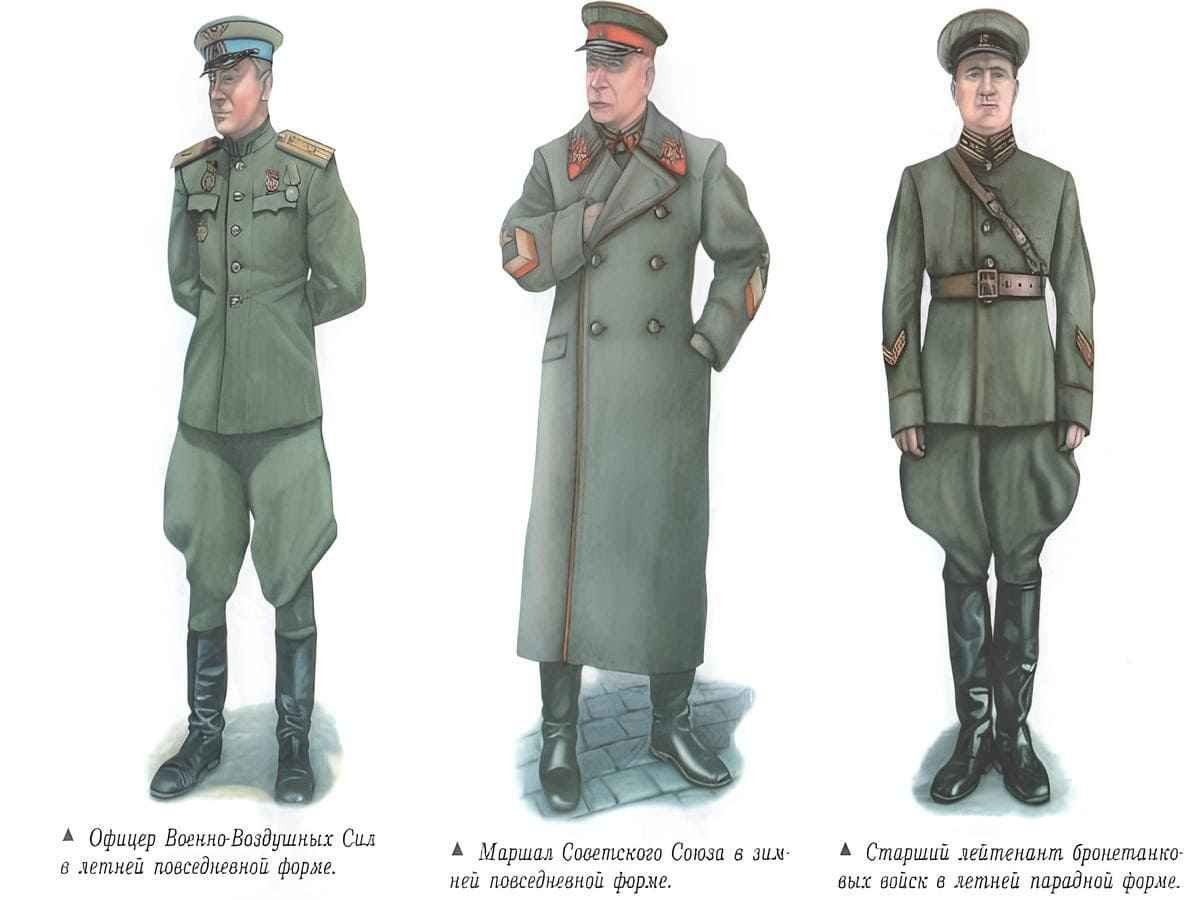
- Air Force officer in summer everyday uniform
- Marshal of the Soviet Union in winter everyday uniform
- Senior lieutenant of armored troops in summer parade uniform
The sleeves of the gymnasterka were made from two pieces and had two folds at the bottom. The cuffs were split and closed with small yellow metal buttons with a star.
A special feature of enlisted gymnasterkas was the pentagon-shaped elbow patches sewn onto the sleeves.
Officer gymnasterkas were made from wool or cotton fabric in khaki color (for armored troops, they were light gray). The collar and cuffs had piping that showed the branch of service. Enlisted gymnasterkas did not have piping.
Every Red Army soldier was issued a greatcoat.
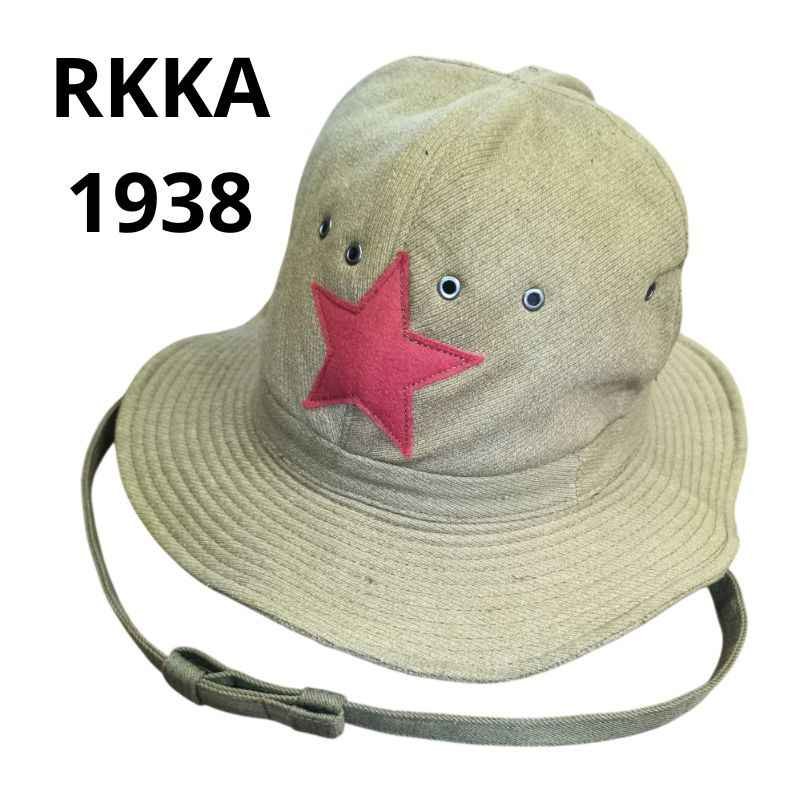
Soviet RKKA M1938 Panama Hat
Looking for an authentic Soviet summer hat? This high-quality RKKA M1938 Panama Hat is made to the original 1938 Soviet GOST standard. It features the classic khaki canvas, large red star, ventilation eyelets and adjustable chin strap, making it perfect for WWII reenactment, collectors and military history enthusiasts.
For officers, greatcoats were made from heavy wool cloth. In the Air Force they were dark blue, in armored troops steel gray, and in all other branches dark gray.
The 1935 pattern greatcoat, used by most branches except cavalry, had open lapels and two rows of buttons (four on each side), but was fastened with four buttonholes. The collar was fold-down, with branch-colored collar tabs.
The sleeves were made from two pieces with straight stitched cuffs. The pockets were slanted and covered with flaps. On the back, there was a central pleat, secured at the top with stitching. At the waist, a straight belt tab was attached with two large buttons. At the bottom back, there was a long slit fastened with four small buttons.
All buttons were standard yellow brass. The bottom edge of the coat was cut straight. The length of the coat was about 35–45 cm above the ground.
Greatcoats for cavalry and horse artillery were longer, reaching about 18–22 cm above the ground.
Their design followed the 1926 pattern cavalry coat: single-breasted, fastened with four hooks, and with a fold-down collar closed by one hook. Collar tabs showed the branch of service.
The sleeves were two-piece, with cuffs that had a pointed shape at the elbow seam. The pockets were vertical slit pockets. The back was made from one piece with a central pleat.
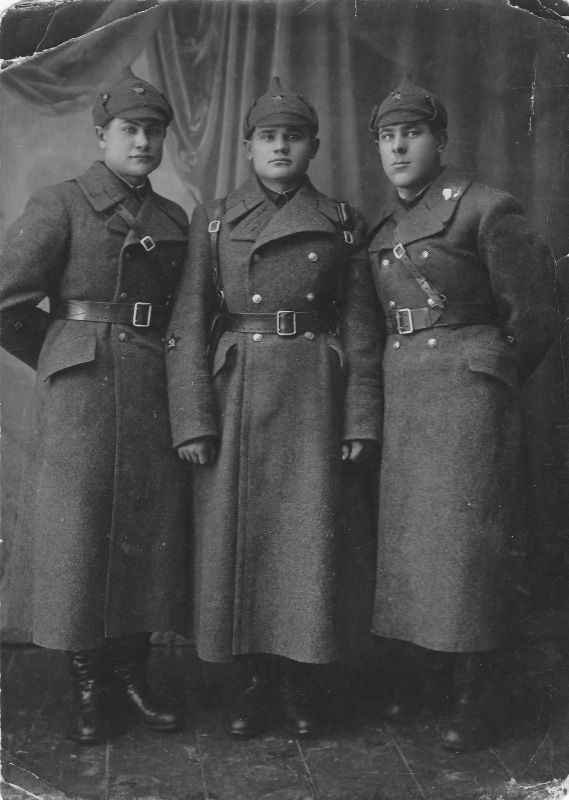
At the waist, there was a shaped belt tab fastened with two large buttons. At the bottom back, there was a long slit (about 78 cm for average height), closed with five small buttons.
In April 1936, after the creation of Terek, Kuban, and Don Cossack units, special parade uniforms were introduced for these troops.
For Terek and Kuban Cossacks, the uniform included a kubanka hat, beshmet, cherkesska coat, dark blue trousers, a burka cloak, and a bashlyk hood.
For Don Cossacks, it included a papakha hat, kazakin coat, trousers with stripes, and a bashlyk.
In May of the same year, a distinctive parade uniform was introduced for a separate cavalry brigade made up of mountain nationalities.
This uniform included a brown fur hat, a red Caucasian shirt, standard army trousers with red piping, a cherkesska, a burka cloak, Caucasian boots, and a red bashlyk. It was worn with Caucasian-style equipment with white decoration and a traditional saber (shashka).
Their everyday uniform was similar to that of regular cavalry units.
Special uniforms were also introduced for women serving in the Red Army.
In summer, they wore a khaki gymnasterka, a wool or cotton skirt, and a greatcoat that buttoned on the left side. Headgear included a dark blue beret with a star or a pilotka. Footwear included boots or shoes.
In winter, the uniform included a wool skirt, a gymnasterka, wool leg warmers, and a khaki open tunic. At first, a winter wool helmet was used, later replaced by the ushanka.
It is also important to note that in the pre-war years, many types of special clothing were developed for technical work.
These were used for operating military equipment and working at airfields, depots, and workshops. They included summer and winter clothing such as overalls, jackets, and boots for tank crews, pilots, technical staff, paratroopers, and others.
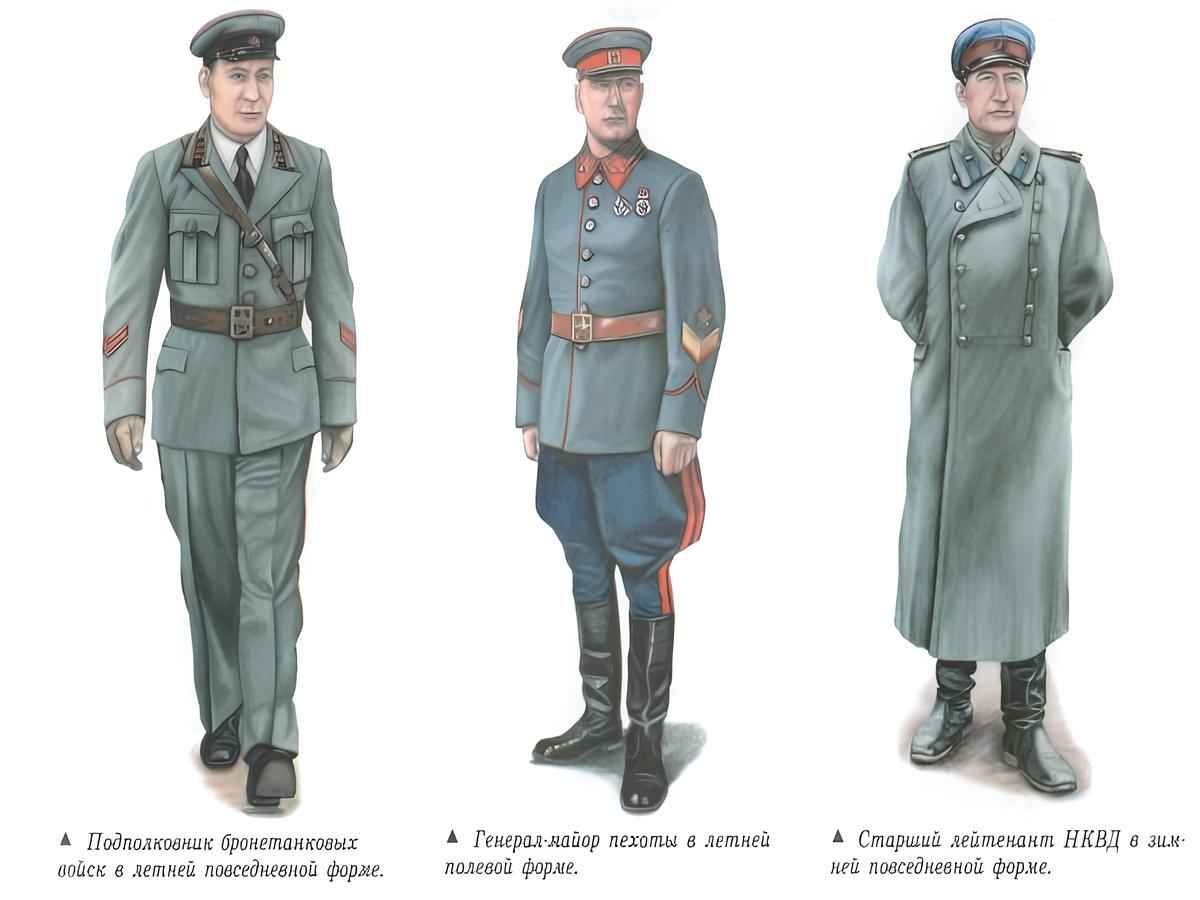
- Lieutenant Colonel of armored troops in summer everyday uniform
- Major General of infantry in summer field uniform
- Senior Lieutenant of NKVD in winter everyday uniform
-
On May 7, 1940, a decree introduced new military ranks for the highest command of the Red Army. As a result, on July 13, 1940, a special uniform was created for generals.
For the first time in the Red Army, three types of uniforms were introduced for them: parade, field, and everyday.
Parade uniform
The service cap was steel-colored, with a branch-colored band and a gold cord instead of a chin strap. In winter, a papakha made from natural gray sheepskin was worn.
The greatcoat was double-breasted, with six buttons on each side, made from high-quality steel-colored wool, with piping and collar tabs based on the branch.
The tunic was single-breasted with six buttons, made from steel-colored fabric, also with piping and collar tabs.
Trousers were worn outside the boots, made from the same fabric, with stripes showing the branch of service. When worn in formation, light blue trousers tucked into boots were used.
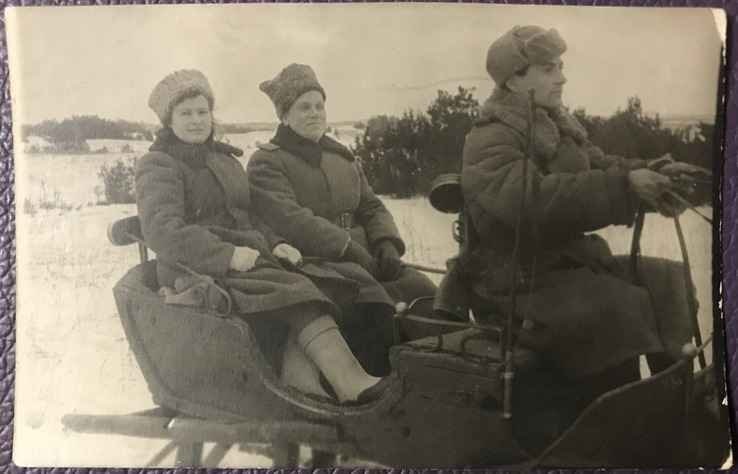
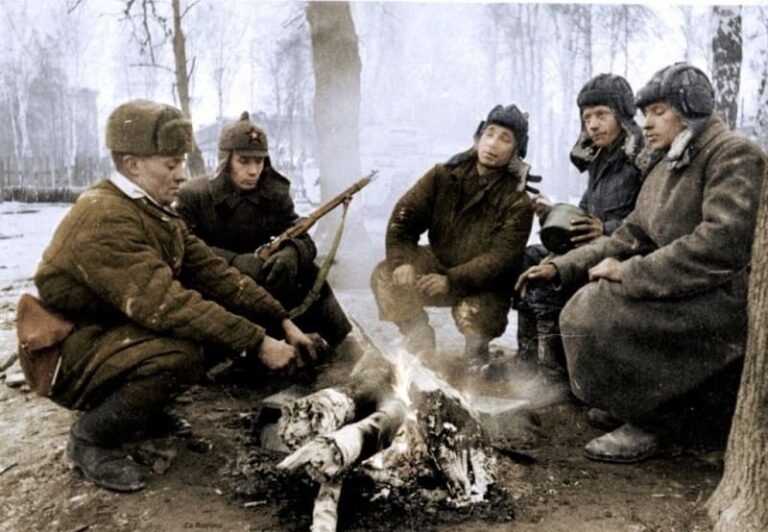
RKKA wearing papakha and ushanka fur hats in winter conditions -
Field uniform
The cap was khaki, with a branch-colored band and a black lacquered chin strap. In winter, a gray sheepskin papakha was worn.
The greatcoat was double-breasted, made from gray wool, with piping and collar tabs.
The tunic was khaki, with five buttons, and had piping and collar tabs.
Trousers were khaki, worn tucked into boots, with branch-colored stripes.
Everyday uniform
The cap was the same as the field version, but with a gold cord instead of a chin strap. In summer, a white cover was added. In winter, a gray papakha was worn.
The greatcoat and tunic were the same as the field uniform. There was also a white summer tunic with five buttons, without piping, but with collar tabs.
Trousers were worn outside the boots, made from dark blue fabric (in summer — lighter material), with branch-colored stripes.
Footwear included polished leather boots or shoes with elastic sides.
The belt was brown leather with a gold-colored brass buckle and hook fastening.
Brown leather gloves were worn.
The standard weapon was a saber (shashka), carried on a belt harness.
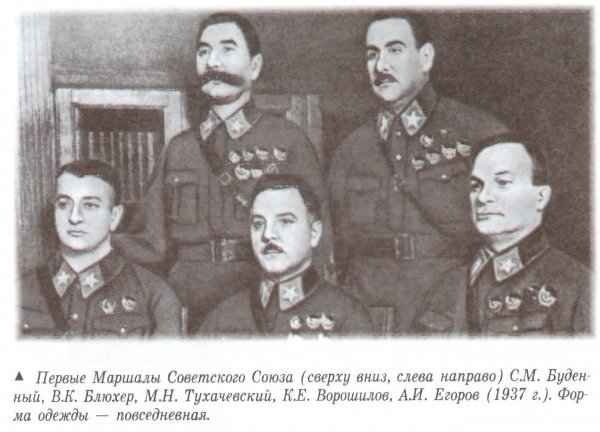
The colors of stripes, collar tabs, and piping on caps and uniforms for generals were set as follows:
- for combined arms generals – red;
- for artillery and armored generals – black (velvet) collar tabs, with red stripes and piping;
- for Air Force generals – light blue;
- for signals, engineer, technical, and supply service generals – raspberry (dark red).
Generals of artillery, armored troops, aviation, signals, engineers, technical troops, and supply services also had special branch emblems on their collar tabs.
The uniform introduced on July 13, 1940 for Marshals of the Soviet Union was mostly the same as the generals’ uniform. However, Marshals had special insignia. Their stripes, collar tabs, and piping were all red.
By mid-1940, this complex uniform system became a serious problem due to the rapid growth of the Red Army.
The Soviet economy, already working at full capacity, could not supply such a wide variety of uniforms – not even for everyday use, and especially not for wartime reserves.
For example, the Air Force was expanded by about 173,000 personnel in 1940–1941. Many of these were transferred from other branches and needed new dark blue uniforms.
The creation of tank and motorized units from cavalry formations also required major resources, as uniforms had to be changed from khaki to light gray.
To solve this crisis, on January 18, 1941, a top-secret decree was issued by the Soviet government.
The main goal was to simplify and standardize uniforms across the Red Army.
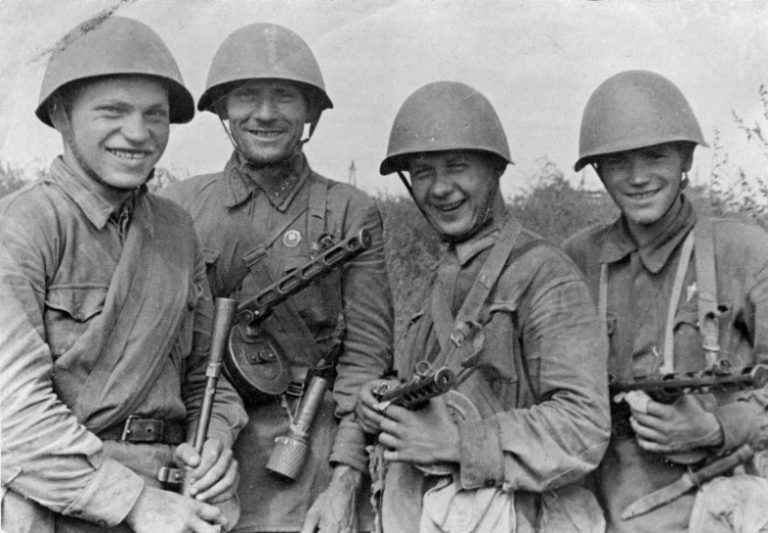
From that point, uniforms for all branches had a unified color and were divided into two types:
- peacetime uniforms
- wartime uniforms
The peacetime uniform was made as close as possible to the wartime version.
The decree removed several items from service, including:
- special uniforms for Cossack units;
- the open tunic for Air Force and armored troops;
- service caps for enlisted soldiers and cadets;
- the bashlyk hood;
- leather gaiters;
- piping on cotton uniforms and officer side caps.
At the same time, new items were introduced for the entire Red Army:
- khaki wool pilotka caps for all enlisted soldiers, junior commanders, and cadets (replacing the service cap);
- a new double-breasted greatcoat for officers with five brass buttons;
- a single-breasted dark gray wartime greatcoat for officers (similar to cadet coats);
- padded cotton jackets for all personnel (based on older cavalry designs);
- double-breasted quilted jackets for enlisted soldiers for winter wartime use;
- fur vests for officers (instead of sheepskin coats);
- wool sweaters for officers in wartime;
- a closed khaki tunic with trousers for staff and rear units (kept in service).
Economic measures were also very important.
These included:
- reducing the length of greatcoats;
- sending worn-out uniforms to the textile industry for reuse;
- using substitutes instead of leather and expensive metals.
For example:
- cotton webbing was used instead of leather for belts;
- kirza (artificial leather) was used for jackboots, bags and pouches;
- cheaper metal fittings were used for equipment.
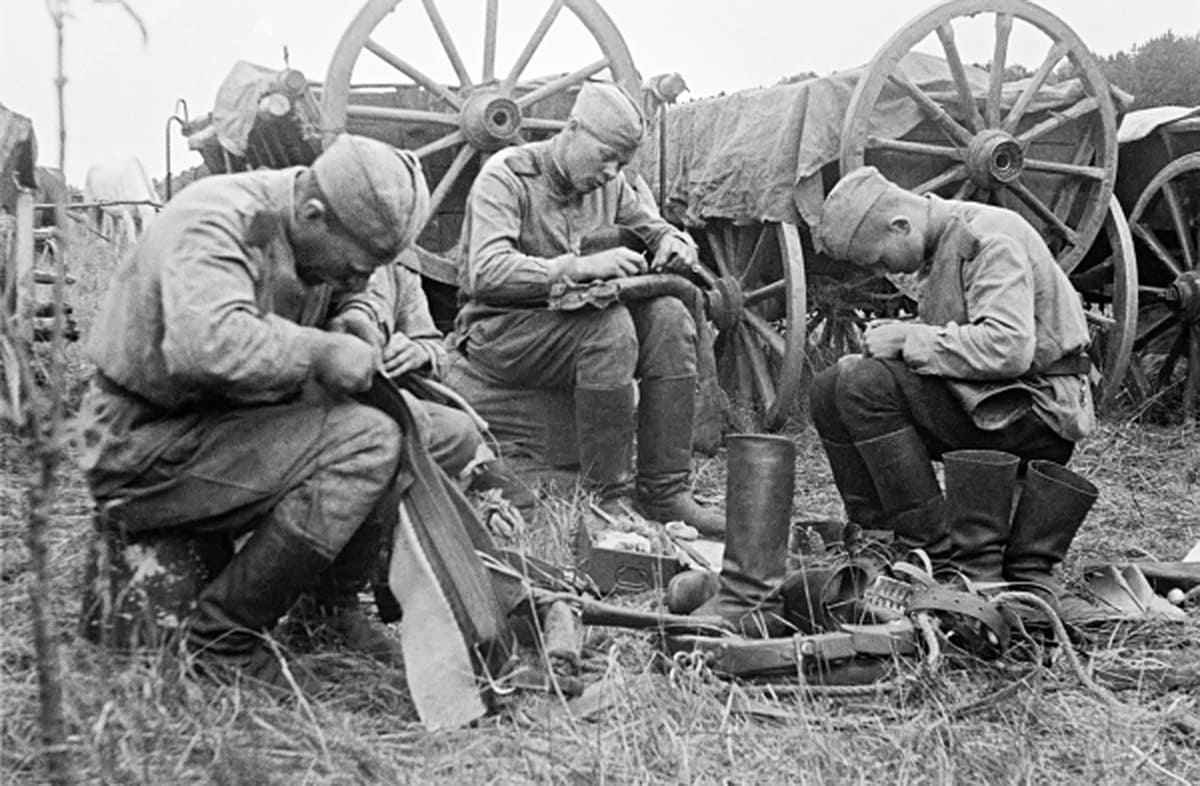
Before the war began, not all of these changes were fully implemented.
During the early period of World War II, both old and new uniform items were used at the same time.
However, the economic effect of these changes was very significant.
In one year, the Red Army saved:
- 1,492,200 meters of wool fabric;
- 1,480,800 meters of linen fabric;
- 7,964,900 meters of cotton fabric;
- 44,550,800 square decimeters of leather.
Financial savings reached 48,895,000 rubles.
More interesting articles:
Equipment Set of a Red Army Soldier in 1941 and 1945
How to Put Together a WWII Soviet Soldier and Officer Uniform for Reenactment
What Soviet Soldiers Really Ate During WW2
How Soviet Soldiers Slept During WW2 (Rare Archival Photos)
Looking original Soviet boots and accessories? Please visit here: Soviet Boots Store