History of Soviet Military Berets
The story of a man who said he took part in the events in Czechoslovakia.
I wrote that Soviet paratroopers already wore blue berets when Soviet troops entered Czechoslovakia in August 1968. According to his story, local people first thought they were UN soldiers.
But this story was not true.
In August and September 1968, the Soviet paratroopers who took part in Operation Danube wore crimson berets, not blue ones. These soldiers came from the 7th Guards Airborne Division, commanded by Major General L. N. Gorelov, and the 103rd Guards Airborne Division, commanded by Colonel A. I. Yatsenko.
For the next 30 years, this mistake was repeated many times. People changed the story and often used stories from veterans as proof.
I can say clearly: blue berets appeared only after the Soviet airborne units had left Czechoslovakia.
More interesting articles:
Soviet Panamanka Hat History – From NKVD to Afghanistan War (Part 1)
Soviet Panama Hat History – 1930s, Afghanistan & Modern Russia (Part 2)
Why Mujahideen Feared Soviet GRU Spetsnaz in the Afghan War
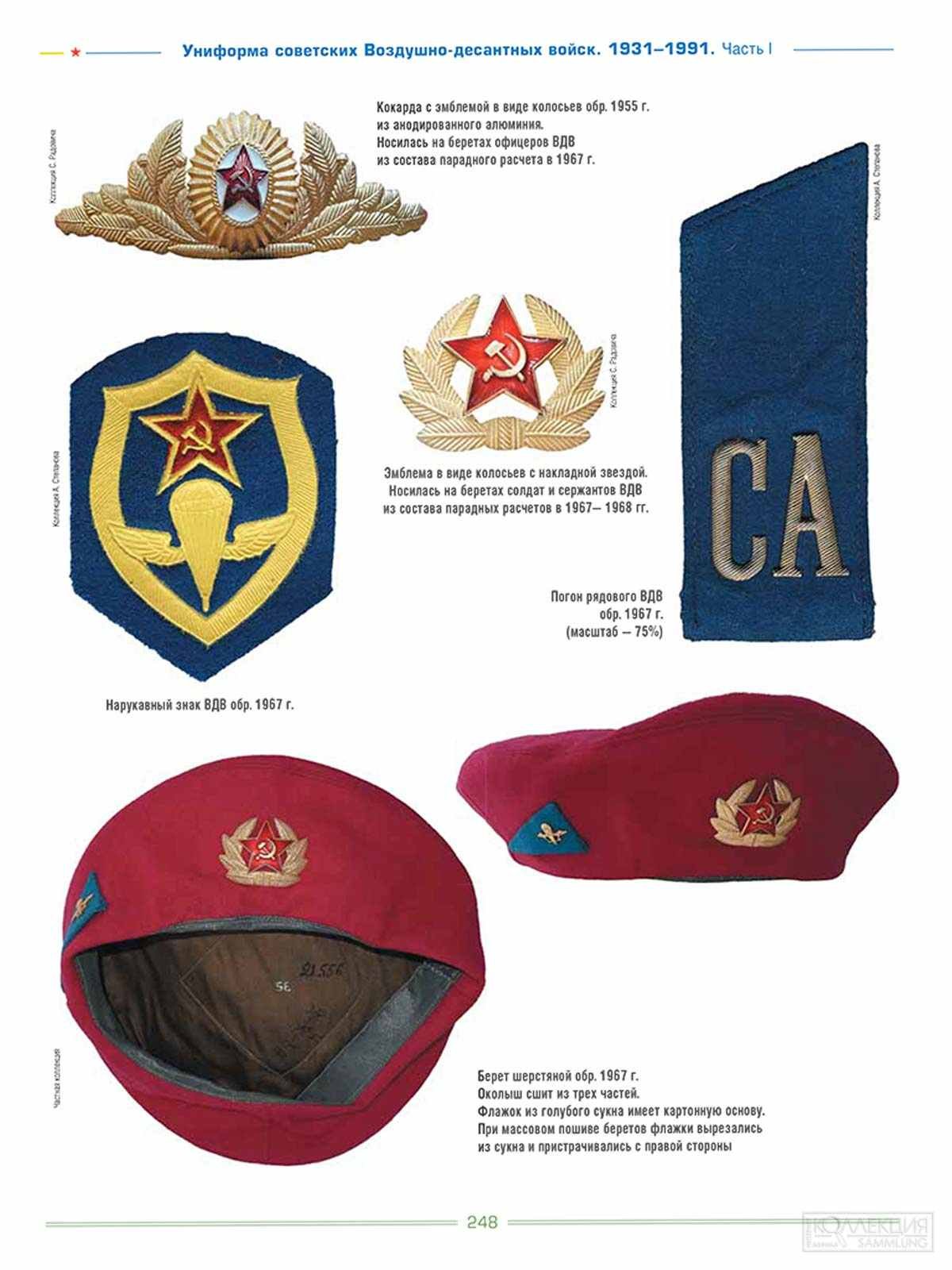
Cockade with a wreath design, model 1955, made of anodized aluminum.
It was worn on the berets of VDV officers from the 1967 parade uniform set.
Wreath-shaped badge with an attached star.
It was worn on the berets of VDV soldiers and sergeants from the 1967–1968 parade uniform sets.
VDV sleeve badge, model 1967.
Shoulder board of a VDV private, model 1967 (scale 75%).
Wool beret, model 1967.
The headband is made of three parts.
The small blue cloth flag has a cardboard base.
During mass production of the berets, the flags were cut from cloth and attached to the right side.
The beret is one of the most common military hats in the world. In the Soviet Armed Forces, berets became popular much later than in many other countries.
Soviet military berets can be divided into four main groups:
- Berets for female soldiers. These were worn as summer headwear with different uniforms. They were first introduced in the Red Army on November 2, 1941, and in the Soviet Navy on August 14, 1942.
- Berets for elite troops. These berets became an important part of the uniform of the Soviet Marines, VDV Airborne Forces, and special units of the Internal Troops.
- Berets for field uniforms. These were used by Soviet border troops and tank crews.
- Berets for work uniforms. These were worn by sailors on surface ships and by some Soviet Air Force ground specialists.
Soviet officers serving as United Nations observers in the Middle East also wore berets. They wore the standard blue UN beret with the UN badge. The blue color was a symbol of peace.
This article will mainly look at the second and third groups because they are the most interesting.
Soviet VDV and Marine berets from the history of military berets in the USSR.
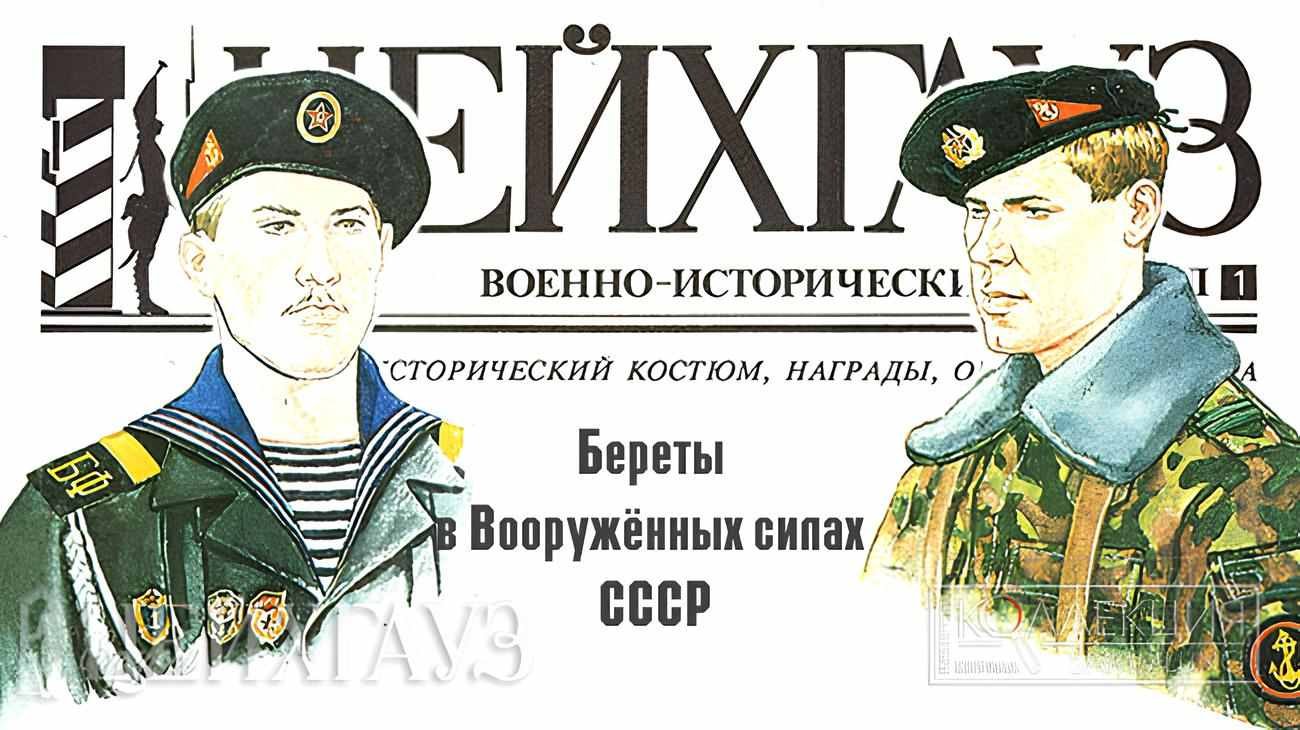
Soviet Marine Black Beret
On November 5, 1963, Order No. 248 of the Soviet Ministry of Defense introduced a new field uniform for the Soviet Marines.
The new uniform included a black beret. Officers wore wool berets. Sergeants and sailors wore berets made from cotton fabric.
The beret had a leather-like band around the bottom. A small red flag with a gold anchor was placed on the left side. Officers had a Soviet Navy badge on the front, while sailors and sergeants had a red star.
At the November 1968 military parade, Soviet Marines wearing their field uniforms marched through Red Square for the first time.
For this parade, the red flag was moved from the left side of the beret to the right side. This was done because the Mausoleum and the stands for important guests were on the right side of the marching troops.
The red star on the berets of sailors and sergeants also received a wreath of laurel leaves.
It is not clear who ordered these changes. It may have been Soviet Defense Minister Marshal A. A. Grechko, or the changes may have been approved by him. No official written order about them has been found.
After that, Soviet Marines marching in Moscow parades continued to wear these special parade versions of the beret and field uniform.
On July 26, 1969, Order No. 191 introduced a new badge for the berets of sailors and sergeants. It was a black oval badge with a gold border and a red star in the center.
On March 4, 1988, new uniform rules were introduced by Order No. 250. The oval badge was replaced by a red star inside a wreath.

Original Soviet Army Kirza Boots
Original Soviet Army Kirza boots, also known as Sapogi. Classic USSR military jackboots in new condition, available in sizes 36–48.
Soviet VDV Berets
In most countries, airborne troops traditionally wear crimson or maroon berets. The crimson beret of the Soviet VDV was designed by artist A. B. Zhuk.
On June 30, 1967, VDV commander Colonel General V. F. Margelov approved Zhuk’s designs for a new uniform for Soviet paratroopers. The designs included two different berets.
For everyday use, paratroopers were supposed to wear a khaki beret with a red star. However, this version was never produced.
Margelov approved the drawing of the crimson beret for military parades in Moscow. On the right side was a small blue flag with the VDV emblem. Soldiers wore a star with a wreath on the front. Officers wore an officer’s badge and a winged aviation emblem.
Crimson berets began to arrive in VDV units in August and September 1967.
On November 7, 1967, Soviet paratroopers wearing their new uniforms and crimson berets marched through Red Square for the first time.
Soon after this, the crimson beret was replaced by the famous blue VDV beret.
The original text claimed that Soviet paratroopers already wore blue berets when Soviet troops entered Czechoslovakia in August 1968. However, as explained earlier in this article, this information was later found to be incorrect. Soviet paratroopers in Operation Danube still wore crimson berets. The blue beret appeared later in 1968.
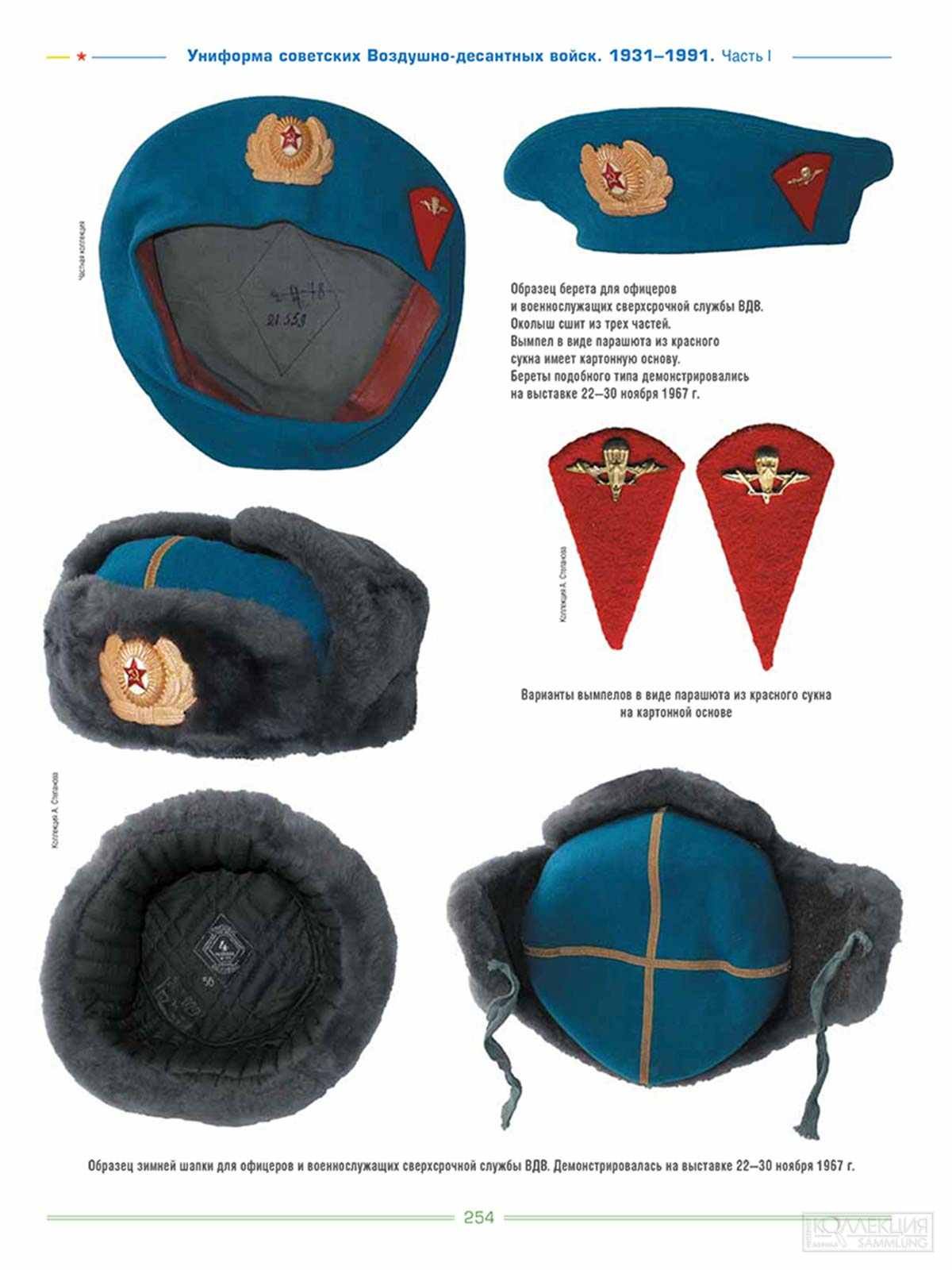
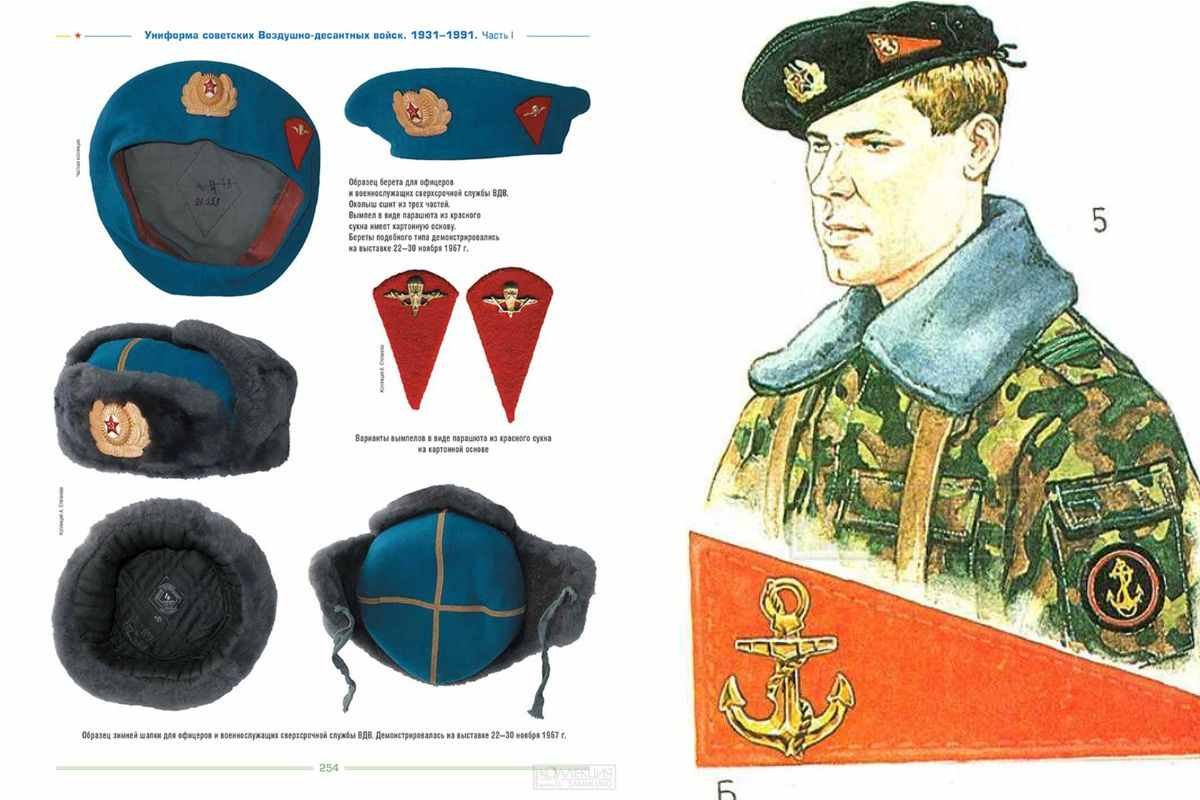
Beret model for officers and long-service servicemen of the VDV.
The headband is made of three parts.
The VDV badge and parachute patch are made of red wool cloth with a cardboard base.
Berets of this type were shown at an exhibition on November 22–30, 1967.
Variants of the parachute-shaped VDV patch made of red wool cloth on a cardboard base.
Winter hat model for officers and long-service servicemen of the VDV. Shown at an exhibition on November 22–30, 1967.
On July 26, 1969, Order No. 191 of the Soviet Ministry of Defense introduced new military uniform rules. This was the first time the blue VDV beret officially appeared in the uniform regulations.
Soldiers and sergeants wore a red star with a wreath on the front of the beret. Officers wore an Air Force officer’s badge.
The official drawing did not show the small red VDV flag on the side of the beret. But soldiers in Guards units still wore it on the left side. During military parades in Moscow, it was moved to the right side.
The idea of using these small flags came from VDV commander V. F. Margelov.
The earlier blue flags used on crimson berets had official sizes. The new red flags were different. Each military unit made its own, so their size and design could vary.
On March 4, 1989, new uniform rules officially allowed all soldiers of the Airborne Forces, air assault units, and special forces units to wear the small flag on their berets.

Original Soviet VDV Blue Beret
Original 1991 Soviet VDV blue beret made in the USSR. Features the classic Soviet Airborne Forces badge and red VDV insignia.
Green Berets of the Soviet Border Troops
The Soviet Border Troops also experimented with berets.
In the summer of 1976, cadets from a Border Troops training unit in Kaliningrad and the Higher Border Troops Command School in Golitsyno tested a new uniform for one month.
It was similar to a VDV uniform. It included an open cotton jacket, a striped shirt with white and green stripes, and a green beret.
However, this experiment was not approved by the Soviet Ministry of Defense, and the uniform was not widely introduced.
The idea returned many years later. In April 1991, soldiers of the KGB Border Troops airborne division stationed in Vitebsk received similar green berets.
A small blue flag with the VDV emblem was worn on the left side of these berets.
Maroon Berets of Soviet Special Forces
Growing ethnic conflicts in the Soviet Union created a need for highly trained soldiers who could carry out special operations. This led to the creation of special forces units of the Soviet Internal Troops.
In May 1989, officials of the Internal Troops and the Ministry of Internal Affairs prepared a proposal for the Minister of Internal Affairs. He approved the maroon beret as a special symbol for soldiers of these special forces units.
Soldiers and sergeants wore a red star with a wreath on the beret. Officers wore an officer’s badge.
Unlike the berets of the Soviet Marines and VDV, the maroon beret was a sign of special qualification. A soldier could receive it only after completing special training and passing difficult tests.
Before earning the maroon beret, new soldiers wore a khaki beret with a small field star.
These berets had the same basic design. They had a high front, a leather-like band around the bottom, and two ventilation holes on each side.
Black Berets of Soviet Tank Crews
On April 27, 1972, Order No. 92 of the Soviet Ministry of Defense introduced a special uniform for Soviet tank crews.
The uniform included a black beret. Its shape was almost the same as the Soviet Marine beret, but the original design did not have the leather-like band around the bottom.
However, berets supplied to the troops did have this band.
Soldiers and sergeants wore a red star on the beret. Officers and warrant officers wore an officer’s badge.
On April 9, 1974, Order No. 85 added a wreath around the star.
In 1982, a new khaki uniform appeared together with the black uniform. It included a khaki cotton beret.
Berets of the Soviet Border Troops
In the mid-1980s, Soviet Border Troops also wore a camouflage beret with their field uniforms.
Later, the camouflage beret was replaced by a field cap.
Soldiers and sergeants wore a star with a wreath on the beret. Officers and warrant officers wore a field badge.
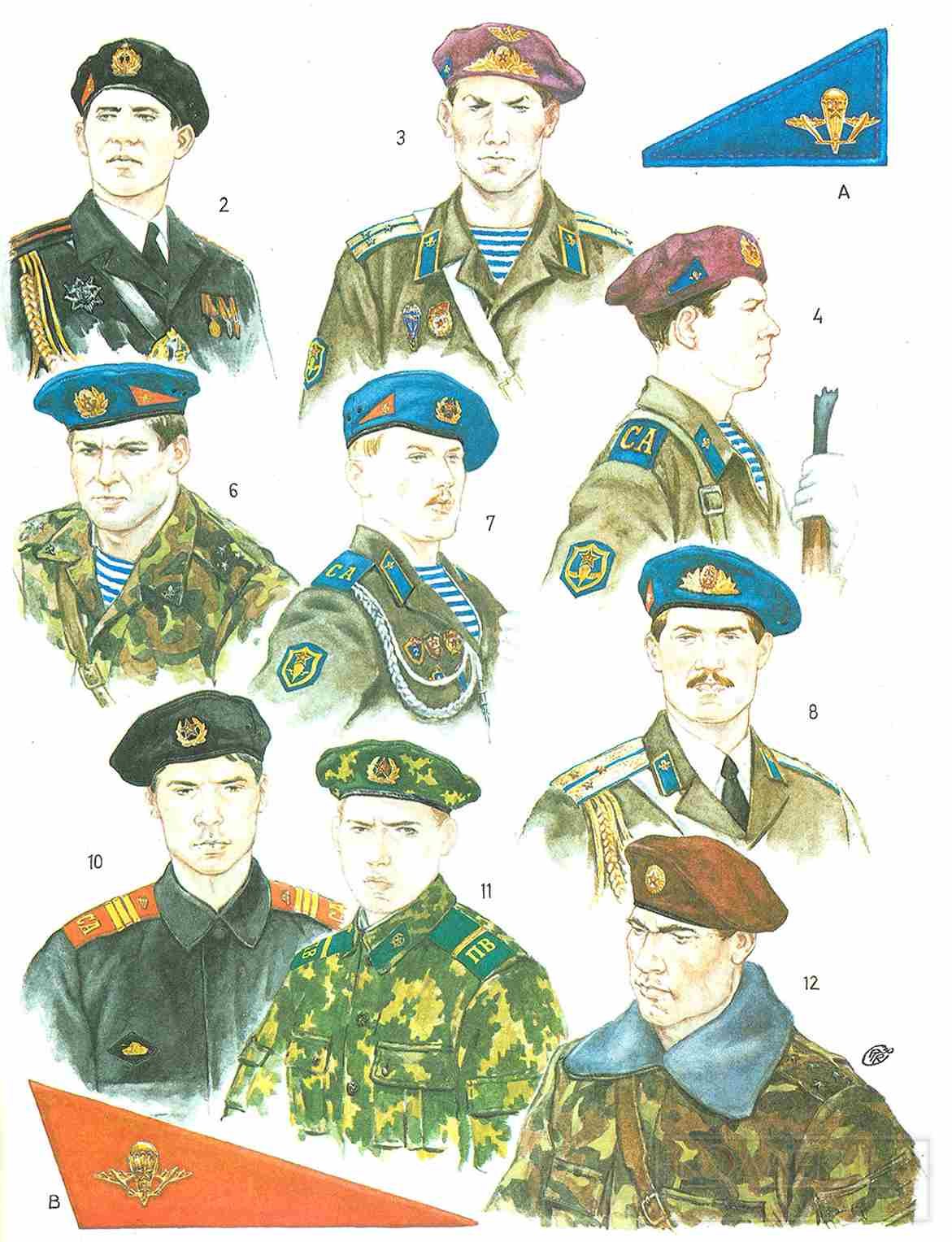
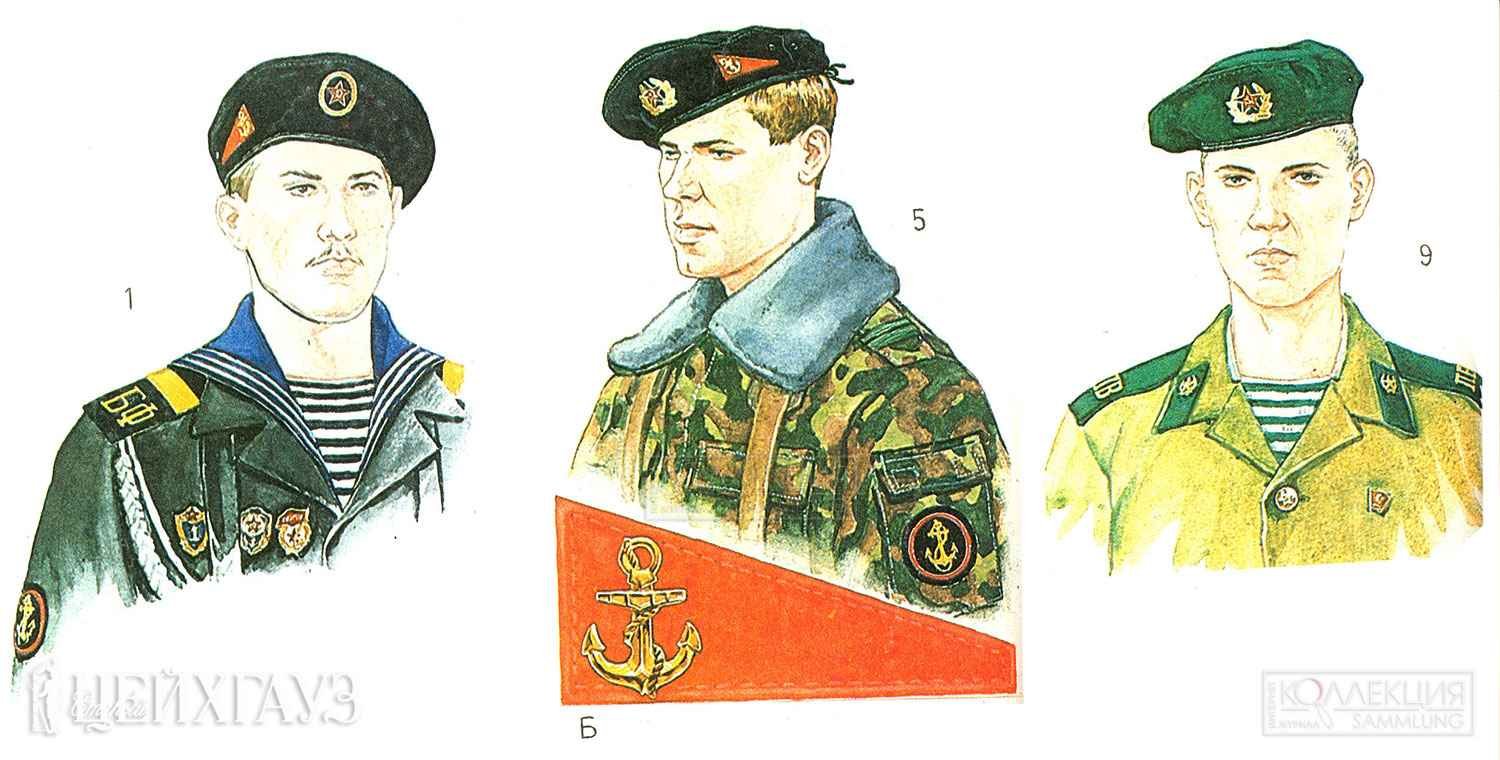
2. Lieutenant Colonel of the Soviet Marines at a parade in Moscow (from 1972). 3. Guards Senior Lieutenant of the VDV at a parade in Moscow (November 1967). 4. VDV Private at a parade in Moscow (November 1967). 6. VDV Senior Lieutenant in summer field uniform (from 1988). 7. Guards VDV Private at a parade in Moscow (from 1972). 8. VDV Senior Lieutenant at a parade in Moscow (from 1972). 10. Sergeant of a tank battalion in a motor rifle regiment (from 1973). 11. Corporal of the Soviet Border Troops in field uniform (mid-1980s). 12. Captain of an Internal Troops Special Forces unit in winter field uniform (1989). A – Beret flag used by Soviet VDV troops (1967). B – Beret flag used by Soviet VDV troops (1968–1988).
- Guards Senior Sergeant of the Soviet Marines at a parade in Moscow (1972–1980)
- Lieutenant Colonel of the Soviet Marines at a parade in Moscow (from 1972)
- Guards Senior Lieutenant of the VDV at a parade in Moscow (November 1967)
- VDV Private at a parade in Moscow (November 1967)
- Junior Sergeant of the Soviet Marines in winter field uniform (from 1988)
- VDV Senior Lieutenant in summer field uniform (from 1988)
- Guards VDV Private at a parade in Moscow (from 1972)
- VDV Senior Lieutenant at a parade in Moscow (from 1972)
- Private of the Soviet Border Troops (1976)
- Sergeant of a tank battalion in a motor rifle regiment (from 1973)
- Corporal of the Soviet Border Troops in field uniform (mid-1980s)
- Captain of an Internal Troops Special Forces unit in winter field uniform (1989)
A – Beret flag used by Soviet VDV troops (1967)
B – Beret flag used by Soviet Marines (from 1963)
C – Beret flag used by Soviet VDV troops (1968–1988)

Russian VDV Summer Telnyashka
Classic blue and white striped sleeveless Telnyashka in the traditional VDV Airborne style. Made from lightweight 100% cotton fabric for comfortable summer wear.
More interesting articles:
Why Mujahideen Feared Soviet GRU Spetsnaz in the Afghan War
Soviet Spetsnaz Uniform in Afghanistan (1979–1989)
What Soviet Soldiers Really Ate in the Afghan War
Soviet Afghanka Uniform. History, Features, and Use in Afghanistan
Looking for original Soviet boots and accessories? Please visit here: Soviet Boots Store