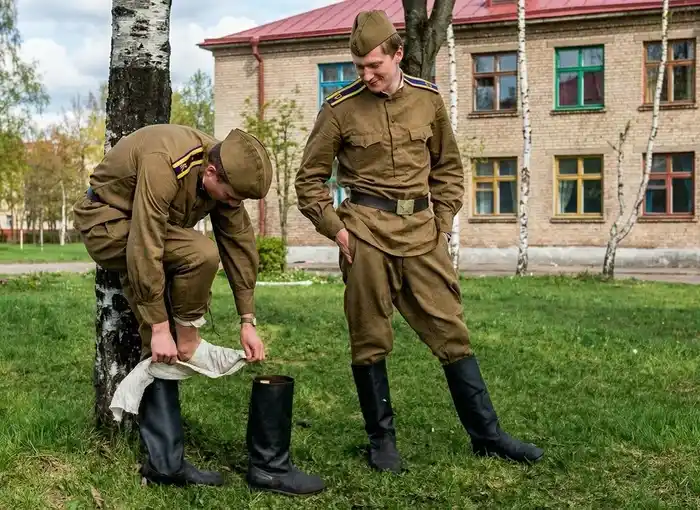
WWII Soviet soldier and officer uniform
Check Soviet WW2 uniforms guides:
How to Put Together WWII Soldier Uniforms for Reenactment (Part 2: Germany, USA, and More)
Equipment Set of a Red Army Soldier: 1941 Vs. 1945
World War II Soviet Uniforms: illustrations from P. Darman’s book
Soviet RKKA Uniforms of the Red Army Soldiers, 1941-1942
Quick navigation
- Frontline Soldier
- Recruit
- Private, Red Army, 1939–1941
- Soviet Infantry, 1941
- Soviet Infantry Officer, 1943
- Red Army Reconnaissance Officer, 1943
- NKVD Lieutenant, 1940–1941
- Padded Jacket (Vatnik / Telogreika), 1941 — NKO Order No. 283
- Red Army Soldiers Wearing Vatniks, 1941
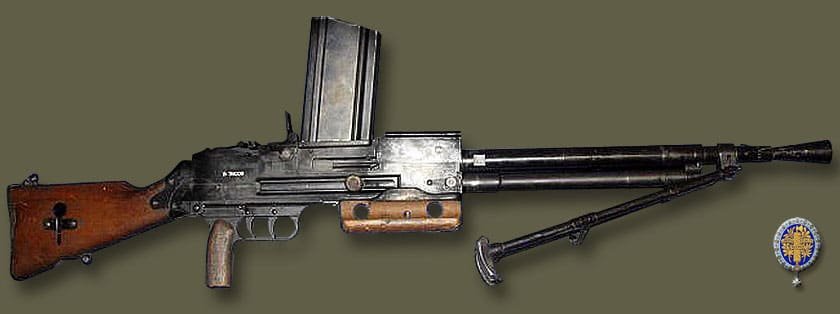
- Chatellerault Mle 1924/29 Machine Gun
- More Soviet WW2 uniform guides
- Check more articles
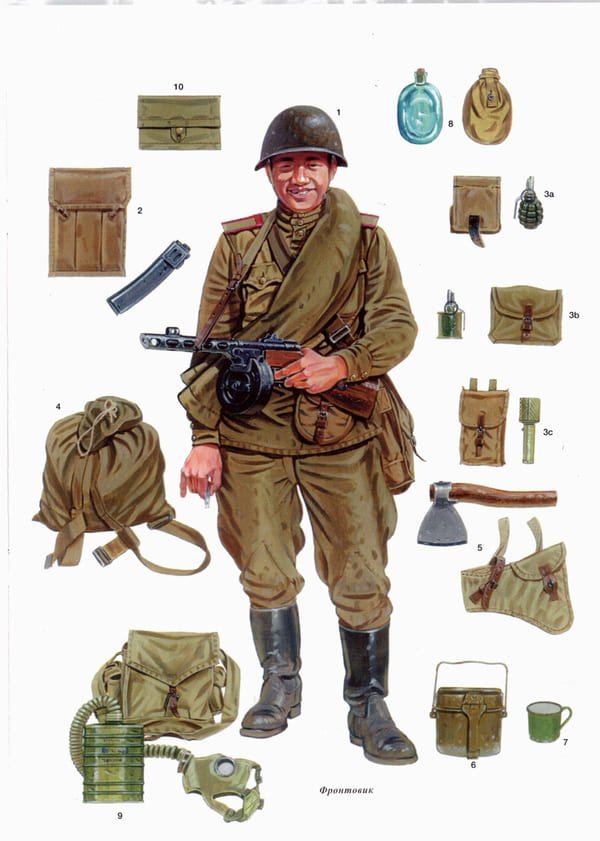
Frontline Soldier
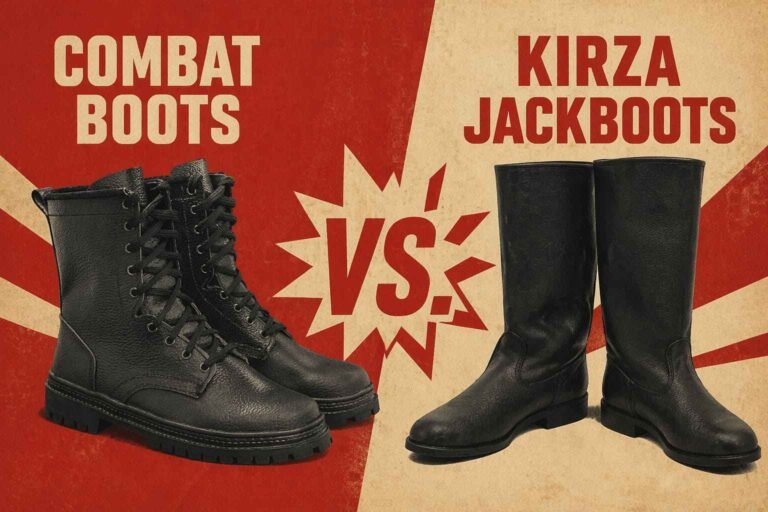
Looking for Soviet kirza ‘Dot’ soles boots? You can get them here → [Soviet ‘Dot’ soles boots]
This illustration shows a frontline Red Army soldier, a corporal (1), wearing the 1943 pattern uniform. Rank insignia were moved from collar tabs to shoulder boards.
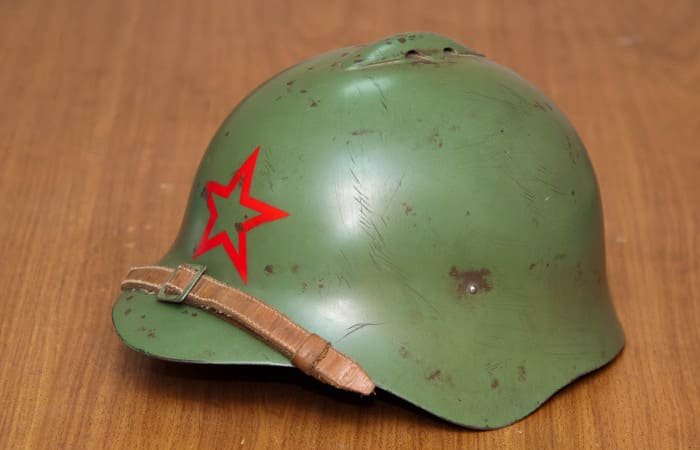
The SSh-40 steel helmet became widely used starting in 1942. Around the same time, submachine guns began to be issued to troops in large numbers. This corporal is armed with a 7.62 mm Shpagin submachine gun, the PPSh-41, fitted with a 71-round drum magazine.
Spare magazines are carried in magazine pouches (2) on the waist belt, next to a pouch for three hand grenades. In 1944, alongside the drum magazine for the PPSh-41, a 35-round box magazine began to be produced. It was also suitable for the PPS-43. Box magazines were carried in three-cell magazine pouches.
Grenades were usually carried in pouches on the waist belt. At the beginning of the war, single-grenade pouches were used; here an F-1 grenade (3a) is shown. More practical three-grenade pouches appeared later; the illustration shows a pouch with an RG-42 fragmentation grenade (3b).
Pouches with two compartments were intended for RGD-33 high-explosive grenades; here a grenade is shown with the fragmentation sleeve fitted (3c).
The Model 1942 haversack (4) had a very simple, almost primitive design. Each squad had an axe (5), which was carried by one of the soldiers on the waist belt in a special sheath.
Also shown is a new-type mess tin (6), similar to the German model, and an enamelled mug (7). Due to shortages of aluminum, glass canteens with cork stoppers (8) were also used. The glass could be green, brown, or clear. Canteens were attached to the belt using a fabric cover.
The BN gas mask (9) was equipped with a speech diaphragm and an improved TSh filter. The gas mask bag had two side pockets for spare eyepieces and a pencil with anti-fog compound.
A rear ammunition pouch (10) was attached to the waist belt on the soldier’s back and could hold six standard five-round stripper clips.
Recruit

Looking for original Soviet low RKKA boots? You can get them here → [Soviet low boots]
Private (1 and 2) wearing the summer field uniform model of 1936 with rank insignia introduced in 1941. The helmet is the 1936 model, paired with lace-up boots and leg wraps. The field equipment is also the 1936 pattern. Almost all gear of this type was lost during the first year of the war.
The equipment includes a field pack, a rolled greatcoat with shelter-half (plashch-palatka), a ration bag, double-cell ammunition pouches, an entrenching tool, a canteen, and a gas mask bag.
The Red Army soldier is armed with a 7.62 mm Mosin–Nagant rifle model 1891/30. The bayonet is fixed in reverse position for easier carrying.
Shown separately are: a Bakelite identification capsule (3), an entrenching tool with cover (4), an aluminum canteen with cover (5), and a bandolier designed to hold fourteen rifle clips (6).
Later in the war, canvas equipment replaced leather gear. Each pocket of the ammunition pouch held two standard five-round stripper clips (7).
The simple mess tin (8) could be used both as a cooking pot and as a bowl. Lace-up boots (9) were worn with leg wraps (10).
The BS gas mask with its bag (11) featured a raised section between the eyepieces, allowing the soldier to wipe fogged lenses from the inside and clear the nose. The gas mask was equipped with a T-5 filter.
Private, Red Army, 1939–1941
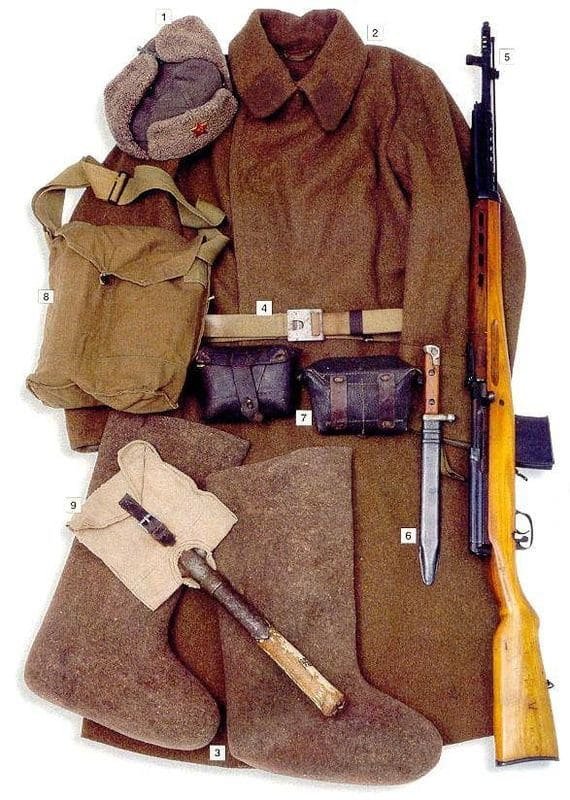
Private of the Red Army, 1939–1941 period.
Looking Soviet Ushanka? You can order here: (Soviet Ushanka)
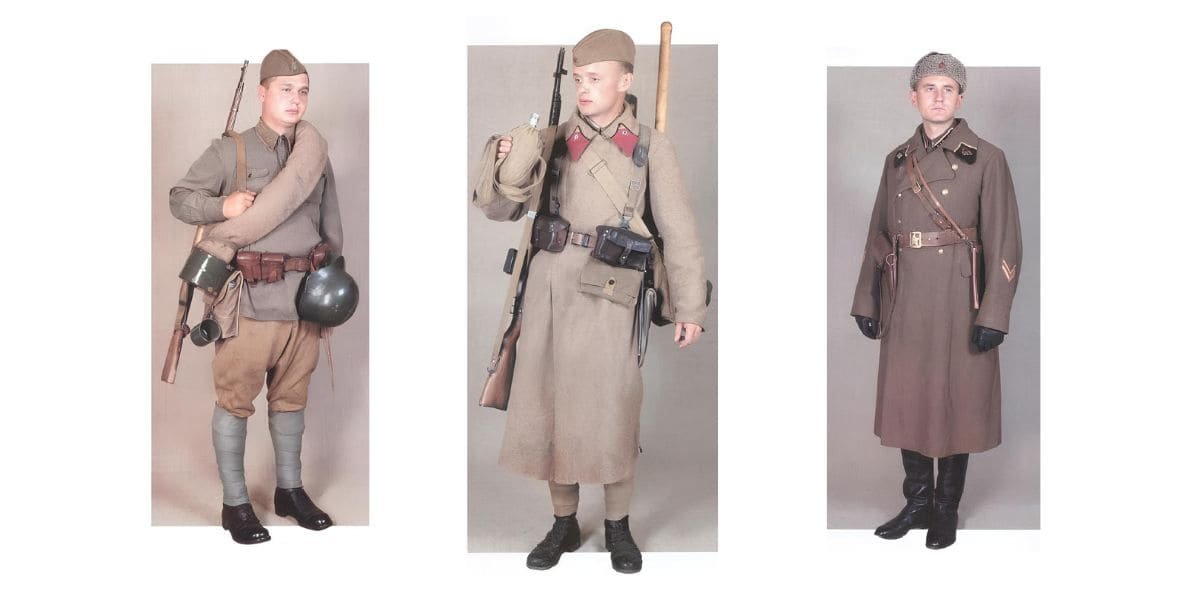
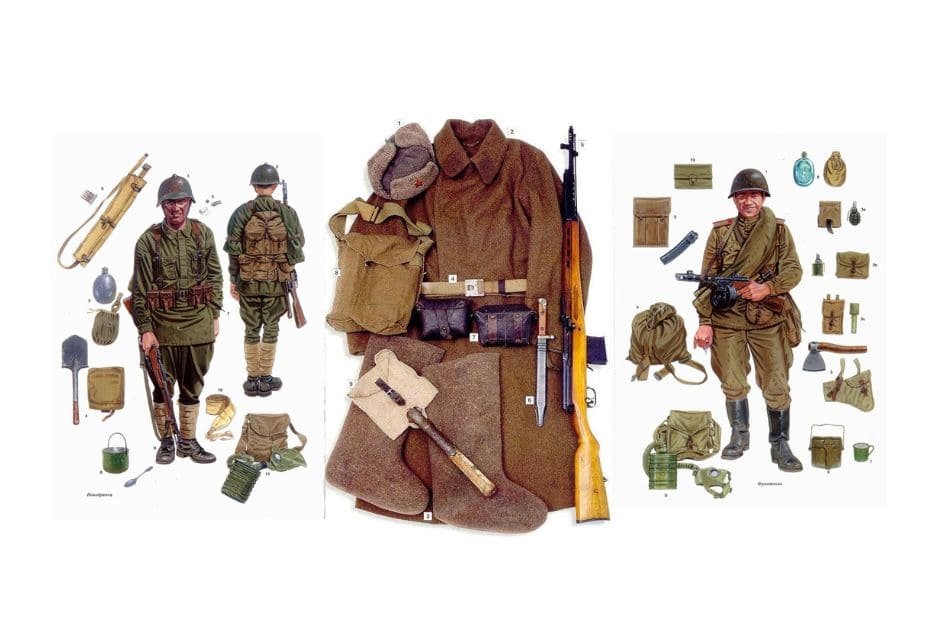
Shown here is a basic infantry set used at the beginning of World War II. The winter headgear is the ushanka (01). The soldier wears a standard wool overcoat (02). Felt boots, known as valenki (03), were commonly used in cold weather. The waist belt (04) supports the basic field equipment.
The soldier is armed with a 7.62 mm Tokarev SVT-40 semi-automatic rifle (05), fitted with a standard bayonet (06). Ammunition pouches (07) are worn on the belt. The gas mask bag (08) carries the standard Red Army respirator. A folding entrenching tool (09) completes the basic field kit.
This setup reflects a typical WWII Soviet soldier uniform private during the Winter War period and the early stages of the Great Patriotic War.
Soviet Infantry, 1941
Soviet infantry uniform from 1941.
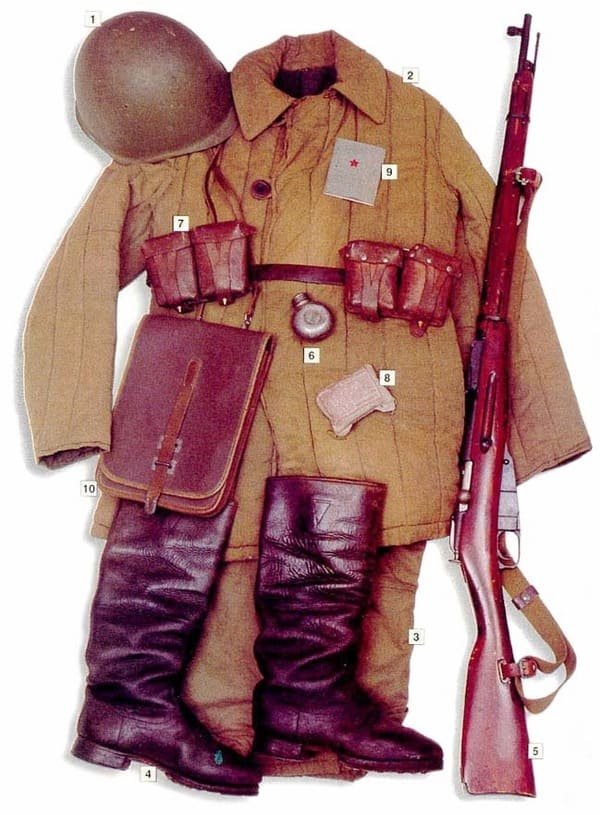
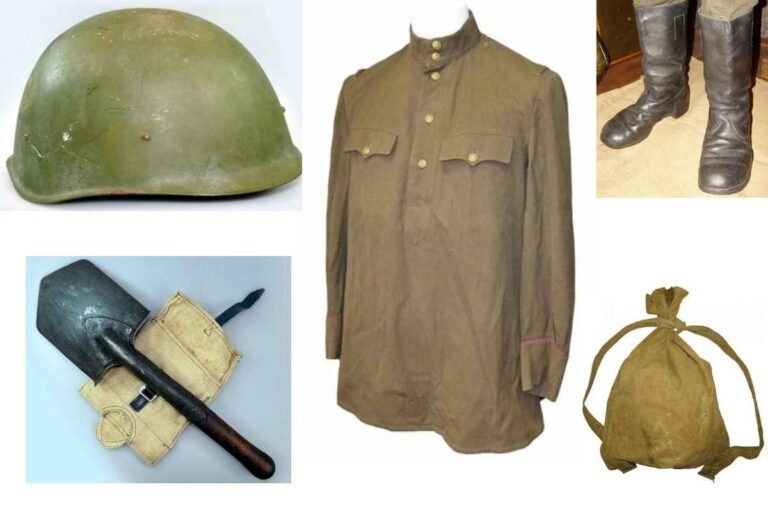
The set shows a typical Red Army infantryman at the beginning of the Great Patriotic War. The soldier wears a Model 1940 steel helmet (01). The main outer garment is a quilted jacket, known as a telogreika (02), widely used in cold conditions. Field trousers (03) are worn with standard leather boots (04).
The infantryman is armed with a 7.62 mm Mosin–Nagant rifle, model 1891/30 (05). A rifle oil bottle (06) is carried for weapon maintenance. Ammunition is stored in a Model 1930 cartridge belt (07). The military ID booklet (09) is kept on the uniform. A map case, or planschét (10), is used to carry documents and personal items.
Soviet Infantry Officer, 1943
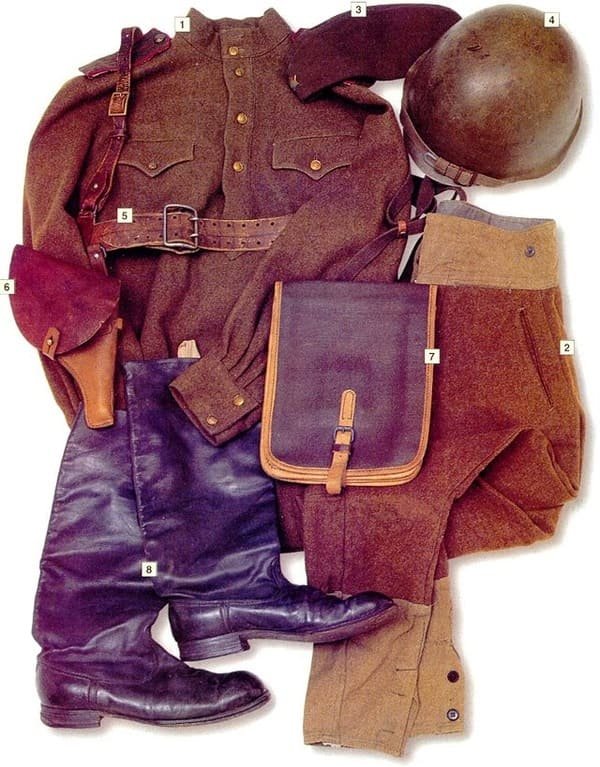
Soviet infantry officer uniform from 1943.
Looking for original Soviet officer boots? You can get them here → [Soviet officer boots]
The set shows a typical Red Army infantry officer during the middle period of World War II. The officer wears a Model 1943 gymnastyorka (01), the officer version of the standard field tunic. It is paired with Model 1935 breeches (02). The headgear includes a Model 1935 peaked cap (03), while a Model 1940 steel helmet (04) is also shown as part of the combat equipment.
The officer uses a Model 1935 officer belt with shoulder straps (05). A holster for the Nagant 1895 revolver (06) is worn on the belt. A map case, or planschét (07), is used to carry documents, maps, and personal items. Footwear consists of standard officer leather boots (08).
This uniform reflects the transition period of the Red Army, combining earlier pre-war elements with updated wartime equipment.
Red Army Reconnaissance Officer, 1943
Red Army reconnaissance officer uniform from 1943.
Looking Soviet Pilotka Hat? You can order here: (Soviet Pilotka Hat)
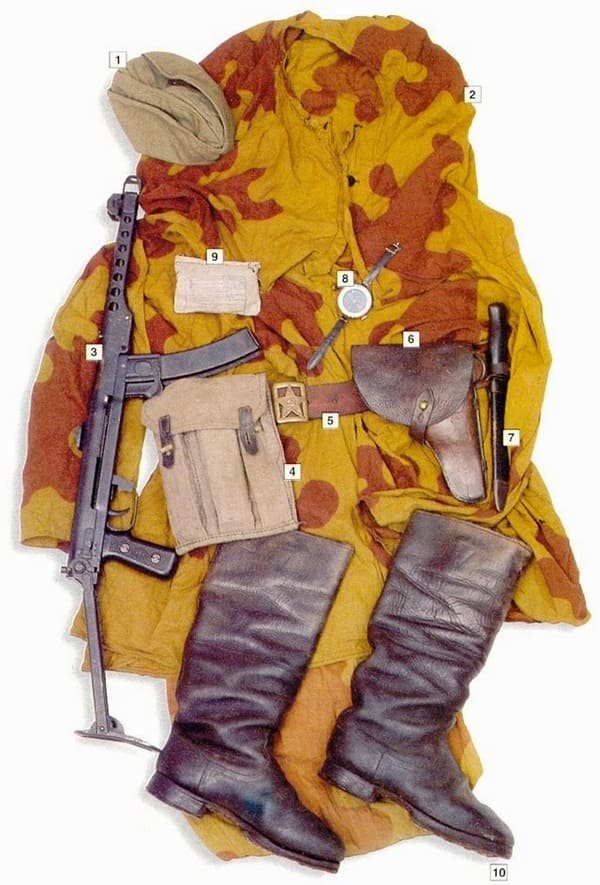
This set shows a Soviet reconnaissance officer during World War II, dressed for autumn operations. The headgear is a Model 1935 Pilotka cap (01). The main clothing is autumn camouflage gear (02), designed to break up the silhouette in forested and mixed terrain.
The officer is armed with a 7.62 mm PPS-43 submachine gun (03). Ammunition is carried in a canvas ammo bag (04). A Model 1935 officer belt (05) is worn as part of the standard officer loadout. On the belt is a leather holster with a 7.62 mm TT pistol (06). A Model 1940 combat knife (07) is carried for close combat and utility tasks.
Navigation equipment includes an Adrianov compass (08). Footwear consists of standard officer leather boots (10). This setup reflects the lighter, more mobile equipment used by reconnaissance officers operating behind or close to enemy lines.
NKVD Lieutenant, 1940–1941
NKVD lieutenant uniform from 1940–1941.
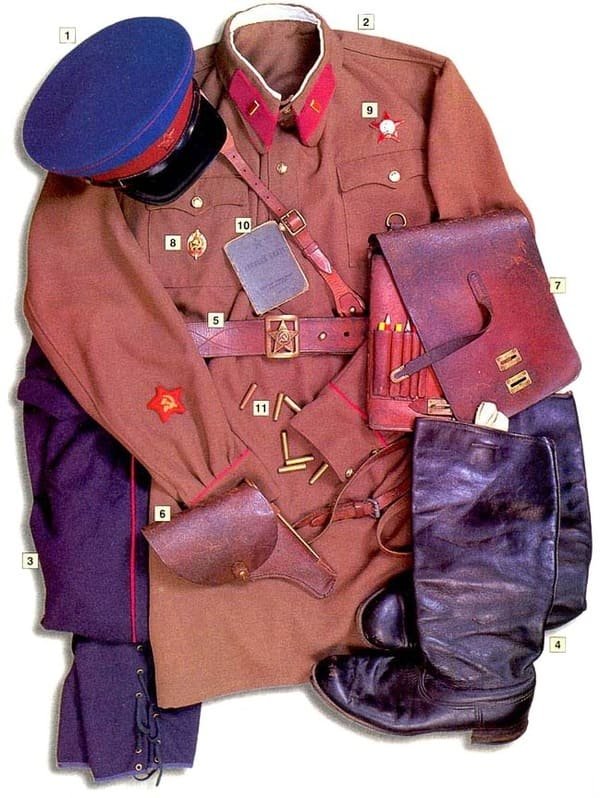
This set shows an NKVD lieutenant during the early years of World War II. The headgear is a Model 1935 NKVD peaked cap (01). The main uniform is a Model 1925 NKVD gymnastyorka (02). The trousers are dark blue wool sharovary with crimson piping (03), a distinctive feature of NKVD uniforms.
Footwear consists of standard service boots (04). The officer wears a waist belt (05). A holster for the Nagant 1895 revolver (06) is attached to the belt. An officer map case, Model 1932 (07), is carried for documents and maps.
The uniform is decorated with the NKVD badge introduced in 1940 (08) and the Order of the Red Star (09). A military ID booklet (10) is worn on a shoulder strap. Ammunition for the Nagant revolver (11) completes the set.
This configuration reflects the distinctive appearance and equipment of NKVD officers on the eve of the Great Patriotic War.
Footnote:
The NKVD lieutenant uniform shown is depicted incorrectly (most likely a reconstruction). Judging by the sleeve stars, this appears to be a Red Army political officer (Senior Political Instructor). However, the uniform cut and collar insignia correspond to a GUGB NKVD lieutenant. In that case, the sleeve stars should not be present, and the NKVD sleeve chevrons are missing.
WWII Soviet soldier and officer uniform
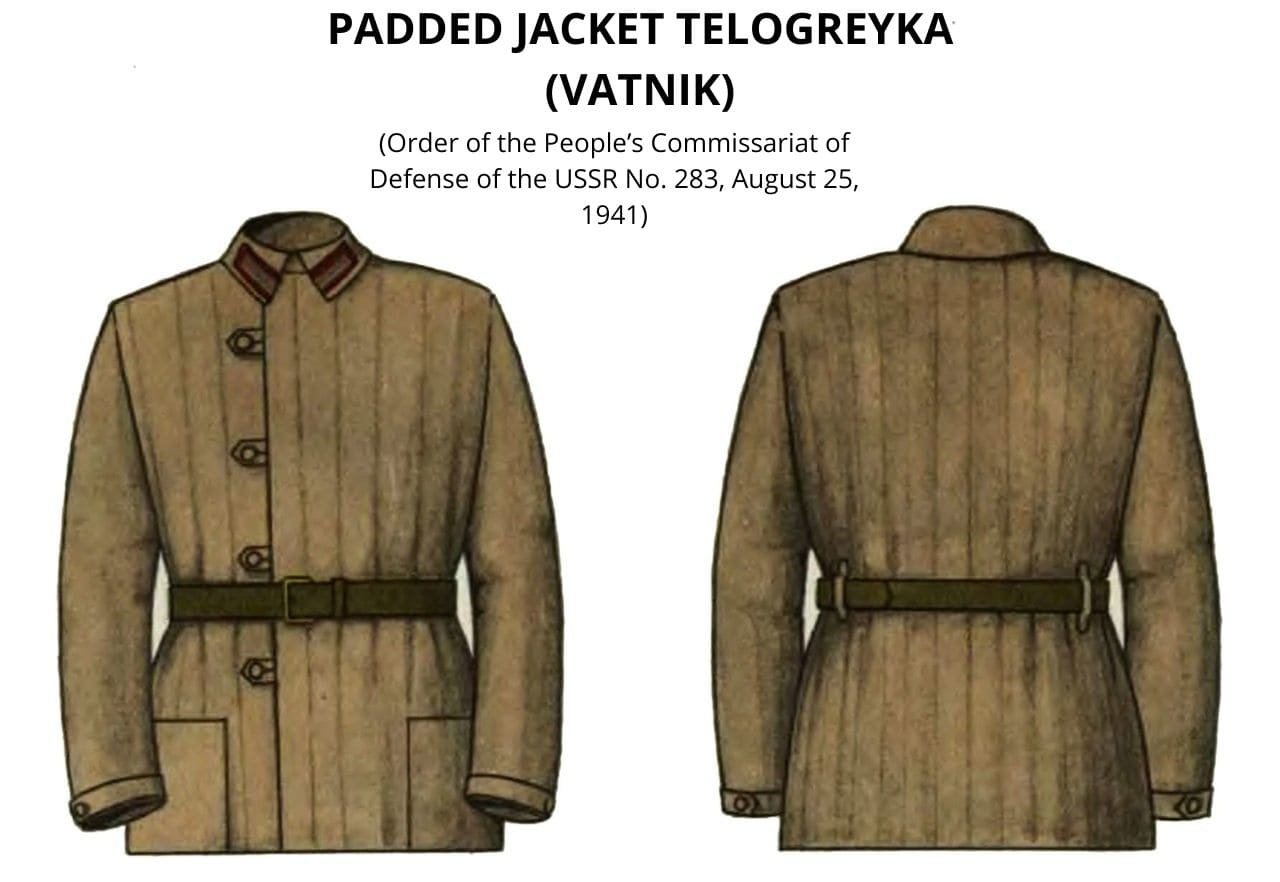
On August 25, 1941, by NKO Order No. 283, a new type of padded jacket (vatnik / telogreika) was introduced.
Unlike the earlier padded jacket, which was intended to be worn under a greatcoat, the new padded jacket was designed to be worn instead of a greatcoat. A soldier would receive either a greatcoat or a padded jacket, not both.
The new padded jacket had a turn-down collar, and collar tabs in protective colors were attached to it, with rank and branch insignia also made in protective colors. The 1932-pattern padded jacket did not have this feature, as it was worn under a greatcoat.
The color of the padded jacket was not strictly regulated. It could range from light gray to dark green or khaki. Belt loops for a waist belt were included.
After the introduction of new rank insignia in early 1943, wearing shoulder boards on the padded jacket was not предусмотрено and was not officially regulated.
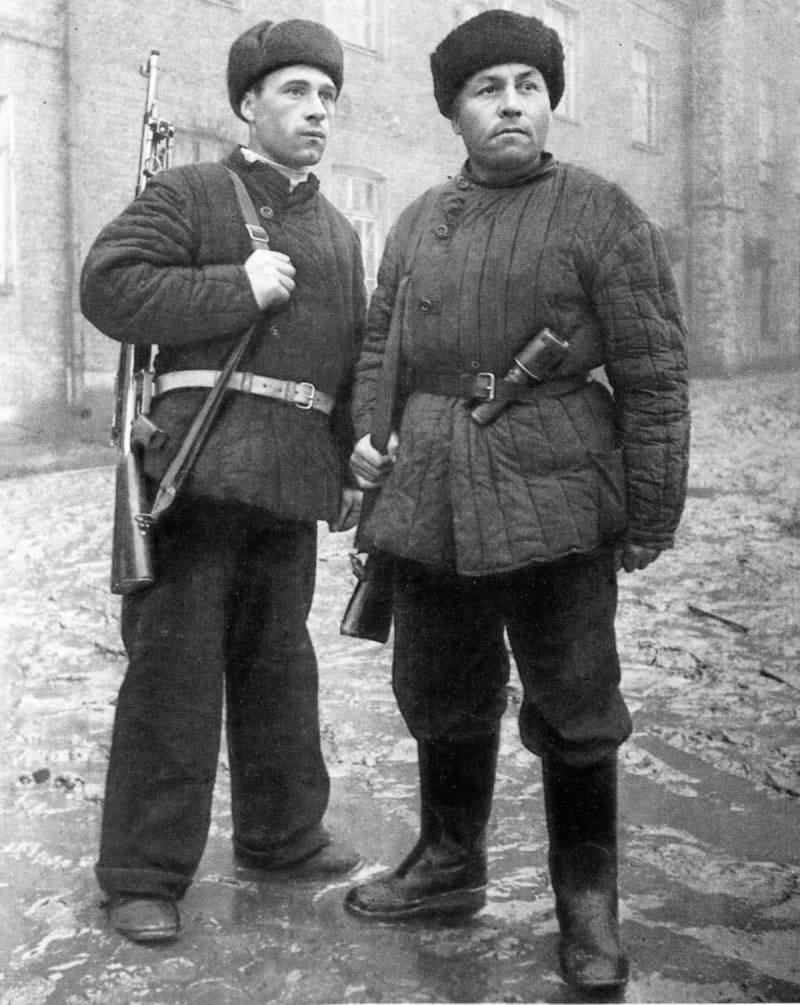
The weapon carried by the militia fighter on the left is the Chatellerault Mle 1924/29 machine gun, developed and produced in France by the Chatellerault Arms Arsenal (French: Manufacture d’Armes de Châtellerault) after the First World War and widely used during the Second World War. It was also used in France’s colonial wars after 1945. Captured light machine guns were used by the Wehrmacht under the designation MG 116(f).
WWII Soviet soldier and officer uniform
Check Soviet WW2 uniforms guides:
Soviet uniform (1936-1941)
Soviet uniform (1941-1943)
Soviet uniform (1943-1945)
Check more articles:
Best WW2 Uniform: Soviet, German, USA. Who Had the Best Army Gear?
Red Army Uniforms of the Russian Civil War (1918–1922)
Field Uniform and Equipment of the Soviet Army in 1968 -1991 Part 1
Field Uniform and Equipment of the Soviet Army (1968–1991) – Part 2
Field Uniform and Equipment of the Soviet Army (1968–1991) – Part 3
Looking original Soviet boots and accessories? Please visit here: Soviet Boots Store
WWII Soviet soldier and officer uniform