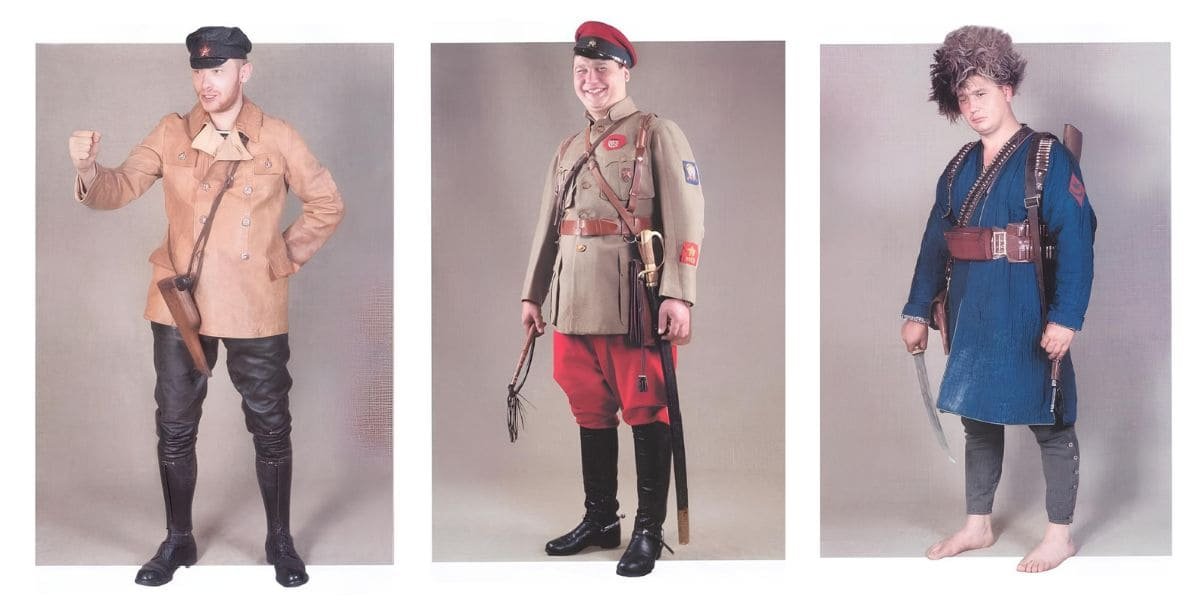
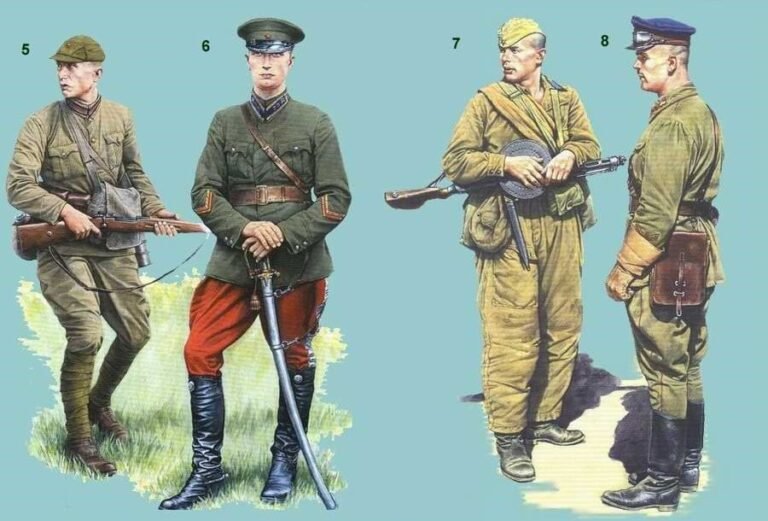
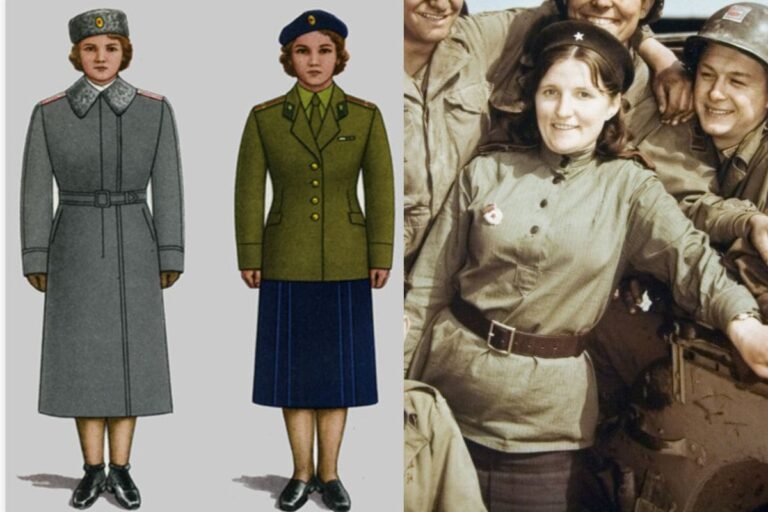
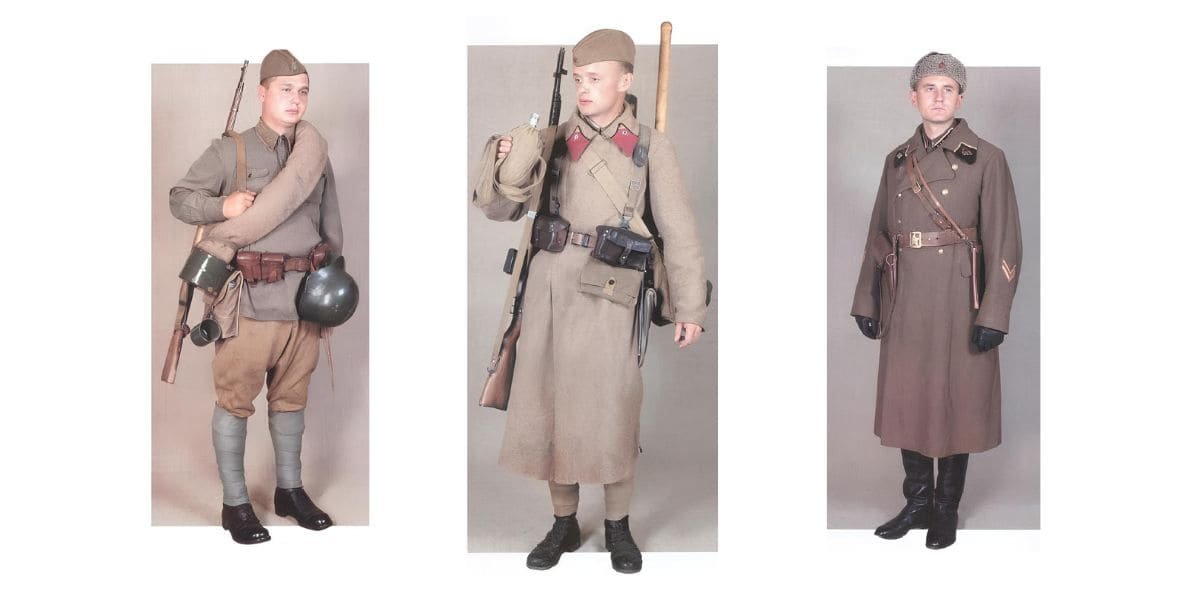
Illustrations based on Peter Darman’s “World War II Uniforms”, with historical commentary
I decided to using Soviet uniform illustrations from P. Darman’s book “World War II Uniforms” and adding my own comments and observations along the way.
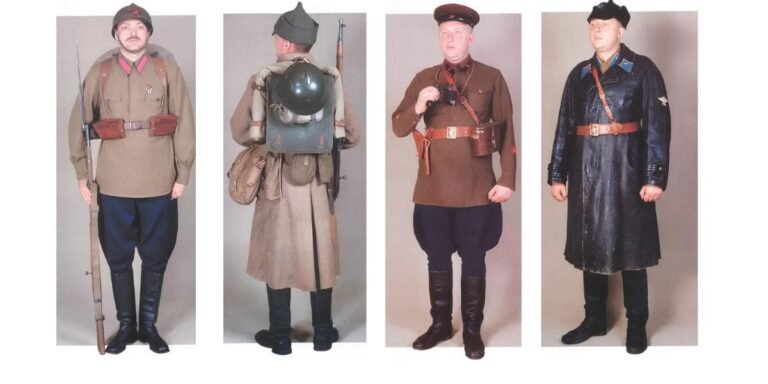
At the beginning of World War II, the Soviet Union possessed the largest army in Europe (its strength was estimated at 1.8 million men). Supplying such a mass of personnel with uniforms and equipment was a difficult task, and therefore the state made efforts to maintain well-tested and proven methods that guaranteed stable supply. As a result, Soviet soldiers mostly wore uniforms developed as early as the beginning of the century. Despite their somewhat crude appearance, they proved to be quite practical, which was confirmed during the course of World War II.
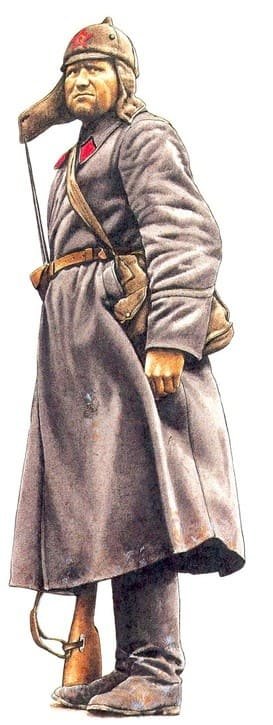
This Red Army soldier is depicted wearing the winter uniform used during the unsuccessful Winter War against Finland. His coarse wool headgear was officially called a “helmet,” but it became better known as the budenovka, named after the legendary cavalry commander Semyon Budyonny. The cloth helmet had a protective khaki color, while the piping and edging were raspberry-colored. The chin strap and supporting straps were made of leather, and a red five-pointed star was.
It is unclear where the author got the figure of 1.8 million men from. It is also unclear why this number was suddenly called the largest army in Europe, when, for example, the Wehrmacht had 3,214,000 personnel on September 1, 1939.
On September 1, 1939, the official strength of the Red Army was 2,265,000 men, but by September 20 it was expanded to 5,289,400 men after the introduction of universal conscription. However, by the end of the year, the army’s size had decreased again to 3,851,700 men.
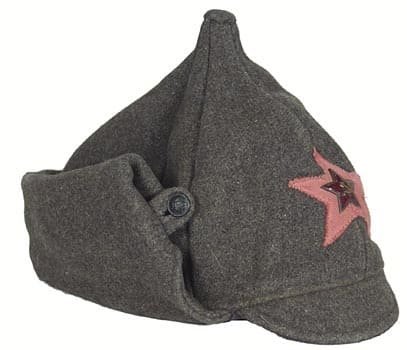
The Budyonovka was officially called the “winter helmet.” This version was adopted in 1931 and officially withdrawn from service in July 1940.
Soviet Budenovka winter hat used by Red Army soldiers during World War II.
Colonel of a Tank Division
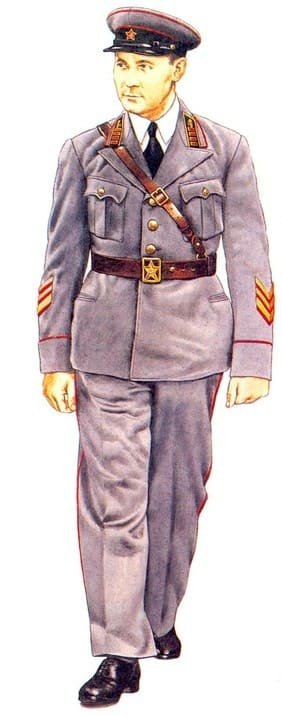
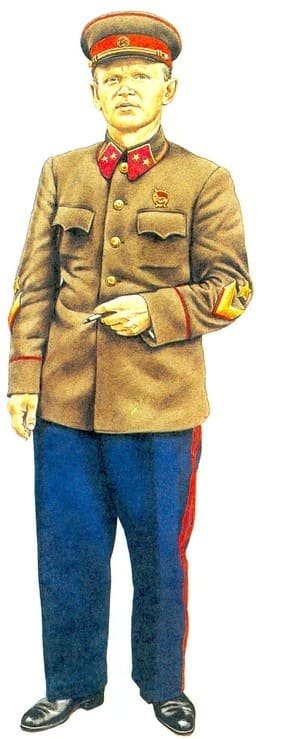
Colonel of a Soviet tank division wearing a steel-grey officer uniform, Red Army, January 1940.
In 1935, Soviet tank troops were ordered to wear uniforms of steel-grey color instead of khaki. This decision was connected with the political intention to emphasize the importance of armored forces in the Red Army, which was considered justified, as tanks were destined to play a key role in the Eastern Front during the years 1941–1945.
However, as in many other armies, during World War II Soviet tank crews mostly wore khaki uniforms, although officers sometimes continued to wear grey service jackets.
On the officer’s cap was a cockade in the form of a red star with a hammer and sickle. In the early years, red stars depicted a plough and hammer, but the plough was later replaced by the sickle, as the symbol of agriculture. In the Red Army, there were no shoulder boards until later in the war; instead, each branch of service was distinguished by the color of collar tabs, piping, and buttons on greatcoats and tunics (“raspashnoy” style).
This system of insignia existed on collar tabs and sleeve patches. After the Revolution, new insignia of military ranks were introduced in the form of triangles, squares, rectangles, and diamonds. In 1924, metal and enamel insignia were moved to collar tabs.
According to the 1935 regulations, officers were also required to wear rank insignia on the sleeves of tunics and greatcoats in the form of chevrons. As shown in the illustration, a colonel wore red chevrons with gold edging.
Date: January 1940 Location: Kiev
What is this strange wording “were ordered to wear”? In December 1935, a new uniform was introduced for pilots and tank crews. In the armored and motorized troops, it was steel-grey in color (with red piping), while in the Air Force it was dark blue (with light blue piping). During World War II, Soviet tank crews wore khaki uniforms because on February 1, 1941, the steel-grey uniform (and the dark blue one in the Air Force) was abolished. I believe this was done for the purpose of uniform standardization.
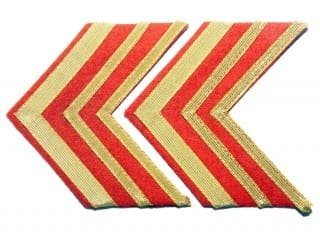
On the colonel’s sleeves, it is not a “red chevron with gold edging,” but a chevron made of gold galloon on a red backing. This chevron is not from 1935, but from 1940.
Gold galloon sleeve chevron of a Red Army officer on red backing, introduced in 1940.
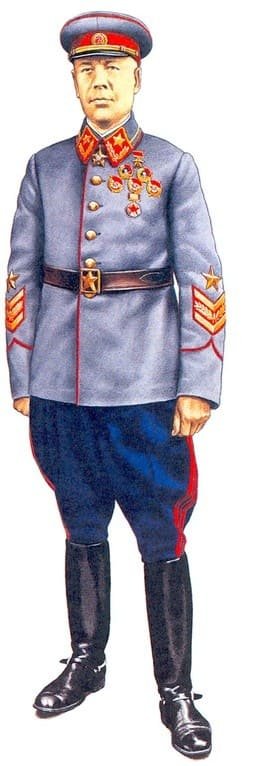
Marshal of the Soviet Union
Marshal of the Soviet Union wearing the ceremonial grey uniform introduced in 1940. Moscow.
The rank of Marshal of the Soviet Union was introduced in 1935. The first to receive it were the People’s Commissar of Defense Voroshilov, commanders Blücher and Budyonny, the First Deputy People’s Commissar of Defense Tukhachevsky, the Chief of the General Staff Yegorov, and the Inspector of Cavalry Budyonny.
In June 1940, a new ceremonial uniform was introduced for generals and marshals in order to enhance the prestige of the senior command staff of the Red Army.
The illustration depicts Marshal Semyon Konstantinovich Timoshenko, commander of the Kiev Military District and Supreme Commander of Soviet forces during the war with Finland, People’s Commissar of Defense in 1940–1941, and later commander of several fronts and operational directions.
He is dressed in the new ceremonial grey uniform trimmed with red piping (marshals and generals also had grey greatcoats trimmed with red piping). Marshals and generals wore a golden shoulder cord, as well as a new cockade: a red star made of copper and enamel, set in a gilded ring with a diameter of 30 mm.
The insignia were also changed: generals wore golden stars on their collar tabs instead of enamel rhombs, while marshals wore a golden star above laurel branches. On the sleeves, they wore a large embroidered gold star, and below it two sleeve chevrons made of gold galloon on a red backing.
On the marshal’s chest are awards: the Gold Star of the Hero of the Soviet Union, two Orders of Lenin, three Orders of the Red Banner, and the jubilee medal “XX Years of the Red Army.”
Date: June 1940 Location: Moscow
I do not know whether this uniform was introduced for reasons of prestige or for other considerations, but in 1940 the Red Army underwent significant changes. New ranks were introduced, lieutenant colonel, sergeant ranks, and general ranks instead of the former ranks of kombrig, komdiv, komandarm, and so on. It seems likely that the changes in uniform were connected with this (new insignia were also introduced).
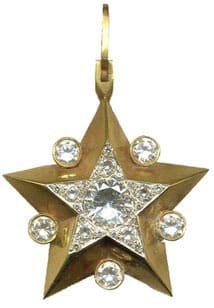
Please note that on their ceremonial uniforms, Marshals of the Soviet Union wore the “Marshal’s Star” insignia.
Marshal’s Star of the Soviet Union – ceremonial insignia introduced in 1940
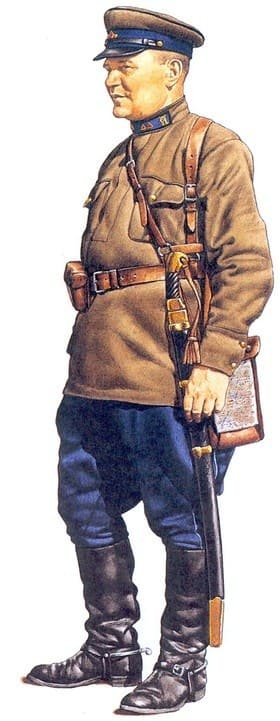
Cavalry Division Sergeant
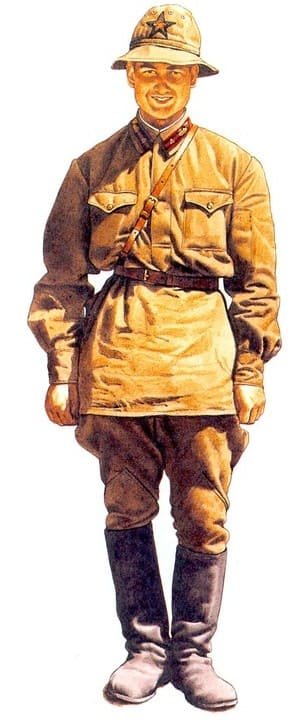
Red Army cavalry division sergeant in standard field uniform, Eastern Front, June 1941
The sergeant is dressed in the standard Red Army enlisted uniform of the early war period on the Eastern Front, with some details specific to his branch of service (cavalry).
His cotton gymnastyorka at that time had a stand-up collar (khaki), but it was this serviceman who had the standing collar, and on the chest there were patch pockets fastened with a button. The sleeves were gathered into cuffs, and the cuffs were fastened with two small buttons (officers had cuffs of a completely different type).
All branches of the Red Army, except the cavalry, wore breeches of the same khaki color as the gymnastyorka, whereas cavalrymen wore dark-blue breeches. On the sergeant’s head is a khaki field cap with a blue band and piping.
Although by 1941 cavalry was considered outdated, on the Eastern Front it played a significant role. In 1940, the Red Army had 40 cavalry divisions, which during the war against Germany carried out many important missions: reconnaissance, raids deep into enemy territory, and serving as a mobile reserve. A cavalry division consisted of three cavalry regiments, an artillery regiment, and support units. Its authorized strength exceeded 5,000 men, with 5,128 horses and 130 vehicles.
The division possessed significant firepower: 447 submachine guns, 48 heavy and 118 light machine guns, 48 light and 18 medium mortars, 76 regimental guns, and 43 anti-tank and anti-aircraft guns, as well as 10 light T-70 tanks.
Date: June 1941 Location: Kiev
Major General of the Odessa Military District
Major General of the Red Army, Odessa Military District. Parade and service uniform after the 1940 rank and insignia reforms. June 1941.
In December 1935, Red Army officers, in order to stand out more clearly, received new uniforms in which, among other changes, distinctive insignia were introduced. This included, in particular, a single-breasted tunic with a stand-up collar. The collar was called a “French collar,” named after a British general who wore such a tunic; it had previously been copied in Tsarist Russia for officers during the First World War. The collar and general cut followed the style of the branch of service.
With the field uniform, it was possible to wear khaki trousers or breeches, as well as khaki or black boots, or dark-blue breeches and black boots (dark-blue general’s trousers with piping were introduced in July 1940). According to the regulations adopted in July 1940, major generals wore gold stars on their collar tabs instead of enamel rhombuses, and on each sleeve a gold chevron with red backing, above which a gold star was embroidered.
At the beginning of the war with Germany, the Red Army found itself in a severely weakened condition. For several years, Stalin had carried out his senseless purges, which almost completely deprived the armed forces of the most knowledgeable and experienced senior officers. The first serious blow was delivered by the Winter War against Finland, during which about 200,000 Soviet soldiers were killed. However, these losses cannot be compared with the tragedy of the first months of Operation “Barbarossa.” And no new regulations or uniform reforms could quickly eliminate the damage that the Soviet dictator inflicted on his army.
Date: June 1941 Location: Odessa
The tunic was copied from the jacket of a British general in Tsarist Russia, but for some reason the influence is considered German 🙂
However, let’s not nitpick, since the author for some reason describes a different tunic, not the one shown in the illustration. What is depicted here is the 1940 model service jacket, which has noticeable differences from the 1935 tunic.
I will not comment on the author’s claims about the “mad purges” in order to avoid pointless arguments; I will only note that, according to official data, Red Army losses in the Winter War amounted to 126,000 men.
Junior Sergeant of a Tank Regiment
Junior Sergeant of a Soviet tank regiment in standard Red Army armored troops uniform, Crimea, July 1941
Looking for original Soviet kirza boots? You can get them here → [Soviet kirza boots]
The tanker shown in the illustration is wearing a steel helmet introduced in March 1938. For units serving in Central Asia, the North Caucasus, Transcaucasia, and Crimea, the tunic was equipped with a standing-and-fall collar and elbow patches, while the breeches featured reinforced knee areas.
The collar tabs of a junior sergeant were of branch color and bore a small metal tank emblem. Tank troops and artillery shared the same collar tab colors: black with red piping. All Red Army personnel wore metal branch insignia on their collar tabs, since cloth piping often wore out quickly. This applied especially to officers, who wore collar tabs with gold edging.
Branch insignia for collar tabs were first introduced by regulations on January 31, 1922; at that time there were about 40 types. All insignia were made of metal. Initially, they were worn without enamel. Armored troops underwent major reorganization in the 1930s and received their own branch emblem only in 1936.
Date: July 1941 Location: Crimea
A very interesting and rather rare piece of headgear is the panama hat. It was introduced for the troops of the southern military districtsб the Central Asian Military District, North Caucasus Military District, Transcaucasian Military District, as well as in Crimea. For as long as 17 years, the panama hat remained in service without any changes. In 1955, it was replaced by a different model.
The tanker is already wearing a protective-colored uniform. Until 1941, Soviet tank troops wore uniforms of a gray-steel color.
Private First Class (Yefreitor) of a Rifle Division
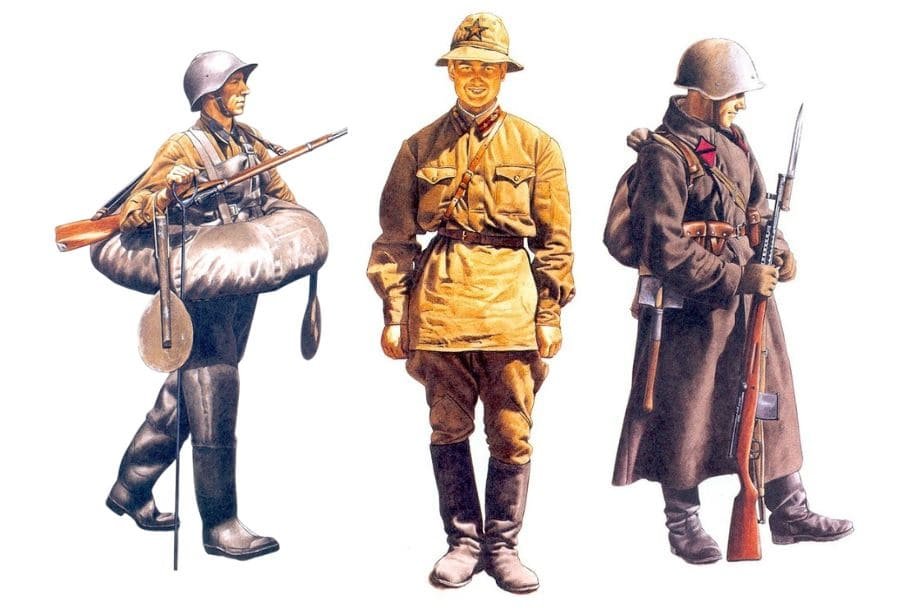
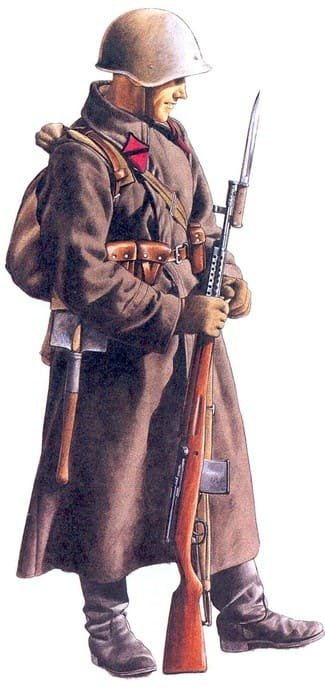
Red Army yefreitor of a rifle division, Ukraine, July 1941 — wearing standard greatcoat, steel helmet, and armed with an SVT-40 rifle.
The typical Red Army soldier lived a difficult and often harsh life. He came from a poor background, had a modest daily ration, and even before the war wore non-standard and often worn-out equipment. The fact that he was probably an average factory worker or collective farmer hardly improved his situation. Even the quality of his clothing was usually quite low. These were the men and women who stood firm against the power of Nazi Germany.
This yefreitor represents a typical Soviet enlisted man of the period of compulsory service. He is wearing a dark gray wool greatcoat (shinel), sometimes brown, with a turn-down collar, concealed front fastening, turn-back cuffs, pleats at the waist, a central rear vent, and side slits with pass-through pockets. Officers, from December 1935 onward, received a new double-breasted greatcoat with a turn-down collar, two rows of four buttons, and turn-back cuffs. The collar and cuffs had branch-of-service piping.
On his head, the soldier wears the steel helmet model of 1940, sometimes earlier models were still encountered. On the helmet is a red star. Collar tabs (petlitsy) indicate his branch of service and rank (equivalent to the German Gefreiter — a soldier exempt from fatigues). His equipment includes an anti-gas cape carried in a bag on his left side, an entrenching tool suspended on the right, a waist belt with ammunition pouches, and field gear in khaki canvas. His weapon is a 7.62 mm Tokarev self-loading rifle, model 1940, with a fixed bayonet.
Date: July 1941 Location: Ukraine
It gives the impression that the text was written by an anti-Soviet propagandist. The rations are described as meager, and the clothing as poor and shabby…
The item on the soldier’s belt is not a sapper’s shovel, but the small infantry entrenching tool, model 1939.
Corporal of a Cavalry Regiment
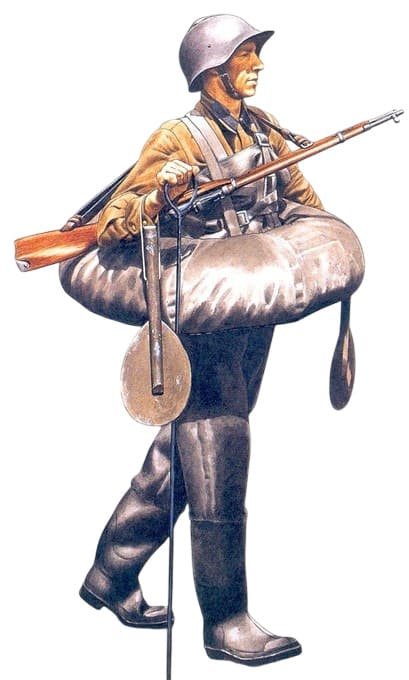
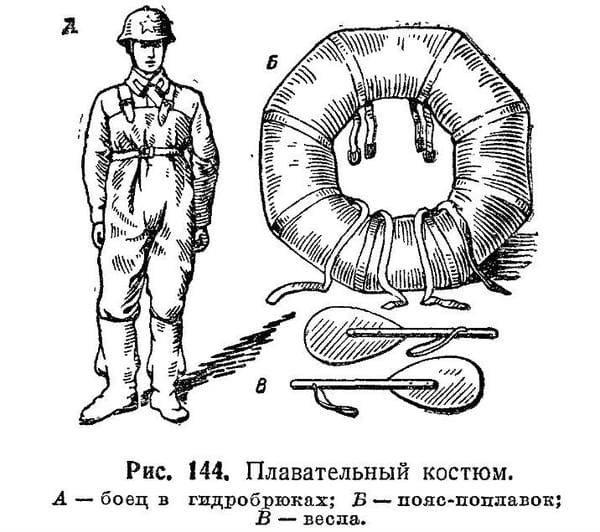
Corporal of a Red Army cavalry regiment equipped with a special river-crossing suit and armed with a Mosin–Nagant rifle. Leningrad Front, October 1941.
The cavalryman is wearing a special suit designed for river crossings, which was introduced in the Soviet Union. The equipment set also included weights and a snorkel for underwater movement. On his head is a steel helmet model 1936, which was soon replaced in active service by the 1940 model.
Before this illustration depicts the situation in July 1941, the Red Army was already retreating along the entire front. German forces were advancing, pushing Soviet troops back everywhere. The Red Army suffered enormous losses of weapons and equipment, but already at this stage managed to organize resistance and counterattacks. Many of the losses in manpower were caused not by direct combat, but by disrupted communications between units and a shortage of trained staff officers.
By the autumn of 1941, the front stretched from Leningrad in the north to Odessa in the south. The Red Army suffered heavy defeats in border battles, but it was not destroyed and, remarkably, continued to inflict painful blows on the enemy.
The corporal is armed with the 7.62 mm Mosin rifle, model 1891/1930, which remained the standard personal weapon of the Red Army. It was accurate, reliable, simple to manufacture, and well suited to harsh conditions. Thanks to these qualities, it remained in service until the 1950s.
Date: October 1941 Location: Leningrad
It is unclear why the author decided that the figure in the illustration is a corporal. A corporal wore a longitudinal stripe on the collar tabs, while here the collar tabs are plain. The author also confuses the branch of service to which the soldier belongs. This is not a cavalryman.
Cavalry collar tabs were blue with black piping. Black collar tabs with blue piping were worn by personnel of the technical branches (for example, sappers, railway troops, etc.).
Pay attention to an interesting piece of equipment, swimming suit.
Soviet Red Army swimming suit PK with floating belt and paddles, used for river crossings during World War IIRed Army soldier equipped with the PK swimming suit and inflatable flotation belt, used for river crossings during World War II.
Officer of a Rifle Division
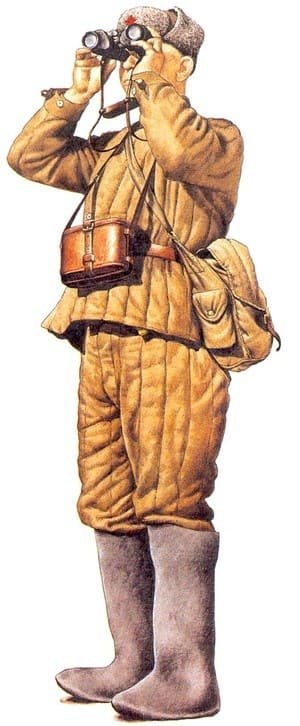
Officer of a Soviet rifle division in standard Red Army winter uniform during the Battle of Moscow, December 1941.
Looking Soviet Ushanka? You can order here: (Soviet Ushanka)
At the end of 1941, the Red Army, and consequently the entire Soviet Union, was saved from defeat largely thanks to the outstanding command talent of the future Marshal Zhukov, as well as the assistance of “General Winter.” On December 5, 1941, under subzero conditions, the counteroffensive near Moscow began, involving more than 720,000 men, 670 tanks, 5,900 artillery pieces, and mortars, as well as 415 rocket launchers. This was the Red Army’s first success in combat against the Germans and gave the troops a much-needed moral boost.
The harsh Russian winter also helped slow the German advance, since unlike the Red Army, the Wehrmacht was absolutely unprepared for conducting warfare in Russian winter conditions.
The Russian winter uniform consisted of a gymnastyorka (tunic), insulated breeches, black leather boots, as well as a grey sheepskin coat and a double-breasted regulation greatcoat.
In addition to this uniform, there were other types of winter clothing: sheepskin coats (usually worn by cavalrymen) and quilted jackets and trousers (the so-called vatniki) of protective color. The officer shown in the illustration is dressed in the most common winter uniform of the Red Army, consisting of a jacket and cotton trousers with a lining made of thick layers of quilted cotton wool. Introduced in August 1941, winter clothing was also supplemented with felt boots (valenki), which proved to be ideal footwear for snow.