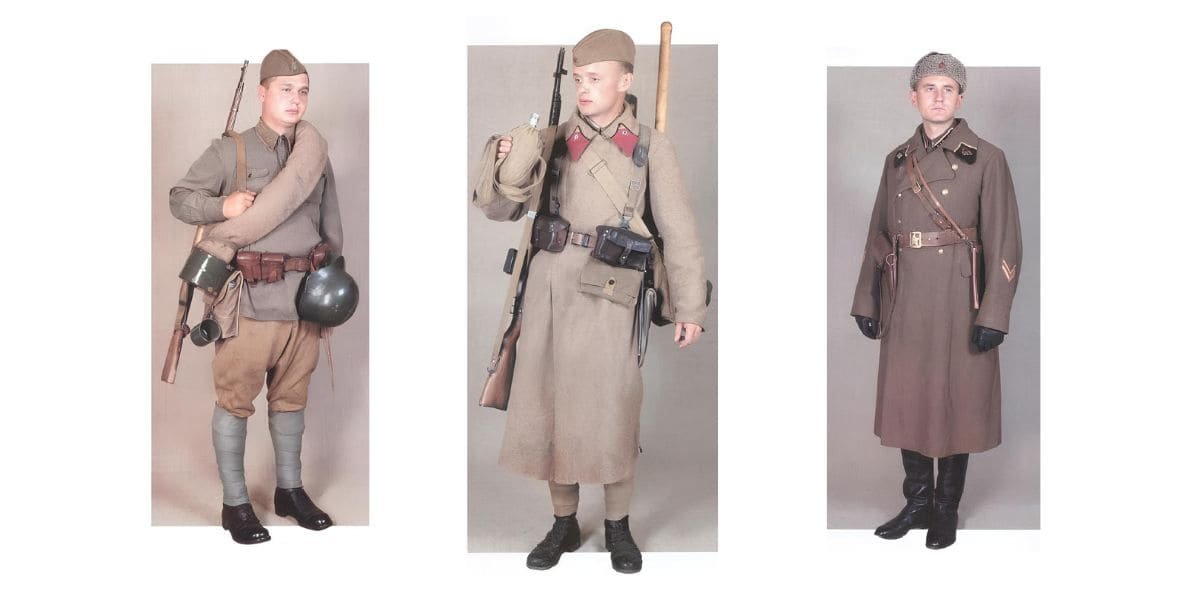
Soviet Uniforms of the Red Army in 1941-1942
Focus topic: Red Army uniforms in 1941-1942 across different branches (infantry, tank crews, airborne, cavalry, NKVD).
Red Army uniforms 1941-1942 were built for survival: simple, durable field clothing adapted to brutal frontline conditions.
Check Soviet WW2 uniforms guides:
How to Put Together a WWII Soviet Soldier and Officer Uniform for Reenactment
History from the Red Army (RKKA) to the Soviet Army
Soviet uniform (1936-1941)
Soviet uniform (1941-1943)
Soviet uniform (1943-1945)
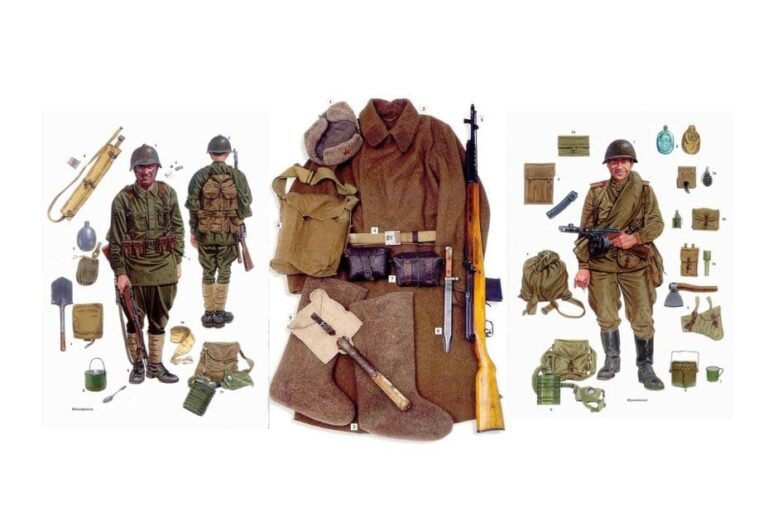
Equipment Set of a Red Army Soldier in 1941 and 1945
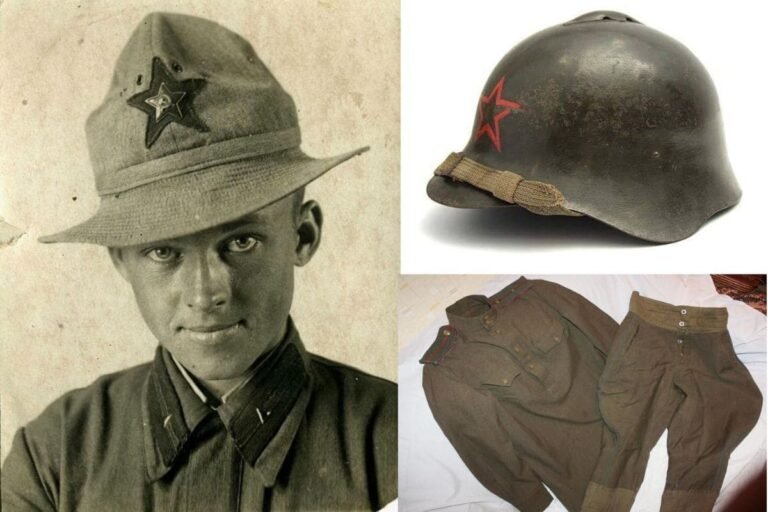
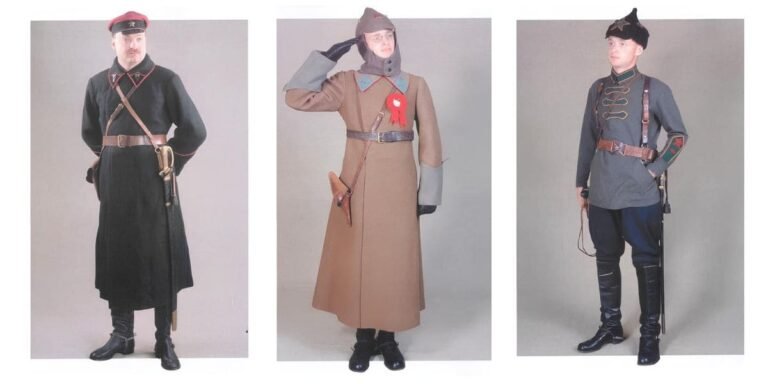
In the first years of the Great Patriotic War, Red Army soldiers fought in extremely difficult conditions. Rapid retreats, lack of supplies, harsh weather and constant combat forced the army to rely on practical, simple, and durable uniforms. This article shows how Soviet soldiers of different branches, infantry, tank crews, airborne, cavalry, and NKVD units, were dressed in 1941–1942, and how their uniforms were adapted to real wartime needs.
Red Army uniforms 1941-1942
Quick navigation
- Regular & Territorial units (Summer 1941)
- Tank, motorized & rifle units (Summer–Autumn 1941)
- Tank, airborne, cavalry & mountain rifle units (Autumn 1941–Autumn 1942)
- Back to top
Soviet Uniforms of the RKKA: Regular and Territorial Units (Summer 1941)

2. Political Officer of the 5th Vitebsk Rifle Division of the Red Army (June 1941)
3. Private of the 24th Latvian Territorial Rifle Corps of the Red Army in Uniform of German Pattern (July 1941)
4. Captain of the 613th Artillery Regiment in Latvian Army Uniform with Soviet Insignia (July 1941)
1. Soldier of the 84th Motorized Tula Division of the Red Army (June 1941)
This Red Army soldier represents a frontline infantryman at the very beginning of the German invasion.
He is dressed in a standard summer field uniform, low leather combat boots with black cloth leg wraps, and a steel SSh-36 helmet.
Such soldiers were among the first to face the Wehrmacht in June 1941, defending Soviet territory during the initial phase of Operation Barbarossa.
Looking Soviet Low Combat Boots? You can order here: (Soviet Combat Boots)
2. Political Officer of the 5th Vitebsk Rifle Division of the Red Army (June 1941)
Soviet political officer (politruk), responsible not only for combat duties but also for morale, discipline, and political education. He wears a cleaner, more formal field uniform with distinctive insignia, binoculars, and officer boots.
Political officers played a key role in maintaining unit cohesion and ideological motivation during the chaotic first months of the war.
3. Private of the 24th Latvian Territorial Rifle Corps of the Red Army in Uniform of German Pattern (July 1941)
This soldier wears equipment of German origin, reflecting the severe shortages faced by the Red Army in summer 1941.
Captured or reused uniforms were common, especially in newly formed or reorganized units.
Latvian territorial units were integrated into the Red Army and took part in defensive fighting during the rapid German advance in the Baltic region.
4. Captain of the 613th Artillery Regiment in Latvian Army Uniform with Soviet Insignia (July 1941)
This officer is shown wearing a Latvian Army uniform adapted with Soviet insignia.
Such combinations were typical during the transitional period after the incorporation of the Baltic states into the USSR.
As an artillery officer, his role was to command gun crews and provide fire support for infantry units during defensive operations in 1941.

6. Lieutenant, commander of a mounted reconnaissance platoon, 22nd Estonian Territorial Corps of the Red Army (June 1941)
7. Submachine gunner of the 201st Airborne Brigade of the Red Army (July 1941)
8. Tank company commander of the 5th Motor Rifle Regiment, 22nd NKVD Division (July 1941)
5. Red Army soldier of the 29th Lithuanian Territorial Corps (June 1941)
This soldier represents a Red Army uniforms 1941-1942 unit formed from local Lithuanian personnel in 1941.
He wears a standard field uniform with a side cap, leather belt, and basic infantry equipment.
Such units were mainly used for internal defense, guarding key locations, and frontline support during the first weeks of the German invasion.
6. Lieutenant, commander of a mounted reconnaissance platoon, 22nd Estonian Territorial Corps of the Red Army (June 1941)
This lieutenant serves as a commander in a cavalry reconnaissance unit.
He is dressed in a regulation officer’s tunic, breeches, officer leather riding boots, and a peaked cap.
Mounted reconnaissance units were used for scouting, patrols, and communication, especially where vehicles could not operate effectively.
7. Submachine gunner of the 201st Airborne Brigade of the Red Army (July 1941)
This soldier belongs to an airborne unit and is armed with a Shpagin submachine gun PPSh-41.
He wears a practical field uniform designed for mobility and combat, with overalls and pilotka hat.
Airborne troops were trained for rapid deployment, raids, and fighting behind enemy lines.
Looking Soviet Pilotka Hat? You can order here: (Soviet Pilotka Hat)
8. Tank company commander of the 5th Motor Rifle Regiment, 22nd NKVD Division (July 1941)
This officer is a commander of a tank company within an NKVD motor rifle division. He wears an officer’s field uniform with leather belt, side cap, and a map case.
NKVD units were responsible for security, protection of rear areas, and later took part in frontline combat during critical moments of 1941.
Soviet Uniforms of the RKKA: Tank, Motorized and Rifle Units (Summer–Autumn 1941)
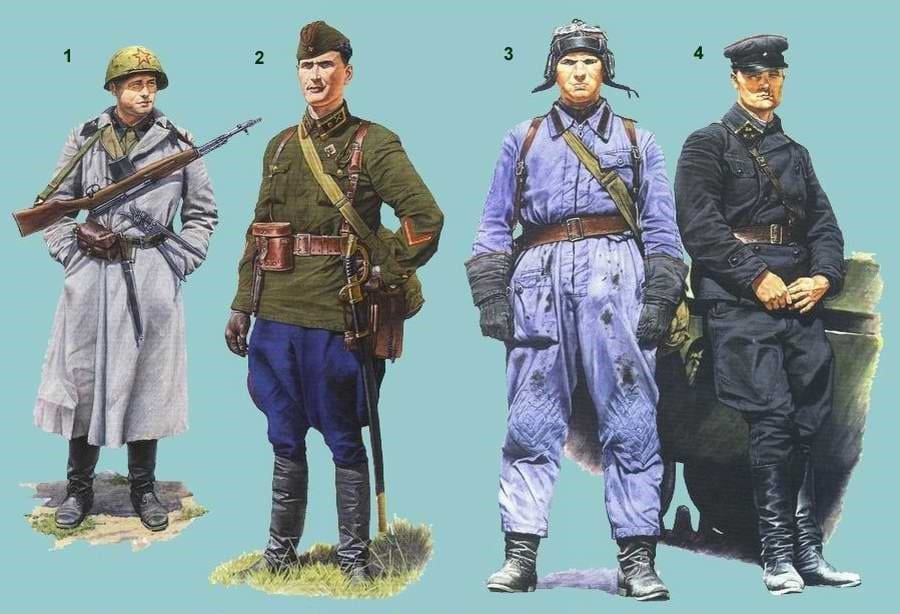
2. Junior Lieutenant – artillery battery commander of the 48th Rifle Division (June 1941)
3. Private tank crewman of the 2nd Tank Division, 3rd Mechanized Corps of the Red Army (July 1941)
4. Tank company commander of the 23rd Tank Division of the Red Army (July 1941)
1. Red Army sapper of the 67th Rifle Division (June 1941)
This soldier is dressed in a field overcoat (shinel) worn over standard infantry uniform. On his head is a steel helmet SSh-36, widely used in the early years of the war.
He is armed with a Mosin–Nagant rifle, the main infantry weapon of the Red Army. Sappers were responsible for building field fortifications, laying and clearing mines, preparing defensive positions, and supporting infantry during advances and retreats. Despite their technical role, they often fought as regular infantry in combat situations.
2. Junior Lieutenant, artillery battery commander, 48th Rifle Division (June 1941)
This figure shows a junior officer of the Red Army artillery. He wears a service tunic (gymnastyorka) with officer insignia, blue breeches typical for artillery troops, and high leather boots. His uniform reflects the pre-war style that was still common in early 1941.
As a battery commander, his main task was to direct artillery fire, support infantry units, and coordinate gun crews during combat. Artillery played a crucial role in both defense and counterattacks, especially during the chaotic first months of the war.
3. Private tank crewman, 2nd Tank Division, 3rd Mechanized Corps (July 1941)
This soldier represents a Red Army tank crewman wearing a protective padded tanker suit (kombinezon) designed for working inside armored vehicles. On his head is an early tank crew helmet (tankovy shlem) with ear protection and communication elements.
He is armed with a PPD or PPSh-type submachine gun, commonly issued to tank crews for personal defense outside the vehicle. Tank units in summer 1941 suffered heavy losses, often fighting in difficult conditions against better-prepared German forces.
4. Tank company commander, 23rd Tank Division (July 1941)
This officer is shown wearing a black tanker uniform, traditionally associated with armored troops. The uniform includes a dark jacket, trousers, and a black tanker’s cap, distinguishing him from regular infantry officers.
As a tank company commander, he was responsible for leading armored units in battle, coordinating attacks, and maintaining control over his crews during fast-moving and often chaotic engagements. Tank commanders frequently fought under extreme pressure, especially during the early defensive battles of 1941.
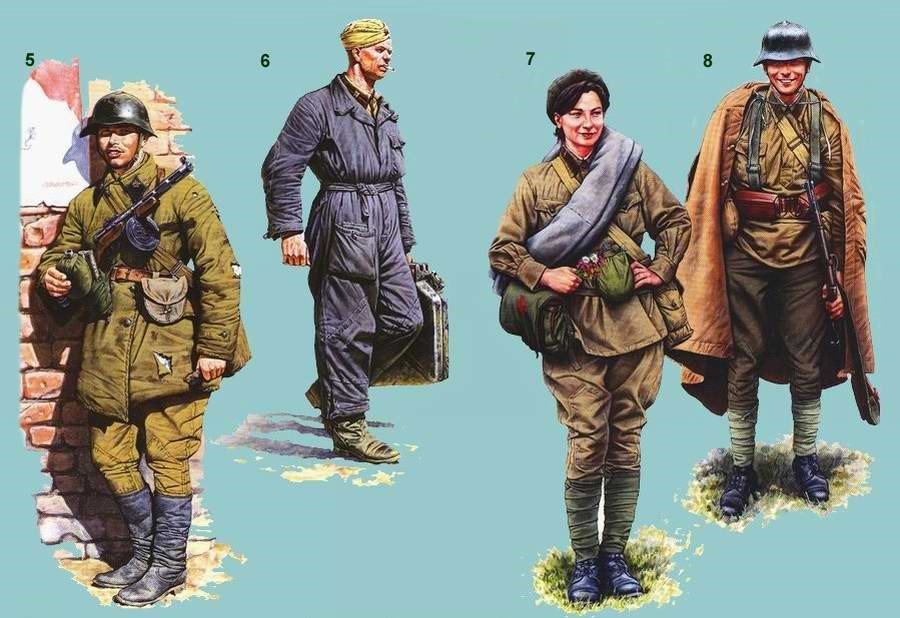
6. Red Army driver from the Reserve Front (October 1941)
7. Medical instructor of the 132nd Rifle Division, 13th Army (October 1941)
8. Private Red Army soldier of the 132nd Rifle Division, 13th Army (October 1941)
5. Red Army signalman, 91st Rifle Division (October 1941)
This soldier represents a Red Army uniforms 1941-1942 signalman during the defensive battles of autumn 1941. He wears a quilted jacket (telogreika) over the standard field uniform, suitable for cold and wet weather. On his head is a steel helmet SSh-36, still widely used at that time.
He is armed with a PPSh-41 submachine gun, a common weapon for support troops. Signalmen were responsible for maintaining communication between units, laying field telephone lines, and ensuring command orders reached frontline troops. Their work was dangerous, as communication lines were often under fire.
Looking for original Soviet boots? You can get them here → [Soviet boots store]
6. Red Army driver, Reserve Front (October 1941)
This figure shows a Red Army driver wearing a one-piece working coverall, designed for vehicle crews and technical personnel. Such clothing protected against dirt, oil, and cold while repairing and operating vehicles.
Drivers played a vital role in supplying the front with ammunition, food, fuel, and evacuating wounded soldiers. In autumn 1941, many drivers operated under constant air attacks and artillery fire while supporting retreating and defensive forces.
7. Medical instructor, 132nd Rifle Division, 13th Army (October 1941)
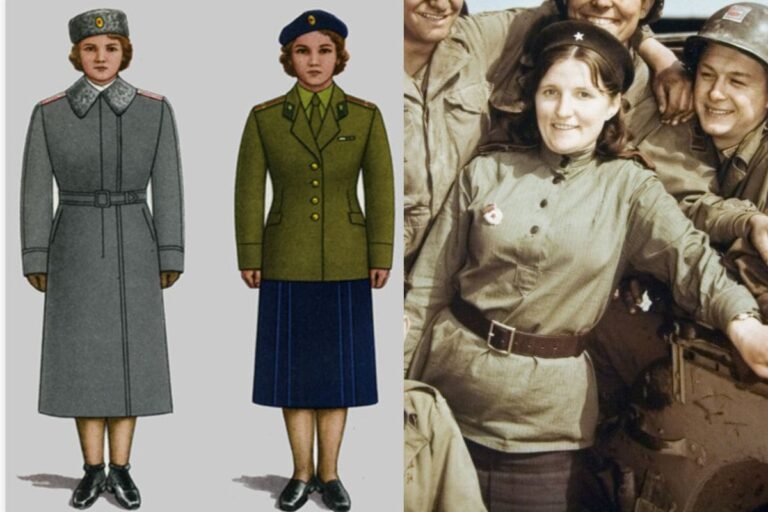
This soldier represents a female medical instructor, one of many women who served on the front lines. She wears a standard field uniform with practical adjustments for mobility, including a cross-body medical bag and personal equipment.
Medical instructors were responsible for providing first aid under fire, evacuating wounded soldiers from the battlefield, and saving lives in extremely dangerous conditions. They often worked directly alongside infantry units during combat.
8. Private Red Army soldier, 132nd Rifle Division, 13th Army (October 1941)
This infantryman is shown wearing a field uniform with a greatcoat (shinel) draped over his shoulders for warmth. On his head is a steel helmet, and his uniform reflects the practical, worn appearance typical of late 1941.
As a rifleman, his main task was direct combat against enemy infantry, holding defensive positions, and participating in counterattacks. By October 1941, Red Army soldiers were fighting under harsh conditions, often short of supplies but determined to stop the enemy advance.
Soviet Uniforms of the RKKA: Tank, Airborne Assault, Cavalry, and Mountain Rifle Units (Autumn 1941 – Autumn 1942)
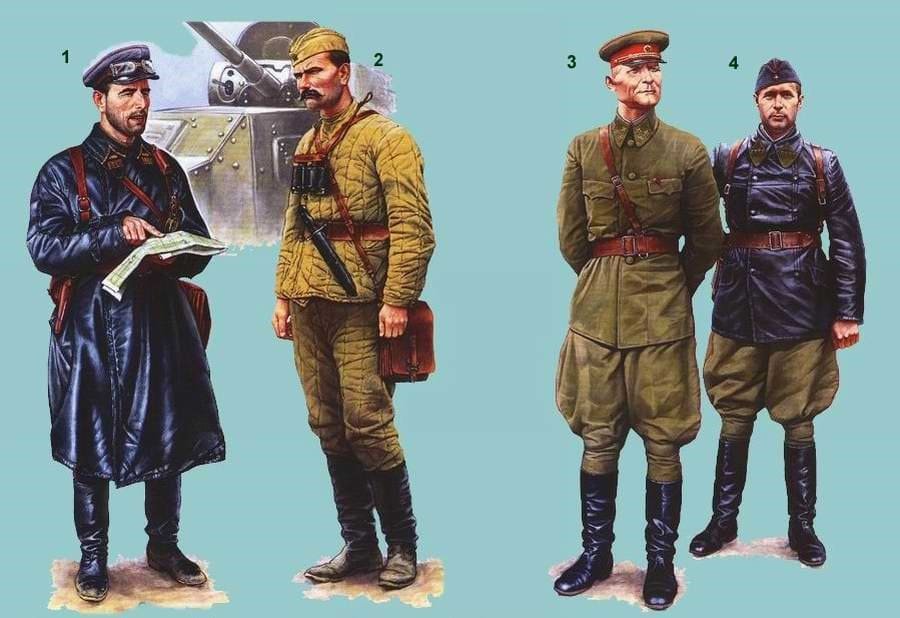
2. Commander of a BA-10 Medium Armored Car (October 1941)
3. Commander of the Western Front, Army General Ivan Konev (September 1941)
4. Regimental Commissar of the 108th Tank Division, 3rd Army, Western Front (September 1941)
1. Commander of the 4th Tank Brigade, Colonel Mikhail Katukov (October 1941)
A senior tank commander during the critical battles of autumn 1941. He is shown wearing a dark leather tank commander’s coat, a tank crew helmet, and high leather boots. This type of uniform was designed to protect tank crews from oil, dirt, and cold inside armored vehicles.
Katukov commanded tank units during defensive operations, organizing counterattacks against advancing enemy forces.
2. Commander of a BA-10 Medium Armored Car (October 1941)
Red Army uniforms 1941-1942 armored car commander, operating the BA-10 reconnaissance and support vehicle. He wears a quilted padded uniform (vatnik), field cap, binoculars, and standard leather boots. This practical outfit provided warmth and mobility for crews working outside and inside armored vehicles.
His role was reconnaissance, convoy escort, and fire support on the front lines.
3. Commander of the Western Front, Army General Ivan Konev (September 1941)
A high-ranking Red Army uniforms 1941-1942 general responsible for commanding large formations during the defensive battles of 1941. He is dressed in a standard officer’s field uniform with a visor cap, leather belt, and riding boots.
His task was coordinating armies, managing defenses, and holding strategic directions.
4. Regimental Commissar of the 108th Tank Division, 3rd Army, Western Front (September 1941)
A political officer attached to a tank unit. He wears a dark leather coat, officer’s breeches, high boots, and a sidearm. Commissars were responsible for political control, morale, discipline, and ideological loyalty within the unit.
They often operated close to combat units and shared the same risks as frontline officers.
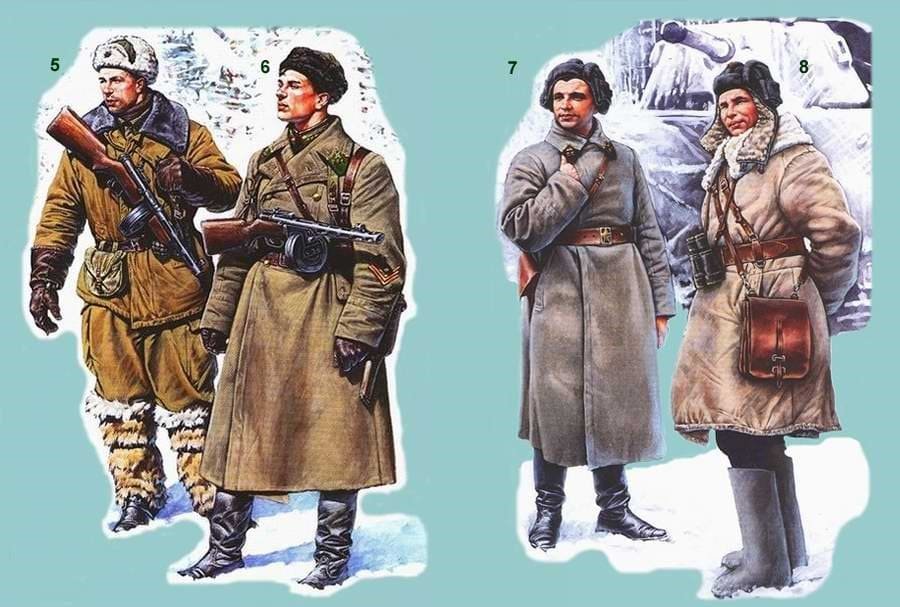
6. Senior Lieutenant, NKVD border guard, 32nd Separate Border Regiment (October 1941)
7. Lieutenant-tanker, 4th Tank Brigade, 50th Army (October 1941)
8. Senior Lieutenant, 4th Tank Brigade, 50th Army (November 1941)
5. Commander of an Airborne Assault Group, Western Front (October 1941)
The officer is wearing a quilted telogreika padded jacket (Model 1935) designed for cold weather operations. He has standard wool trousers tucked into leather boots. His equipment includes leather belt gear and field pouches.
This type of uniform was widely used by airborne and assault units operating behind enemy lines or in difficult terrain during the early winter of the war.
Looking Soviet Ushanka? You can order here: (Soviet Ushanka)
6. Senior Lieutenant, NKVD Border Troops, 32nd Border Detachment (October 1941)
The officer is dressed in a long woolen greatcoat (shinel, Model 1935), worn over a standard field uniform. He carries full leather officer equipment and binoculars.
Border troops were responsible for security, reconnaissance, and rear-area defense, especially during retreats in 1941.
7. Tank Lieutenant, 4th Tank Brigade, 50th Army (October 1941)
The tanker wears a tank crew winter uniform, including a padded jacket and trousers designed for armored vehicle crews. The uniform allowed movement inside tanks and provided warmth.
Tank units played a key defensive role during the Battle of Moscow.
8. Senior Lieutenant, 4th Tank Brigade, 50th Army (November 1941)
This officer is dressed in a heavier winter tank uniform, combined with a sheepskin-lined coat. Leather gear and sidearm complete the outfit.
By late 1941, tank officers increasingly relied on warm layered clothing due to harsh winter conditions.
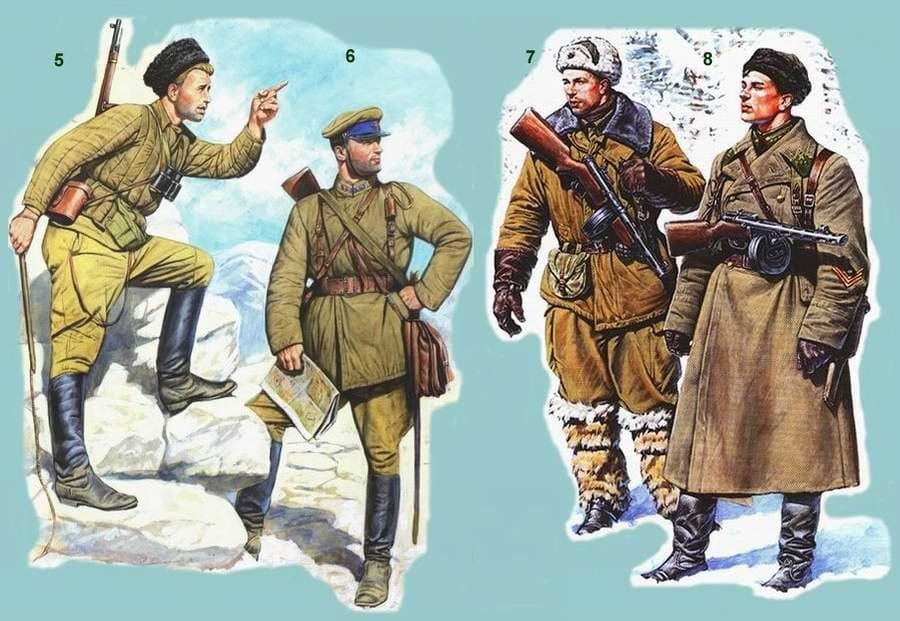
6. Cavalry lieutenant, 220th Cavalry Regiment, 63rd Cavalry Division (August 1942)
7. Commander of an airborne assault group, Parachute Service of the Western Front (October 1941)
8. Senior Lieutenant, NKVD Border Troops, 32nd Separate Border Regiment (October 1941)
5. Red Army Cavalryman, 214th Cavalry Regiment, 63rd Cavalry Division (August 1942)
The cavalryman wears a summer field uniform (Model 1935) with riding breeches and high leather cavalry boots. His equipment is adapted for mounted combat and long marches.
Cavalry units were still actively used in 1942 for reconnaissance and fast maneuvers.
6. Cavalry Lieutenant, 220th Cavalry Regiment, 63rd Cavalry Division (August 1942)
The officer is dressed in a standard field tunic (gymnastyorka, Model 1935) with officer leather gear. Tall boots and a map case indicate his command role.
Cavalry officers often led patrols and coordinated attacks in difficult terrain.
7. Commander of an Airborne Assault Group, Western Front (October 1941)
The commander wears a padded telogreika jacket and standard field trousers with PPSh-41 submachine gun. His equipment is light, allowing mobility during assault operations.
Airborne assault groups were used for surprise attacks and rapid raids.
8. Senior Lieutenant, NKVD Border Troops, 32nd Border Detachment (October 1941)
The officer is shown in a long wool greatcoat, designed for cold climates. Leather belt gear and PPSh-41 submachine gun complete the uniform.
NKVD border troops played a key role in maintaining order and defending strategic areas.
Red Army uniforms 1941-1942
Check Soviet WW2 uniforms guides:
Equipment Set of a Red Army Soldier in 1941 and 1945
History from the Red Army (RKKA) to the Soviet Army
Check more articles:
Best WW2 Uniform: Soviet, German, USA. Who Had the Best Army Gear?
Red Army Uniforms of the Russian Civil War (1918–1922)
Field Uniform and Equipment of the Soviet Army in 1968 -1991 Part 1
Field Uniform and Equipment of the Soviet Army (1968–1991) – Part 2
Field Uniform and Equipment of the Soviet Army (1968–1991) – Part 3
Looking original Soviet boots and accessories? Please visit here: Soviet Boots Store