Early Soviet Military Uniform and the Red Army Origins
The soviet military uniform went through a long and complex evolution, starting with the early Red Army and continuing through World War II, the Cold War and the Afghan War.
Each historical period shaped the Soviet Army uniform in its own way, combining practicality, ideology and military tradition.
More interesting articles:
Telnyashka: History of the Russian Navy and VDV Striped Shirt
Equipment Set of a Red Army Soldier in 1941 and 1945
How the Soviet Army Uniform Changed from 1955 to 1991
Over the long and eventful history of the Workers’ and Peasants’ Red Army (RKKA) and later the Soviet Army, the uniforms of Soviet soldiers and officers changed many times. There were serious highs, and there were also controversial moments. But today we clearly understand that, overall, the development of military clothing can be divided into several main stages:
-
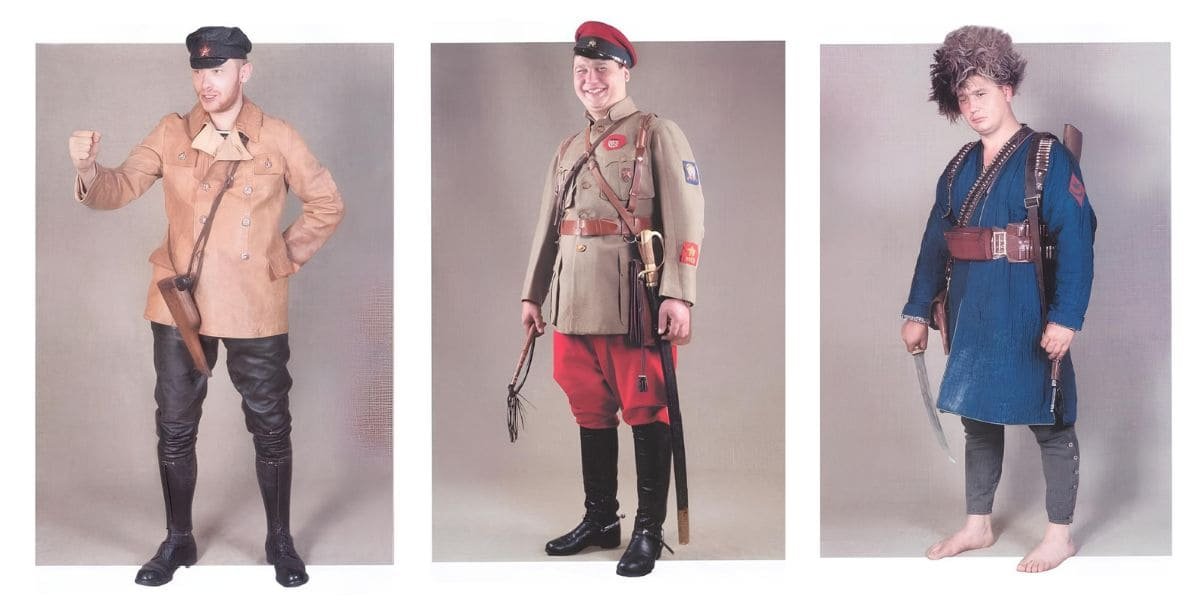
The transitional stage from the Tsarist Army to the RKKA. This was a period of searching for new solutions and forming the Revolutionary Military Council, during which the foundations of the new army and its distinctive features were laid.
-
The most advanced stage of development, from the Civil War of 1918–1922 to the end of the Great Patriotic War, when the troops still retained what can be called the “wartime” uniform.
-
The peacetime stage, which meant revising and changing the old uniform in favor of simplicity, reliability, and cost efficiency.
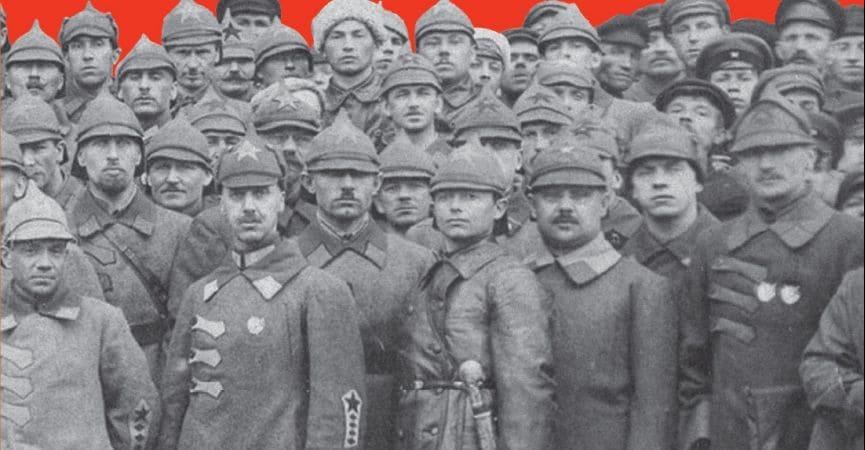
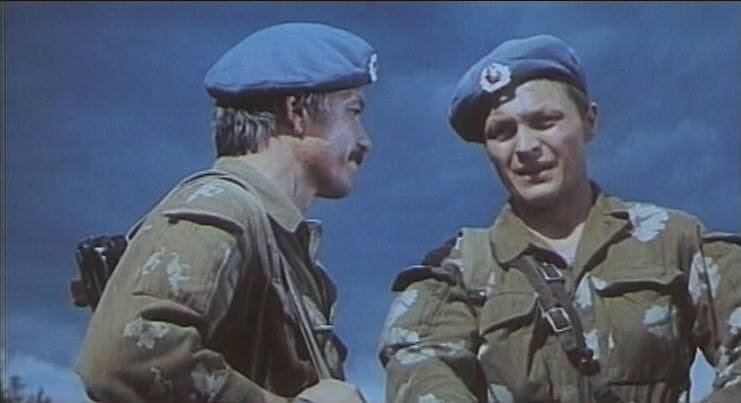
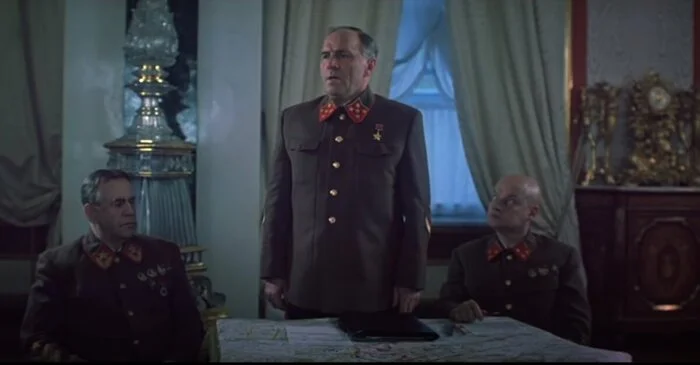
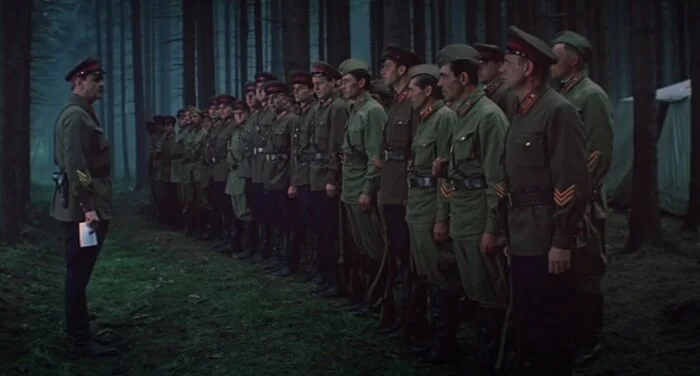
Today, we will take a brief overview of all these stages in the formation and development of the Soviet military uniform. We will also look at Soviet cinema, which illustrates this topic very well, showing it in a convincing and informative way.
The search for a new uniform, new insignia, and a break with everything old.
RKKA and Russian Civil War uniforms
Early Soviet Army uniform (1930s)
Soviet uniform in 1942
Soviet WWII winter uniform
Post-war Soviet Army uniform
Cold War Soviet military uniform (1960–1991)
From the moment the decree of the Council of People’s Commissars of the RSFSR “On the RKKA” was published in 1918, active work began to organize a new army. First of all, it was meant to consist of the most conscious and organized elements of the working classes.
Of course, at that time the basic figure was the Red Army soldier.
Often he had nothing except his old Tsarist greatcoat, so he was asked to show his new affiliation by attaching a red ribbon, a chest badge, and other symbols of the new army.
During the years of the Civil War, there was complete confusion in the military administration. This was mainly due to the extremely difficult military and political situation. But an army cannot be mixed and chaotic – it must be a single, clear organism. That is why it was necessary to bring it to a common standard.
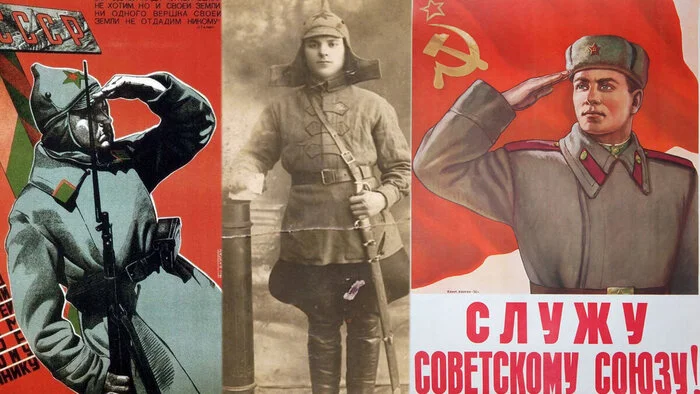
The first such unifying element of the new army became a headgear, well known among the people as the Budenovka. It also had other names, given in honor of different commanders – Frunzevka and Bogatyrka.
Along with this unified element came the main symbol of the new power – the red star.
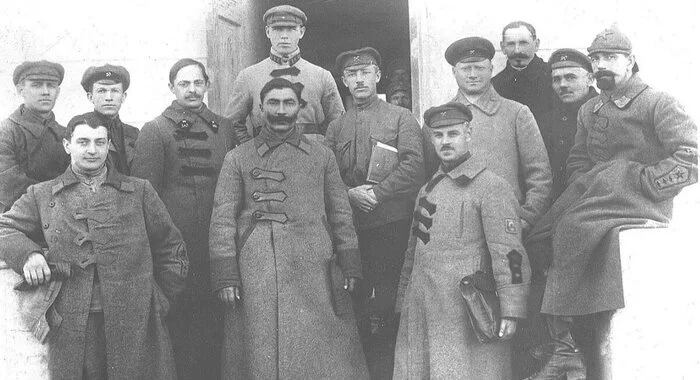
In the 1920 photograph, we see Semyon Mikhailovich Budyonny standing in the very center. He wears no rank insignia, but collar tabs already appear, along with black piping.
On the right stands an army commander with rank insignia, Pavel Efimovich Dybenko.
On the left is Mikhail Nikolayevich Tukhachevsky.
As we can see, several future Marshals of the USSR are present in this single photograph.
At the same time, the first rank insignia appear, completely new and unusual for soldiers of that era.
Sleeve insignia are introduced in the form of a five-pointed star with triangles, along with clear distinctions within the command structure: from “commanders and senior enlisted men” to “company commander, brigade commander, regimental commander, division chief, or army commander.”
Thanks to these changes, Red Army soldiers already differed clearly from the old imperial troops, primarily due to collar tabs, the new headgear, and various insignia worn on sleeves and trousers.
Interestingly, after 1922, color distinctions were introduced. This further unified the army, helping it function as a single organism that could be recognized even from a distance.
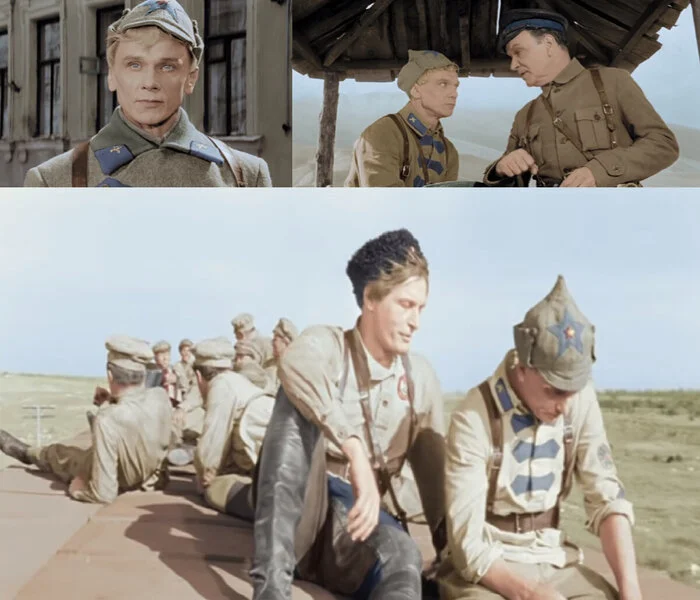
Each branch of service received its own color for all insignia.
Infantry – crimson.
Artillery – red.
Engineer troops – black.
Cavalry – blue.
Aviation – light blue.
Railway troops – light green.
What did the uniform consist of at that time?
First of all, there were two sets (summer and winter). Soldiers were issued: a greatcoat, a gymnastyorka tunic, trousers, boots or shoes with puttees, a woolen headgear, and field equipment.
The red star was replaced by the hammer and sickle, and the cockade became more laconic and simple in its design.
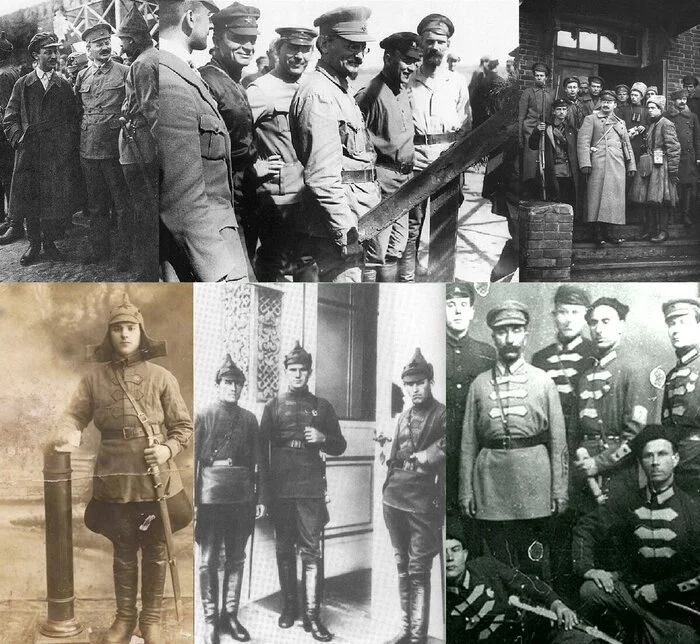
In 1924, the traditional peaked cap appears, with a red star, a protective visor, and a chin strap.
A new gymnastyorka tunic is introduced, now featuring a collar with collar tabs and patch pockets.
It is important to note that it is precisely in the mid-1920s that the mandatory wearing of orders and other military decorations begins.
In 1932, a unified commander’s belt appears, with a rectangular buckle. The belt included a holster for personal weapons; in addition, officers also carried a sabre and a field bag.
A binocular could often be seen worn around the neck, and a canteen was attached to the shoulder strap.
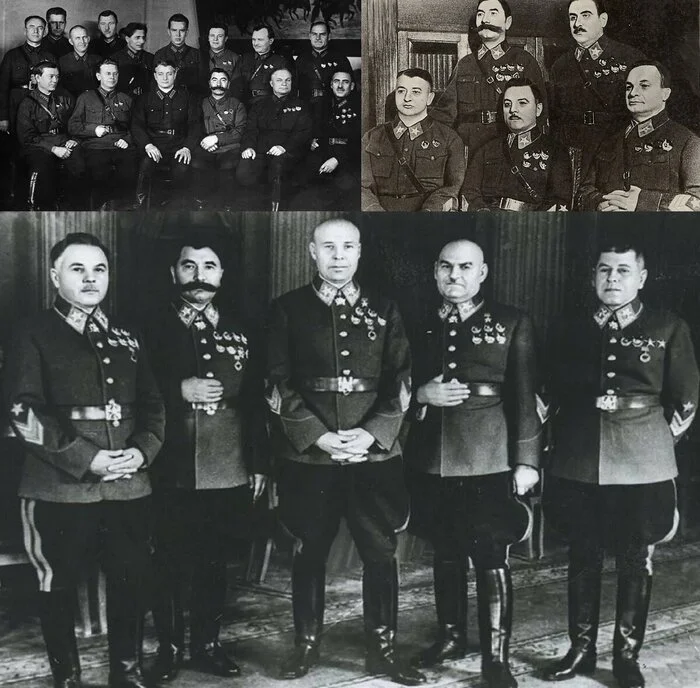
In the final stage of peacetime life, the military uniform becomes fully unified, with mandatory wearing of awards, weapons, and insignia. One only needs to recall the famous 1935 photograph of the first Marshals, whose collar tabs featured large five-pointed stars.
Looking for original Soviet officer boots? You can find them here: Soviet Officer Boots
The period from 1939-1940 until the end of World War II in 1945
During this time, a clear difference between soldiers and officers becomes visible.
This difference is expressed even in headgear: the army side cap and the peaked cap.
Buttons with large stars, the hammer and sickle appear on the tunic.
Moreover, commanders were allowed to purchase felt boots, sheepskin coats, and other types of clothing at their own expense, especially for winter service.
Only those with high ranks could afford this. In simple terms, these were commanders above the average level, those with large diamonds or bars on their insignia.
Changes begin with the first serious military conflicts.
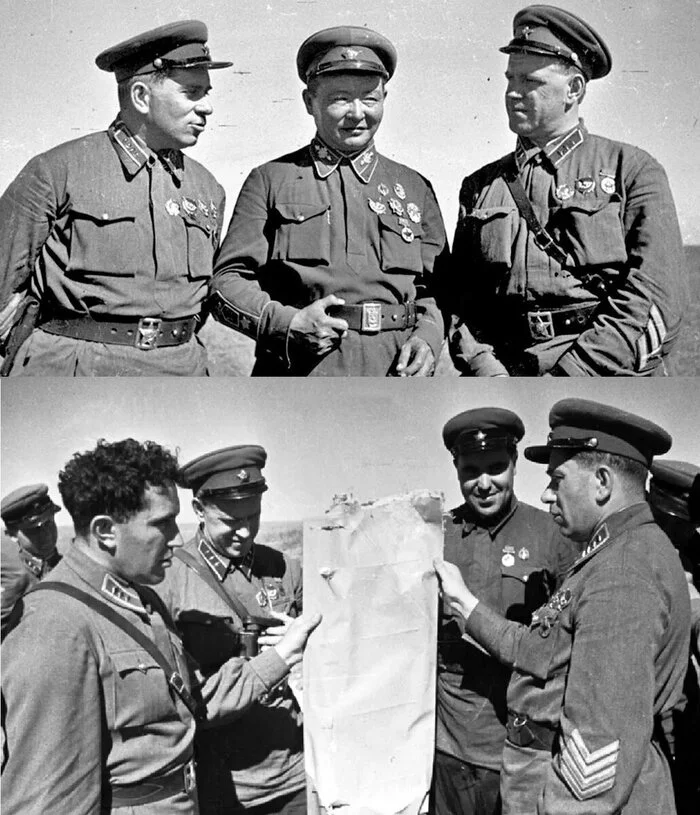
It is enough to recall the participation of Soviet troops together with Mongolian forces in the battles at Khalkhin Gol in 1939.
By the time the USSR took part in the Soviet–Finnish War of 1939–1940, the winter uniform had already begun to be updated. This included replacing the older SSh-36 steel helmets for enlisted soldiers with the newer and more practical SSh-40. At the same time, the old Budenovka was completely phased out.
It was during this period that the negative aspects of clearly distinguishing commanders from ordinary Red Army soldiers became evident. In winter conditions, this made commanders an easy target for enemy snipers. However, this issue was not immediately taken seriously.
It can be noted that by 1940, personal military ranks had already become firmly established. These ranks were displayed through special collar tabs and sleeve insignia. Branch insignia also appeared on the collar tabs for each type of troops. For example, tank troops used a small self-propelled gun symbol, while artillery had two large cannons.
All branches of service received color distinctions, as mentioned earlier: infantry used crimson, artillery black, and air forces light blue.
All troops wore standardized headgear, a gymnastyorka, a single-breasted tunic, trousers or breeches, a winter helmet, and a greatcoat.
It is worth noting that uniforms still differed slightly depending on the branch of service. For example, pilots had special sleeve insignia in the form of wings. This insignia changed four times starting in 1936 and continued to evolve further.
All cadets in military schools wore the uniform of junior command personnel. However, outside their academies they were often allowed to use elements of officers’ uniforms. This was usually reflected in better tailoring, more comfortable gymnastyorkas or caps, and especially higher-quality boots.
It is extremely important to note the most expensive and at the same time absolutely necessary attribute of every soldier – the boots. ( Russian boots history )
At different times, various types of boots made from kirza were used, and they kept changing. By the mid-1930s, samples made from synthetic rubber appeared, but they had very poor practical qualities.
Looking for classic Soviet kirza boots? You can find them here: Soviet Kirza Boots
Synthetic rubber often cracked and broke, while natural leather was in extremely short supply. Because of this, boots were sometimes produced using alternative methods, but this was only acceptable until the moment when large-scale production was required.
By 1941, there was clearly not enough natural leather for the growing number of new soldiers, so kirza boots were brought back and their properties were significantly improved.
As a result, all servicemen received kirza boots that were comfortable and durable, fairly lightweight, and at the same time capable of retaining warmth.
These boots were not made entirely of kirza: the lower part was produced from natural yuft leather. Boot care was simple and well known to every soldier – it was enough to have goose fat and then polish the boots with shoe polish.
Looking for Soviet boots cream? You can find them here: Original Soviet Cream
Soviet leather belt with buckle you can find here: Soviet Belt
Everyone who managed to use kirza boots will remember that running in them was no pleasure at all, especially with full combat gear. However, back in the 1940s this problem was compensated by using foot wraps (portyanki).
Socks for a soldier were considered nothing more than a waste of fabric.
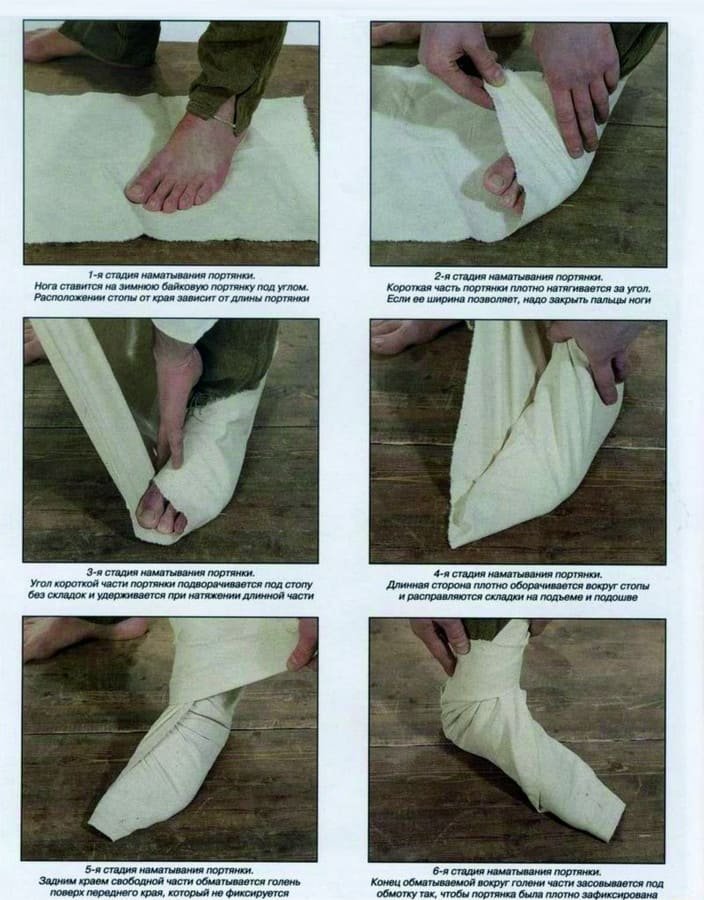
Foot wraps, on the other hand, covered the entire foot in just 6 simple moves: you place your foot down, take the edge and wrap it once, then wrap it the other way, and after that you lift the fabric and wrap the upper part around the ankle and lower leg. Done.
Looking for original Soviet portyanki from old stock You can find them here: Soviet Portyanki
1st stage of wrapping foot wraps
The foot is placed on a flat cotton foot wrap at an angle.
The position of the foot relative to the edge depends on the length of the foot wrap.
2nd stage of wrapping foot wraps
The short part of the foot wrap is tightly pulled over the corner.
If the width allows, the toes should be covered.
3rd stage of wrapping foot wraps
The corner of the short part of the foot wrap is tucked under the sole without folds and held in place by tension from the long part.
4th stage of wrapping foot wraps
The long side is tightly wrapped around the foot, smoothing folds at the instep and sole.
5th stage of wrapping foot wraps
The free end of the long part is wrapped around the lower leg over the folded edge, which is not fixed.
6th stage of wrapping foot wraps
The end of the foot wrap wrapped around the lower leg is tucked under the wrap so that the foot wrap is firmly secured.
Moreover, in summer the foot wraps were made of cotton, while in winter they could be woolen or flannel.
It is important to note that over the years the types of uniforms also changed. Not only everyday uniforms appeared, but also field uniforms and parade uniforms.
During the years of the Great Patriotic War, the placement of orders, patches, and badges often changed. For example, the “Guards” badge in 1942 was worn on the right side of the chest, just like star-shaped orders, while round medals were worn on the left side.
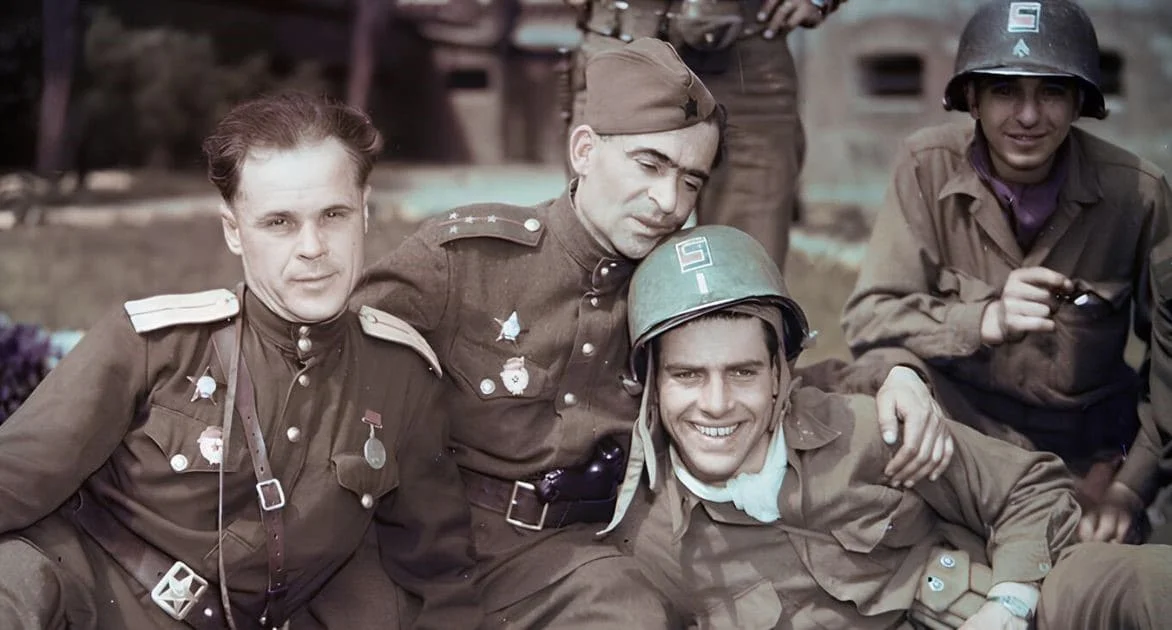
A very important change happened in 1943: insignia were moved from collar tabs to shoulder boards, and the word “officer” officially returned.
Shoulder boards had their own buttons: the state emblem for generals, and a star for all other ranks.
The general staff received colored trouser stripes (lampasy). The tunic also underwent small changes, especially for senior officers. The famous single-breasted tunic with piping along the collar became a true symbol of Victory.
The peacetime stage and the transition from the WWII uniform to the new Khrushchev and Brezhnev era
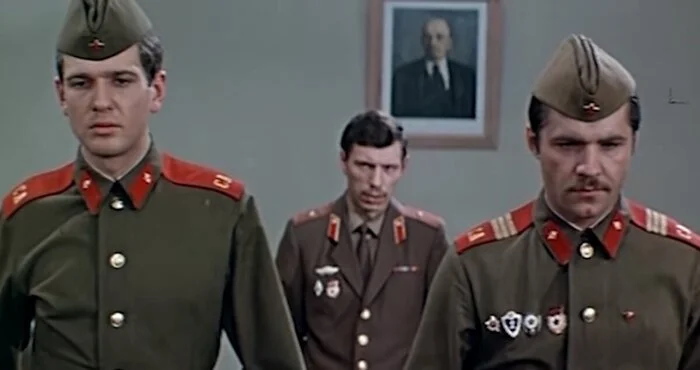
It is important to note that in 1946 the Armed Forces officially changed their name to the Soviet Army. The People’s Commissariats were replaced by ministries, and all soldiers and officers had already been wearing shoulder boards for three years.
Major changes affected senior officers. Embroidered laurel and oak leaves appeared on collars and cuffs of dress uniforms. General’s trousers with colored stripes were preserved and could be worn either tucked into boots or outside. A black tie with a white shirt was introduced.
The most noticeable change was the appearance of the double-breasted tunic. This element immediately stands out. In my subjective opinion, this uniform looked simpler and more economical – frankly, the old one was better.
Depending on the type of uniform, instead of full awards, officers could wear ribbon bars. All gilded elements were removed, clearly reflecting the new Khrushchev era, where economy replaced parade display.
New troops required new uniforms. The Airborne Forces received helmets, jumpsuits, and specialized jackets. Many of the best design elements from aviation uniforms continued to develop in the right direction, focusing on comfort and practicality.
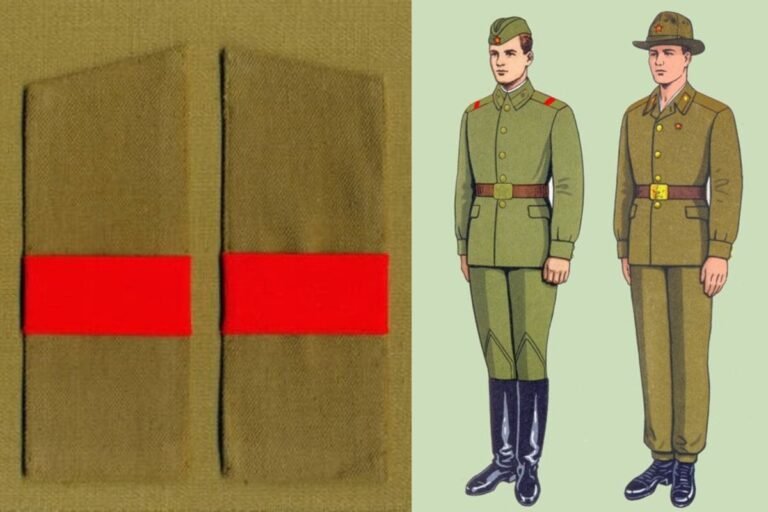
In 1956, the military uniform was significantly simplified. It became easier to maintain and more practical. Decorative piping on collars and tunics disappeared, and patch pockets became standard.
Contract soldiers received a single distinguishing feature in the form of sleeve chevrons – a detail well known from Soviet cinema.
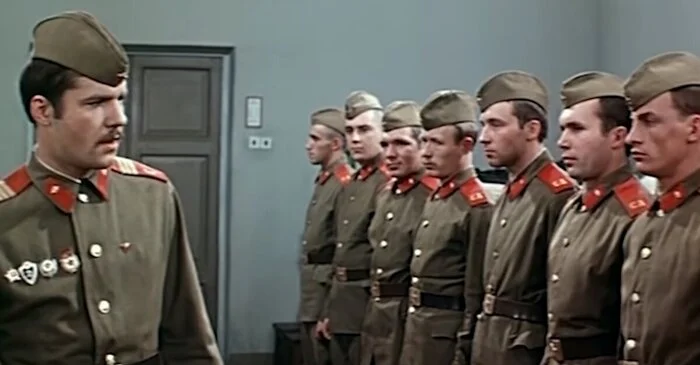
Officers began to look the way we recognize them today. Usually it was a service jacket in a protective color, with the color depending on the branch of service. Under the jacket there was a shirt and a black tie, or sometimes a tie in branch color, a simple cockade, and a chin strap.
During the Brezhnev era, some ceremonial elements returned. For example, senior officers began to wear gold and silver shoulder boards with piping. Coats and dress shoes appeared, and in hot regions light summer jackets with shoes were used.
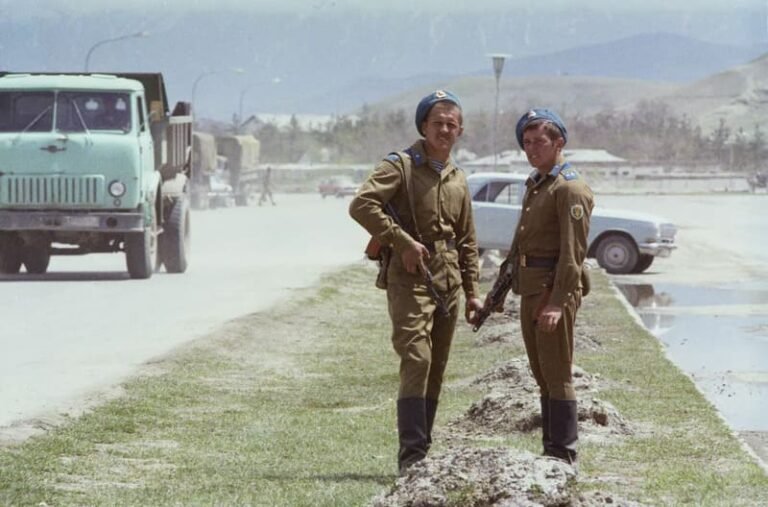
During the Afghan conflict starting in 1979, the uniform underwent minor changes in favor of practicality and economy. Most ceremonial elements, colored shoulder boards, and cockades were replaced, and everything shifted toward protective colors.
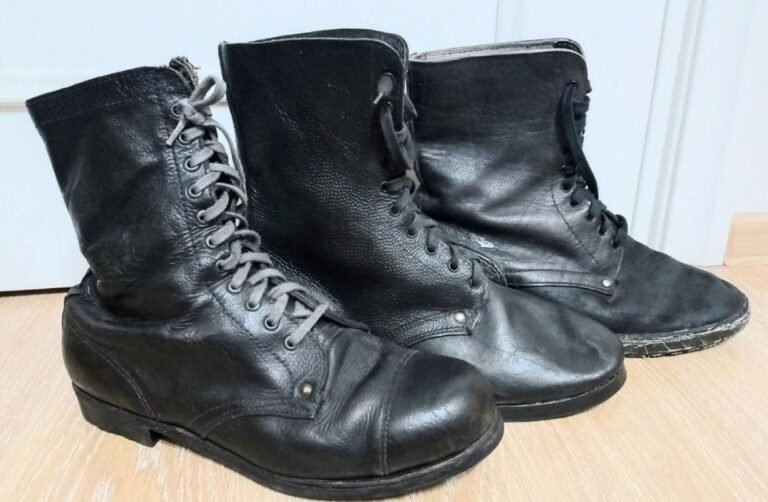
Camouflage began to be used, coveralls were applied more often, and lace-up Afghan combat boots gradually replaced kirza boots. ( 3 designs Afghan boots guide )
At that time, a new term appeared: “Afghanka”. ( Afghanka Uniform M88 guide )
This referred to a field cap with ear flaps and a protective visor. Loose-fitting jackets with patches and pockets. Trousers in basic colors with pockets and fasteners, and boots began to be used more actively.
By the end of the 1980s, the uniform did not undergo significant changes and remained largely the same as previously adopted. Apart from the changes of 1988, there were no major updates.
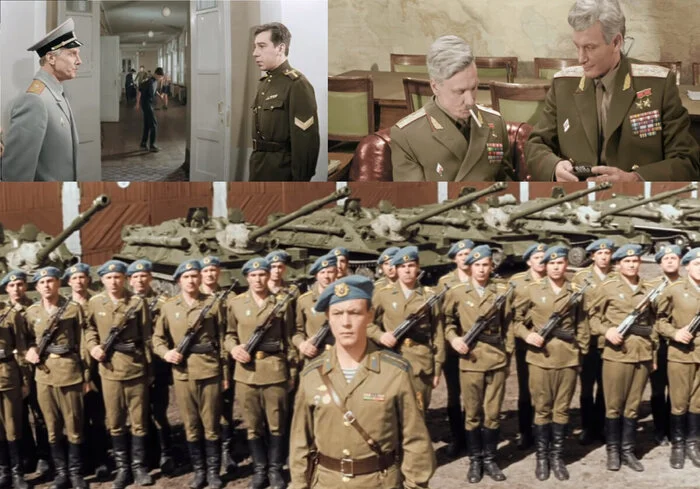
Summing it all up, we can confidently say that through several stages of development and change, the Soviet military uniform evolved from simple old Tsarist patterns into something new, modern, and truly.
We can especially highlight the uniform of the Stalin era, when the tunic was incredibly strict and beautiful. A company of soldiers could be seen from far away and looked like a powerful, intimidating force. Similar images can be recalled in the 1970s, when the Soviet soldier, especially the “demobilized soldier”, was seen as a symbol of courage and resilience, honor and masculine beauty.
Soviet Afghan combat boots? You can get them here → [Soviet M88 combat Boots]
More articles about Afghan period:
Soviet Spetsnaz Uniform in Afghanistan (1979–1989)
How the Soviet Army Uniform Changed from 1955 to 1991
Field Uniform and Equipment of the Soviet Army (1968–1991) – Part 1
Looking original Soviet boots and accessories? Please visit here: Soviet Boots Store